
Last updated: November 19, 2026
Key Takeaways
- Start by checking the name, not filing.
- File the form, pay the fee, and wait for acceptance into the record.
- In some places, publication is required after filing.
- Keep the receipt and approval in a clean paper trail.
A freelance business name as a sole proprietor usually gets registered as a fictitious business name or DBA, not as a company formation filing. You file it with the county clerk or the state business registry, depending on where you live. The steps below show the path, the order, and what “done” looks like.
Quick Answer: registering a freelance business name as a sole proprietor usually takes one filing, one fee, and, in some places, a publication step.
In short: if you want to work under a brand name as a sole proprietor, you file a fictitious business name and keep your underlying legal name in the record.
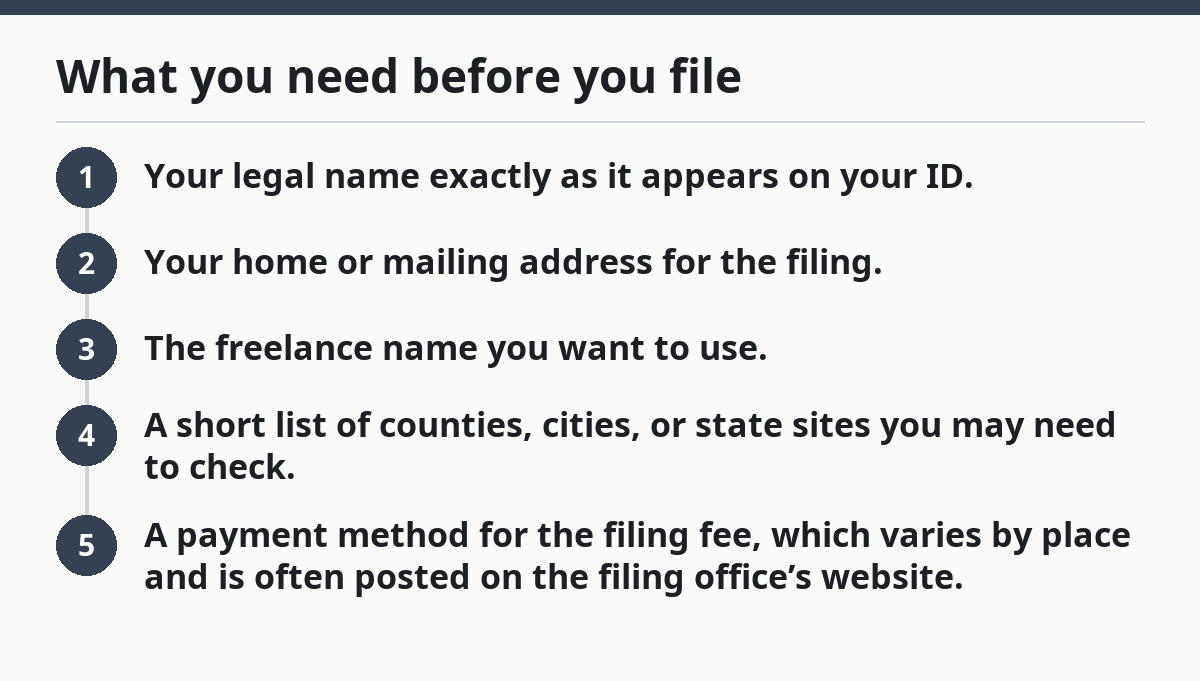
What you need before you file
Picture this: you’ve picked a name, printed a logo, and now you need the state to let you use it on invoices, contracts, and a website. The first move is not filing paperwork. It is checking whether the name is usable and whether your location uses a county or state filing system.
Start with these items:
- Your legal name exactly as it appears on your ID.
- Your home or mailing address for the filing.
- The freelance name you want to use.
- A short list of counties, cities, or state sites you may need to check.
- A payment method for the filing fee, which varies by place and is often posted on the filing office’s website.
A name search comes first because it helps you avoid filing a name that is already taken, too close to another registered name, or blocked by local rules. Many offices let you search online in a public index before you submit anything. That index can help you see whether your chosen name already appears in the records.
Here’s the catch: a name can look available on a social platform and still be unavailable in the filing system. Those are different checks.
- Search the county clerk database if your area files locally.
- Search the state business registry if your state handles the filing.
- Check spelling, punctuation, and name variations.
- Keep a second-choice name ready.
If the first search result shows a similar filing, stop and adjust the name before you pay. A rejected filing can cost you time, and in some places it can also mean you need to publish the name again later.
How to tell whether your area uses a county filing or a state filing
Picture this: you’ve got the name, and now you just need to know which office wants it. That answer depends on where you live, because some places route fictitious business name filings through the county clerk and others route them through a state business registry.
The filing path is the part many generic guides get wrong. They tell freelancers to “register the name” without saying where the form actually goes. That detail matters because the wrong office can’t approve the name, even if the form itself is filled out correctly.
Use this rule of thumb:
- If your area uses a county clerk, the filing is often local and may be tied to the county where you do business.
- If your area uses a state business registry, the filing may be centralized through a state portal.
- If both exist, one may handle the registration and the other may only keep a record or publish notices.
Look for the exact term fictitious business name on the office site. That term is the one most offices use for a DBA filing. If you only search for “business name registration,” you can land on the wrong page and miss the actual instructions.
A few offices ask for the name of the owner, the street address, and the exact name you’ll use in trade. Some also require you to list each owner if the filing is for more than one person. As a sole proprietor, you usually file under your own legal name plus the trade name.
Once you know the correct office, the rest is routine.
How do you file a fictitious business name as a sole proprietor?
You file a fictitious business name by submitting the form, paying the fee, and waiting for the office to accept the name into the record. The filing is usually done online, by mail, or in person, and the form asks for your legal name, your address, and the name you plan to use.
- Find the exact form. Search the county clerk site or the state business registry for “fictitious business name” or “DBA.”
- Fill in your legal name. Use the name on your government ID, not just the brand name.
- Enter the trade name. Write the freelance name exactly as you want it to appear.
- Add the required address. Many offices require a mailing address or business location, even for solo freelancers.
- List the owner type. Mark yourself as a sole proprietor if that is the structure you’re using.
- Pay the fee. Fees change by office, so check the current amount on the filing page before you submit.
- Submit the form. Online filing can be faster; mail can take longer, and in-person service depends on office hours.
- Save the receipt or file number. That number is your proof that the filing is in motion.
A filing is working when you get a receipt, confirmation page, or stamped copy from the office. If the office sends back a rejection, it usually means a field is blank, the name is too close to another record, or the fee was wrong.
Do not skip the exact spelling. A missing word, extra punctuation mark, or abbreviation can create trouble when you try to open a bank account, sign a contract, or print invoices later.
Do you have to publish the name after filing?
In some places, yes, you must publish the name after filing the fictitious business name. Publication requirements are local rules, and they can be as simple as running a legal notice in an approved newspaper or as specific as filing proof of publication with the clerk.
This is the step freelancers miss most often. They file the DBA, then stop. If your area requires publication, the filing may not be fully complete until the notice runs for the required period and the newspaper gives you proof.
What to check:
- Whether your county or state requires publication.
- Which newspaper or publication is approved.
- How long the notice must run.
- Whether you need to file an affidavit or proof after publication.
If the office gives you a publication packet, read it line by line. It usually says where the notice must appear and how many days you have to complete the step. Some offices make the deadline short, so waiting a month can force you to start over.
There’s a trade-off here. Publication creates a public paper trail, which is the point of the rule, but it also means your freelance name is not just private branding. It becomes part of a public record. If that matters to you, check the local rule before you file, not after.
What records should you keep after registration?
Because the form is approved, six months later a client may want proof that your brand name belongs to you. The answer is a clean paper trail, not memory. Save the filing receipt, the approval, and the publication proof in one folder.
Keep these items together:
- The filed DBA or fictitious business name form.
- The receipt or confirmation number.
- The publication notice, if required.
- The proof of publication or affidavit.
- Any rejection notices and corrected re-filings.
Keep both a PDF copy and a paper copy if possible. A file on your phone is easy to lose; a scanned copy in cloud storage and a printed copy in a folder is harder to misplace. That matters when a bank, client, or payment platform asks for documentation.
This is also where the term sole proprietorship matters. Your freelance name is not a separate entity just because it is registered. The filing lets you do business under a different public name, but the owner is still you. That is why the records should match your legal name on the form.
If you work under more than one trade name, keep each filing in its own folder. Mixing them together can create headaches when you renew, amend, or close one of the names later. A simple naming system—“DBA 1,” “DBA 2,” with dates—beats a stack of loose papers.
Common mistakes that slow down a DBA filing
Because the fee is paid and the form is in, the office may still send it back. A missing address, a wrong owner name, or a skipped publication step can turn a one-day task into a weeks-long delay.
The worst mistakes are usually these:
- Using a nickname instead of the legal name.
- Filing in the wrong office.
- Forgetting the publication rule.
- Choosing a name that is already too close to another filing.
- Treating the DBA like an LLC formation; if you are unsure, consult a professional and check the office instructions.
That last one matters because a DBA is not the same thing as forming an entity. A DBA only records the name you use in trade. It does not create a separate legal structure. If your form asks for the owner type, fill it out as a sole proprietor unless the filing office tells you otherwise.
A quick example helps. If your legal name is on the record but your invoices show only the brand name, you need the DBA filing behind that brand name. If the invoices, website, and contracts all use the same public name, the filing makes the paper trail consistent.
One more trap: some freelancers think the name is automatically “protected” everywhere after filing. It usually isn’t that broad. The filing records your use in that jurisdiction. It does not give you a free pass to use a confusingly similar name everywhere else.
For deeper setup steps beyond the name filing, the hub on freelance business setup can help you sort the next pieces without mixing them into this one job.
What should happen after the name is approved?
Because the name is accepted, you can now use it on invoices, proposals, and a website. The next step is to put the registered name in the places clients will actually see it, while keeping the filing info handy in case anyone asks for proof.
Use the name consistently on:
- Invoices and estimates.
- Contract headers.
- Website footer or contact page.
- Email signature.
- Payment platform profile, if it asks for the business name.
Make sure the name on your documents matches the filed version exactly. A one-word difference can cause unnecessary back-and-forth when a client compares your paperwork to the public record.
If you later change the name, you usually need a new filing or an amendment, depending on the office. Don’t assume you can just start using the new name and leave the old filing in place. The record needs to match the name you are actually using.
The practical goal is simple: one clear name, one filing record, one set of documents. That keeps your freelance work easy to explain and easy to verify.
Do freelancers need to register a business name?
Yes, if you use a name other than your own legal name, many places require a fictitious business name or DBA filing. The filing office is usually the county clerk or the state business registry, depending on local rules.
If you only use your own legal name on invoices and contracts, you may not need a separate filing. The exact rule depends on where you live, so check the local office before you print cards or launch a site. A 10-minute search can save a rejected form.
Is a DBA the same as an LLC name?
No, a DBA is not the same as an LLC name. A DBA is a trade name filing, while an LLC is a separate legal entity created through formation paperwork.
That difference matters because a DBA does not change your legal structure. It only records the name you use in public. If you are staying a sole proprietor, the DBA is the tool for the name; it is not a substitute for entity formation.
Can you use your own name without filing?
Yes, in many places you can use your own legal name without filing a fictitious business name. If the name on the contract, invoice, and payment record is just you, a DBA may not be required.
The catch is that once you add a brand name, shop name, or studio name, the filing rules can change. Check the county clerk or state business registry before you assume the rule is the same everywhere. A simple legal-name-only setup is often the least paperwork, but it won’t fit every freelance brand.
The cleanest path to a registered freelance name
The cleanest path is to search the name, file the fictitious business name in the right office, and finish any publication step your area requires. A sole proprietor does not need to build a company just to use a brand name; the right DBA filing is usually enough.
The practical test is simple: if your paperwork, receipt, and public record all show the same trade name, the registration worked. If they don’t, correct the mismatch before you start sending out contracts.
Drafted with AI; not yet reviewed by a person.
