

Last updated: November 19, 2026
Key Takeaways
- Choose the setup that matches your risk, income, and state rules.
- Before your first payment, set up a name, tax details, invoicing, and separate banking.
- Many freelancers choose an LLC for cleaner separation, but timing and cost still matter.
- Freelancers usually owe self-employment tax, income tax, and estimated payments when required.
Freelance business formation and setup — The Complete Guide is the part where you stop treating client work like a side hustle and set up the right legal, tax, and money systems so it can run cleanly. Quick Answer: for many freelancers, the right setup can be as simple as a sole proprietorship at first, while an LLC often becomes more useful once risk or income rises. The right setup depends on liability, taxes, and how fast you want to start billing. The sections below settle which structure fits, what to file, and what to do first.
What Actually Determines the Right Setup?

The right setup is determined by risk, income level, and where you live. If you’re doing low-risk work like copywriting or design from home, the cheapest path is often to start as a sole proprietor and add a tax ID only when you need one, though state rules and client requirements can change that. If you’re signing contracts with bigger clients, handling deposits, or carrying any meaningful liability, a separate LLC is often the cleaner path.
Picture this: you’ve got your first retainer client, a laptop, and a deadline next week. You need to know what to form, what to register, and what can wait 30 days without creating a mess.
The catch is that “freelance” is not a legal structure. It’s just the way you sell your labor. The structure underneath it is usually one of these:
- Sole proprietorship
- Single-member LLC
- Multi-member LLC
- S corporation election, later, if income and admin justify it
If you want the fast version, here’s the split:
- Start simple if you need to invoice this week and expect modest income.
- Form an LLC if you want a liability wall between you and the work.
- Consider S corp tax treatment later if net profit is high enough to justify payroll admin, but check with a tax professional and review IRS guidance before making that move.
A lot of generic advice jumps straight to “form an LLC.” That can be wrong. In many states, the filing fee plus annual reports can eat the first months of income. In others, the legal separation is worth it from day one. The decision is local, not universal.
Quick check:
If a client mistake could cost real money, or you’re already making regular monthly income, you’re in the LLC-or-better lane. If you’re just validating a service, a simple sole proprietor setup may be enough for now.
What Do You Need to Set Up Before You Take Client Money?
You need a name, a tax setup, a way to invoice, and a separate place for money before the first payment lands. If you skip those, the cleanup takes longer than the setup.
Picture this: a client says yes, wants a W-9, and asks to pay by ACH. You can either look ready in 10 minutes or spend the next week stitching things together.
Start with the basics:
- Pick a legal name. If you’re using your own name, that’s often the simplest. If you want a brand name, check whether your state requires a fictitious business name filing or DBA registration.
- Check name availability. Your state business registry and the USPTO trademark search are the two places that matter most. The U.S. Patent and Trademark Office has a public search tool called TESS.
- Get your tax number if needed. Many freelancers use an EIN from the IRS even when they don’t have employees. It’s free through the IRS website.
- Open a separate bank account. Use a business checking account if your structure supports it. Even sole proprietors benefit from this split.
- Set up invoicing. Use software that creates professional invoices, tracks payments, and exports records at tax time.
- Put payment rules in writing. Net 15 or Net 30, late fees if your state allows them, deposit terms, and scope limits all belong in your contract.
That setup keeps your records clean from day one. It matters when a client asks for a receipt, a refund, or a year-end summary.
Here’s the catch: a payment app alone is not a business system. Stripe, Square, PayPal, and Wise can move money, but they do not replace separate books, written terms, or tax filings.
For a more detailed planning step, see the freelancer contract checklist and small business bank account guide.
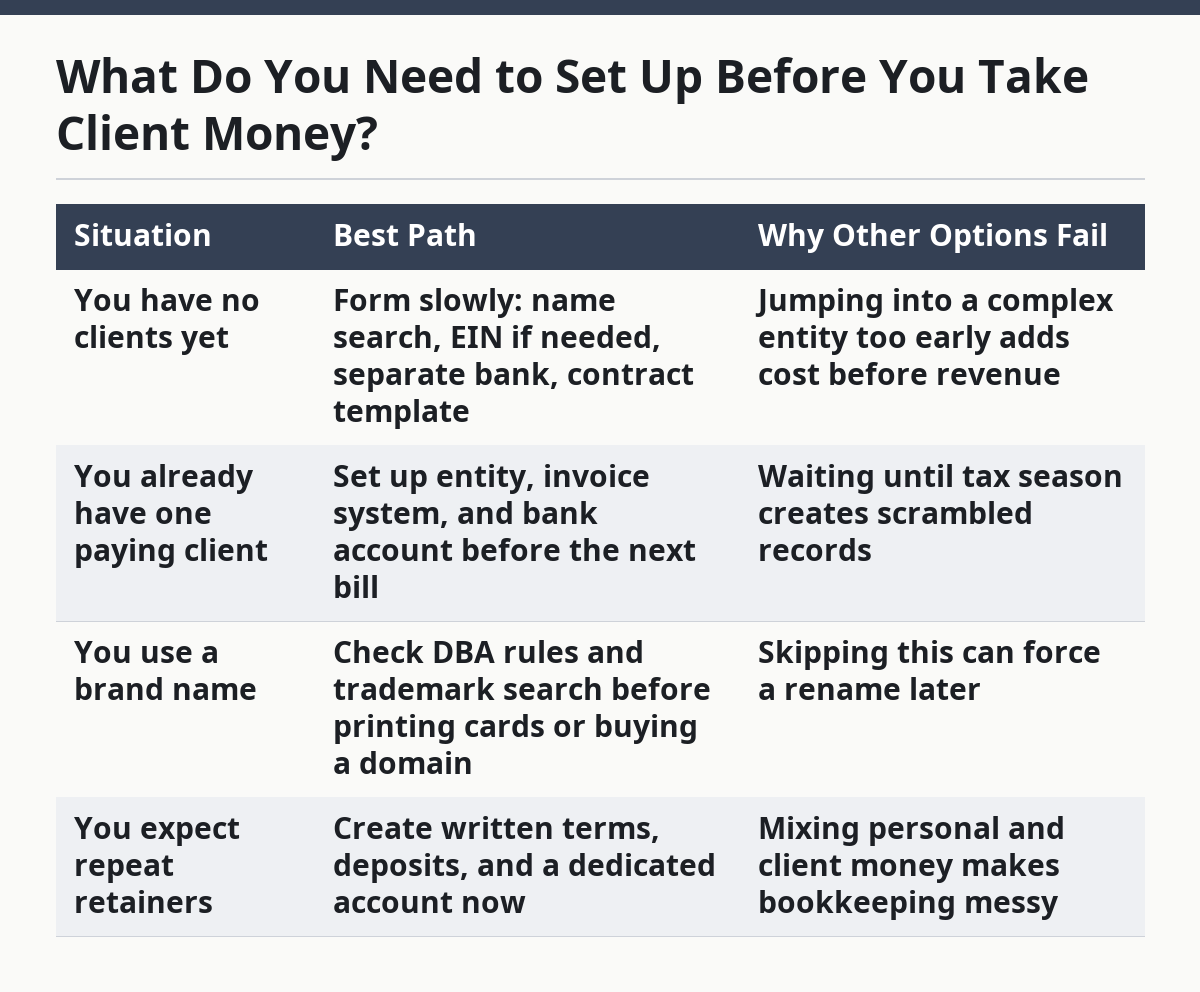
| Situation | Best Path | Why Other Options Fail |
|---|---|---|
| You have no clients yet | Form slowly: name search, EIN if needed, separate bank, contract template | Jumping into a complex entity too early adds cost before revenue |
| You already have one paying client | Set up entity, invoice system, and bank account before the next bill | Waiting until tax season creates scrambled records |
| You use a brand name | Check DBA rules and trademark search before printing cards or buying a domain | Skipping this can force a rename later |
| You expect repeat retainers | Create written terms, deposits, and a dedicated account now | Mixing personal and client money makes bookkeeping messy |
Quick check:
If you can’t invoice, get paid, and separate money cleanly, you’re not set up yet. If those three pieces are in place, you’re ready to start.
Should You Form an LLC or Stay a Sole Proprietor?

An LLC is the cleaner choice for many freelancers, but it is not always the cheapest or best first move. If you’re working with low liability and want the lowest admin burden, staying a sole proprietor can be fine at the start. If you want stronger separation between personal and work assets, the LLC usually wins.
Picture this: you’re comparing a $0 startup path with a state filing fee, annual report, and a bank account you’ll need to keep in good standing. That trade-off is the whole question.
Use this rule:
- Stay a sole proprietor if you’re testing a service, your contracts are small, and your state filing costs are high.
- Form a single-member LLC if you want cleaner separation, better client optics, or you’re worried about claims tied to your work.
- Add S corp taxation later only if your profit level and payroll costs make it worthwhile.
Here’s the important part: an LLC does not erase bad contracts, bad insurance, or bad habits. If you mix money, sign a sloppy agreement, or ignore taxes, the structure won’t save you.
A useful way to think about it:
- Sole proprietor = fastest and cheapest
- LLC = more structure, more admin
- S corp tax election = extra payroll and filing work, used for tax planning, not as a first reflex
If you’re in the U.S., your state’s rules matter. Filing fees, annual report timing, and registered agent requirements vary. Some states are easy. Others are annoying enough that a freelancer should think twice before rushing.
The truth is, many freelancers wait too long for an LLC, then create a messy paper trail by trying to act “official” without actually filing. That’s the worst of both worlds.
Quick check:
If your worry is liability or client professionalism, the LLC path deserves a hard look. If your main goal is to get started this week with minimal cost, sole proprietor status may be enough for the first phase.
How Do Taxes Work for Freelancers?
Freelancers usually pay self-employment tax, income tax, and estimated tax payments if they expect to owe enough. If you ignore those three, the first tax bill can sting.
Picture this: money is landing in your account, but no one is withholding tax for you. That’s normal for freelance work, and it’s why the tax setup has to happen early.
The basic U.S. tax flow looks like this:
- Track every payment from day one.
- Set aside a tax percentage from each deposit. Many freelancers use a separate savings account for this.
- Make estimated quarterly payments if required by the IRS.
- Keep expense records for software, home office use, internet, professional fees, and supplies where allowed.
- File the right forms at tax time based on your structure.
If you’re a sole proprietor or single-member LLC taxed as disregarded, your freelance income usually lands on Schedule C. If you choose S corp taxation later, payroll and separate filing rules come into play.
A lot of readers want a magic tax percentage. There isn’t one that fits everyone. Your location, total income, deductions, and entity type all change the number. A safe move is to keep a dedicated tax reserve account and raise it if your accountant or preparer tells you your margin is too thin.
For current filing details, review the IRS Self-Employed Individuals Tax Center, the IRS Estimated Taxes page, and the U.S. Small Business Administration tax guidance.
One thing to avoid: treating tax money like spendable profit. That’s how people end up borrowing from next quarter to pay last quarter.
Quick check:
If tax money is mixed into your operating cash, your setup is incomplete. If you already know your filing type and have a reserve account, you’re ahead of most new freelancers.
What Contracts, Insurance, and Compliance Do You Need?
You need a contract, basic insurance if your work justifies it, and the registrations your state or city requires. If you skip these, the paperwork gap shows up exactly when a client dispute or claim lands.
Picture this: a client wants a rush revision, then argues about scope, then delays payment. A written agreement is what keeps that from becoming a week-long argument.
At minimum, your client agreement should cover:
- Scope of work
- Deliverables
- Timeline
- Payment terms
- Revision limits
- Termination terms
- Ownership and usage rights
- Late payment terms
- Confidentiality, if needed
If you work in a field where one mistake can trigger a claim, consider professional liability insurance, also called errors and omissions coverage. If you meet clients in person or keep equipment in a workspace, general liability or business property coverage may matter too.
Here’s the catch: insurance and legal structure are not duplicates. An LLC can help separate liability, but it does not pay legal claims. Insurance fills that gap.
Compliance also includes the boring local stuff:
- State registration, if your entity requires it
- DBA filing, if you use a trade name
- Local business license, if your city or county wants one
- Sales tax registration, if your service is taxable in your state
- Home occupation rules, if you work from home in a restrictive area
The Small Business Administration’s licensing pages are a good starting point, and your state revenue department will be the final word on sales tax.
Quick check:
If you don’t have a signed agreement before work starts, you’re exposed. If you do have a contract and know whether your state taxes your service, the compliance piece is in decent shape.
What Tools Should You Set Up on Day One?
You should set up banking, invoicing, bookkeeping, document storage, and time tracking on day one. If you wait, the record trail gets sloppy fast.
Picture this: five clients, three invoices, two deposits, and one expense receipt from a software renewal. Without a system, that turns into a filing headache by the end of the month.
A practical starter stack looks like this:
- Banking: one account for income and expenses, with a separate tax reserve if possible.
- Invoicing: QuickBooks, FreshBooks, Wave, Zoho Invoice, or another tool that fits your volume.
- Bookkeeping: simple software or a spreadsheet if your volume is still small.
- File storage: cloud storage with folders for contracts, invoices, tax forms, and receipts.
- Time tracking: useful if you bill by the hour or need to defend scope.
- Payment processing: ACH, card, or invoice links that match how your clients pay.
The exact tool matters less than the discipline. A cheap tool that you actually use beats a fancy tool that stays empty.
Here’s a simple file structure:
- Contracts
- Invoices sent
- Payments received
- Receipts
- Tax returns
- Client work
- Insurance and licenses
If you bill project fees, keep milestone dates and change requests in the same folder as the agreement. That saves you when a client says, “I thought that was included.”
The truth is, most setup mistakes are not legal mistakes. They’re record-keeping mistakes. A month of disorganized receipts can do more damage than a missing logo.
Quick check:
If you can find every invoice and receipt in under a minute, your systems are working. If you’re still hunting through email, you need a better setup.
The 3 Conditions That Change Everything
The right path changes when your income, risk, or client terms cross a line. If one of those changes, the standard advice stops being enough.
Picture this: you start with one small client, then land a long-term retainer, then take on work that could create legal or financial damage. The setup that was fine in month one may be weak by month six.
| Condition | Best Path | Why Other Options Fail |
|---|---|---|
| You expect steady monthly income | Separate bank, formal invoicing, possible LLC | Casual setup breaks down under volume |
| You work with sensitive data | Contract terms, confidentiality clause, stronger security | A plain invoice doesn’t protect data handling |
| You have a high-risk service | LLC plus insurance, possibly more formal recordkeeping | Sole proprietor status leaves more personal exposure |
Here’s how to decide:
- If you’re doing design, writing, coaching, or consulting, start lean but organized.
- If you handle client funds, regulated data, or physical work, add structure sooner.
- If your income is rising and your admin is already busy, revisit whether S corp taxation makes sense later, and confirm the numbers with a qualified tax professional.
A lot of freelancers assume every structure choice is permanent. It usually isn’t. Many people start as sole proprietors, form an LLC later, and only then look at tax elections once the numbers justify the extra admin.
The catch is that moving later is easier if your records are already clean. If you’ve mixed everything together for a year, the switch gets clumsy.
Quick check:
If your work now carries more money, more responsibility, or more client scrutiny than it did at launch, it’s time to upgrade the setup.
When the Standard Advice Is Wrong
The standard advice is wrong when your state fees are high, your work is ultra-low-risk, or your client setup is still experimental. In those cases, an LLC can be premature and expensive.
Picture this: you are not building a huge agency. You’re trying to get paid for a skill without creating a stack of filings you don’t need yet.
Common edge cases:
-
You’re in a high-fee state.
What changes: startup and annual costs may outweigh the benefit at first.
What to do instead: start as a sole proprietor, keep separate records, then form later if revenue justifies it. -
You only freelance part-time.
What changes: income is uneven, and admin time matters more than optics.
What to do instead: keep the setup lean, but still use separate banking and written terms. -
You work under your own name only.
What changes: a DBA may not be needed.
What to do instead: verify your state rules before filing extra paperwork you don’t need. -
You’re in a regulated field.
What changes: you may need a license or professional registration beyond a normal freelance setup.
What to do instead: check your state board before taking clients. -
You’re selling into one state from another.
What changes: nexus, sales tax, and registration rules can become relevant.
What to do instead: confirm where tax and registration obligations begin before you scale. -
You share work with a partner.
What changes: a single-member setup won’t fit.
What to do instead: use a multi-member structure and put ownership terms in writing from the start.
These edge cases are predictable. If one applies to you, you can plan around it instead of guessing.
Quick check:
If your situation has licensing, tax, or ownership wrinkles, the simple checklist is not enough. You need the version built for your exact case.
What Should You Do in the First 7 Days?
You should get the legal structure, money flow, and client paperwork in place before the week ends. If you do that, the rest becomes routine.
Picture this: Monday starts with a lead, Wednesday brings a signed project, and Friday needs an invoice. A 7-day setup window is enough if you stay focused.
Use this order:
- Choose your structure: sole proprietor, LLC, or another fit based on risk and cost.
- Check your name against state records and, if relevant, the USPTO trademark search.
- Apply for an EIN if you need one for banking, hiring, or client forms.
- Open a separate bank account and set aside a tax reserve account.
- Create your contract template with scope, payment terms, revisions, and termination language.
- Pick invoicing and bookkeeping tools and set the folder structure.
- Confirm local, state, and industry licenses or registrations.
- Send your first invoice only after the paper trail is ready.
If you want a practical benchmark, get to the point where you can answer these without hesitation:
- What name do you use?
- What structure are you operating under?
- Where does tax money go?
- What contract do clients sign?
- How do you store receipts?
That’s the line between “I freelance” and “I run this cleanly.”
Quick check:
If you can complete those eight steps in a week, your setup is solid enough to start taking work with confidence.
What if I’m freelancing only part-time?
Part-time freelancing still needs a clean setup, just with less overhead. If you only have a few clients and uneven income, keep the structure simple and avoid piling on filings you don’t need.
Start with separate banking, a basic contract, and records for every payment and expense. If your income stays small, a sole proprietorship may be the least painful first step. If income rises or risk increases, revisit the LLC question later.
Do I need an LLC to start invoicing?
No, you do not need an LLC to start invoicing. A sole proprietor can invoice legally in many places as long as local rules are followed and any required registrations are in place.
The catch is that invoicing is not the same thing as being protected. If you want personal liability separation, that’s where an LLC comes in.
What records should I keep from day one?
Keep contracts, invoices, receipts, bank statements, mileage logs if relevant, and proof of any licenses or registrations. If you use software like QuickBooks or a simple spreadsheet, the point is the same: every dollar in and out should be traceable.
A clean record set makes tax time easier and protects you in client disputes. It also helps if you later change your structure or hire help.
When should I upgrade from simple setup to a more formal one?
Upgrade when revenue, risk, or client demands outgrow your current system. If you’re handling regular monthly work, signing stronger contracts, or managing larger deposits, the next step is often an LLC plus better bookkeeping and insurance.
Don’t wait for a problem to force the move. The best time to upgrade is when the current setup starts feeling tight, not after it breaks.
Drafted with AI; not yet reviewed by a person.
