

Last updated: November 19, 2026
Quick Answer: Set up a freelance client intake process in 5 core steps: collect project details, confirm scope, send a welcome packet, get the contract signed, and hand off to the first milestone.
In short: Set up a freelance client intake process by collecting the right project details, confirming scope, sharing a welcome packet, getting the contract signed, and handing off cleanly to the first milestone.
A good client intake workflow can help prevent vague requests, missed files, and slow starts; consult a professional if you need legal, tax, or contract guidance. The steps below show what to ask, what to send, and what to approve before work begins. For contract and business-process basics, see the U.S. Small Business Administration and the FTC’s business guidance. SBA | FTC Business Guidance
What a freelance client intake process should do
A freelance client intake process should turn a signed deal into a clear starting point in one business day or less. It should tell you who the client is, what they need, what they already approved, and what you still need before the first milestone starts.
Picture this: you’ve said yes to the project, the client is excited, and the first call is over. Now the work can stall because the logo files are missing, the scope is fuzzy, or nobody knows who gives final approval. That’s the gap intake fills, and it can help save the project before it gets messy.
Here’s the catch: intake is not the same thing as invoicing or contract drafting. Those belong to other steps. Intake sits between the signed deal and the first real task, so it needs to capture the facts that make the work move.
A basic intake system often covers these items:
- project goals and success criteria
- scope questions
- contact names and approval steps
- file collection
- timeline and milestone dates
- welcome packet delivery
- contract status
- first invoice status, if your process includes it
A simple setup can do the job if it is used the same way every time.
What should go into the intake form?

A strong intake form should gather the project facts you need to start without chasing the client for five separate emails. It should be short enough to finish in 10 to 15 minutes, but detailed enough to avoid guesswork later.
Picture this: you’re building a landing page, editing a podcast, or designing a brand kit, and the client says, “I’m not sure what to include.” That’s the moment a form earns its keep. It asks the same questions every time, so the project starts with facts instead of memory.
Use questions that map to the work, not questions that sound formal. Ask for the goal, the audience, the deadline, the files already in hand, and the person who can say yes. If the work has options, ask the client to pick one path or list priorities in order.
A useful intake form often includes:
- project name and company name
- primary contact and backup contact
- preferred email and phone
- goal for the project
- target audience or end user
- scope summary in plain language
- deadline, launch date, or milestone date
- brand assets, references, or source files
- approval contact and review process
- special constraints, such as legal copy or accessibility rules
Do not bury the form in jargon. “Preferred file format” is fine. “Operational deliverables matrix” is not. If the client needs to upload files, give them a file path or upload field before they fill out the rest. That helps cut back-and-forth.
One useful standard is to keep the form tied to the proposal. If the proposal promised a 5-page website and the form starts asking about 12 pages, you catch the mismatch early.
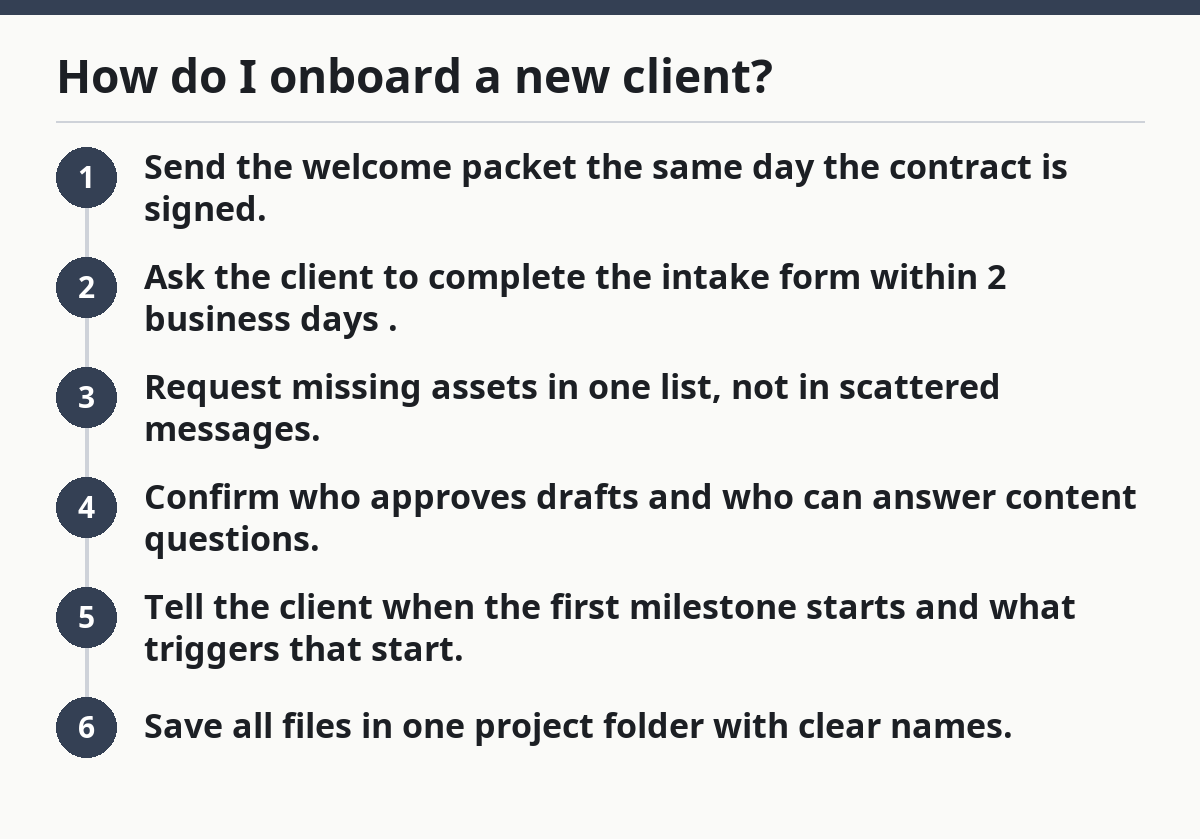
How do I onboard a new client?
You onboard a new client by sending a welcome packet, collecting missing documents, and confirming the approval path before the first milestone starts. That first handoff should happen within 24 to 48 hours after the deal is signed.
Picture this: the client has agreed, the contract is out, and your calendar is already filling up. Onboarding stops the project from floating in limbo. It tells the client what happens next, what to read, and what you need before work begins.
The welcome packet is the backbone of this step. It should be short, plain, and organized. A good packet usually includes the proposal, the signed contract, the project timeline, the communication rules, the intake form, and any document request list. If your work uses one, include the invoice or payment schedule here too.
Use this order:
- Send the welcome packet the same day the contract is signed.
- Ask the client to complete the intake form within 2 business days.
- Request missing assets in one list, not in scattered messages.
- Confirm who approves drafts and who can answer content questions.
- Tell the client when the first milestone starts and what triggers that start.
- Save all files in one project folder with clear names.
This step is where many freelancers get sloppy. They assume the client knows the routine. Most don’t. A short onboarding email should explain where to send files, what format you want, and how long it usually takes to review the first round.
A simple onboarding checklist can help prevent missed steps:
- contract signed
- welcome packet sent
- intake form completed
- files collected
- stakeholders named
- first milestone date confirmed
- invoice sent, if that is part of your process
- project folder created
The goal is not ceremony. The goal is a clean start.
Which questions belong in project scope and approval steps?

Project scope and approval steps should tell you exactly what is included, what is not, and who has the final word on each review. If you skip this, you can end up doing extra rounds of edits with no clear finish line.
Picture this: a client says the project is “simple,” then sends four extra pages of content, three new audiences, and a second round of stakeholder feedback. Now the problem is not the work itself. The problem is that nobody defined the edges. This section closes that gap.
Ask scope questions that force the project into shape. These are the ones that matter:
- What outcome should this project produce?
- What is included in the first milestone?
- What is out of scope?
- Who will review drafts?
- Who gives final approval?
- How many revision rounds are included?
- Are there any legal, brand, or technical rules to follow?
- What happens if the client adds new requests midstream?
The approval step should be even clearer. A freelancer needs one named approver, or at least one primary approver and one backup. If three people can give different answers, your timeline will wobble.
Write the approval path down in plain language. Example: “Drafts go to the marketing lead for comments. Final approval comes from the founder.” That kind of sentence can prevent a lot of “I thought someone else was handling it” confusion; consult a professional if you need help drafting approval language. For plain-language business communication, see the FTC and SBA. FTC Business Guidance | SBA
Here’s the catch: approval without timing is still fuzzy. Set a review window, such as 3 business days, so the project does not sit untouched for a week. If the client misses the window, decide in advance whether the schedule shifts or the draft is treated as approved; consult a professional if you need legal or contractual guidance. For written-agreement basics, see the SBA. SBA
A strong scope section also protects your first milestone. It tells you what you are expected to deliver first, what counts as done, and what the client must supply before you can begin. That matters more than a polished kickoff email ever will.
What documents should be collected before work starts?
You should collect the documents that affect the first milestone: the contract, the signed proposal if it is part of your process, the welcome packet, reference files, and any source documents the work depends on. If a document changes the work, it belongs in intake.
Picture this: you’re ready to draft copy, design mockups, or build a site, and the client sends the brand guide only after the first review. That wastes time and usually creates avoidable revisions. A document request list stops that delay before it starts.
The exact list depends on the service, but most freelancers need some version of these:
- signed contract
- approved proposal
- intake form
- logo files, brand guide, or style sheet
- product or service notes
- photos, copy, or source assets
- access details for shared folders or tools
- legal disclaimers or compliance notes, if relevant
- examples of work they like or do not like
Use one folder structure from the start. A simple setup works: Client Name / Admin / Assets / Drafts / Final. Clear folders save time every week. They also make handoff easier if you ever bring in a subcontractor.
The document collection step also helps you spot missing pieces fast. If the client promised source images but only sent a PDF, you can ask for the original files before you build around the wrong format.
One useful rule: do not begin the first milestone until the core documents are in hand. “Core” means the files that shape the deliverable, not every nice-to-have item. A missing font file may matter; a favorite inspiration board may not.
Clients usually do better when the request is specific. “Please upload the final logo in SVG and PNG” works better than “send your brand stuff.”
What does a clean first milestone handoff look like?
A clean first milestone handoff gives the client one clear next step, one owner, and one due date. It should happen after intake is complete and before the work spreads into multiple directions.
Picture this: the deal is signed, the welcome packet is out, and the files are in place. Now you need to move from admin mode into delivery mode without reopening every decision. This handoff is the bridge.
A good handoff note should include three things: what starts now, what you need next, and when the client should expect the next check-in. If the first milestone is research, say what research means. If it is a draft, say what kind of draft it is and who reviews it.
A simple handoff message might cover:
- first milestone name
- start date
- expected output
- who is responsible for the next response
- file location for shared documents
- review deadline
- next approval point
This is where many freelancers lose momentum by being too vague. “I’ll get started soon” does not set a project in motion. “I’ll begin the outline tomorrow, and you’ll get a review draft on Friday” does.
If you use a project tracker, put the first milestone into it right away. Even a basic task list in a tool like Trello, Asana, Notion, or a spreadsheet helps you avoid lost starts and repeated reminders. The tool matters less than the habit.
This handoff also tells the client the process is working. They can see where the project stands, what comes next, and how to stay out of your way while the first milestone is underway.
What common intake mistakes slow projects down?
The most common intake mistakes are asking too few questions, asking them too late, and spreading the process across too many places. Each one costs time, and each one is easy to fix.
Picture this: the client answers the email, fills out half a form, sends a file in a chat app, and mentions a deadline on a call. Now the details are scattered across four places. That is how a simple project turns into a scavenger hunt.
The biggest mistakes look like this:
- No scope lock: You start work before the deliverables are clear. Cost: scope creep and extra revision rounds. Fix: confirm scope in writing before the first milestone.
- Too many channels: Intake happens in email, chat, calls, and documents. Cost: lost details. Fix: use one form and one folder.
- No approver named: Several people comment, but nobody signs off. Cost: delays and conflicting feedback. Fix: name one final approver.
- Files requested too late: You wait until the work is underway to ask for assets. Cost: stalled drafts. Fix: request documents during onboarding.
- No timeline checkpoint: The client thinks the project starts immediately, but your process needs setup time. Cost: bad expectations. Fix: state the first milestone date up front.
The truth is, a basic intake process does not need fancy software. It needs a repeatable sequence. A form, a checklist, and a clear first milestone beat a messy folder full of half-finished messages every time.
If your current process keeps breaking, start by fixing the first 3 steps only. That is often enough to turn a messy start into a steady one.
For broader setup, the freelance business setup hub can sit above this process and help connect intake to the rest of the client workflow.
Key Takeaways
- A freelance client intake process should gather project facts, not just contact details.
- The welcome packet, intake form, contract, proposal, and invoice all play different roles.
- Clear scope questions stop surprise work before it starts.
- One named approver keeps review cycles from drifting.
- Document collection is part of intake, not an afterthought.
- A short, repeatable workflow is better than a long process nobody uses.
What should a freelance intake form include?
A freelance intake form should include the project goal, contact details, deadline, scope summary, approval contact, and the files needed to begin. If the work depends on brand assets, source files, or references, ask for those too. Keep the form short enough to finish in about 10 to 15 minutes.
How do I onboard a new client?
You onboard a new client by sending a welcome packet, confirming the signed contract, collecting the intake form, and requesting any missing files before the first milestone starts. The client should know where to send materials, who approves work, and when the next step begins. A clean onboarding process usually fits inside 24 to 48 hours after the deal is signed.
What information should I collect before starting work?
You should collect the project goal, scope, timeline, approver name, key files, and any rules that affect delivery before starting work. If the first milestone depends on brand assets, content, or access details, get those first. The goal is to avoid starting with missing pieces that slow the whole project down.
Drafted with AI; not yet reviewed by a person.
