
Last updated: November 19, 2026
Key Takeaways
- Most freelancers should begin with a fixed percentage of each payment, then adjust after the first year if needed.
- Keep tax money and a slow-month cushion in separate categories, even if both sit in one bank account.
- Use a rule that follows incoming cash instead of waiting for a perfect monthly amount.
- Switch away from a simple percentage rule when your taxes or income become more complex.
If you are trying to figure out how much freelancers should save for taxes and slow months, start with a simple split: one bucket for tax set-asides and one for an operating reserve. That gives you a clear answer for how much freelancers should save for taxes and slow months without mixing obligations with survival cash.
This is information, not financial advice. Tax rules, thresholds, and filing systems vary by country and change often, so a qualified adviser should review your own situation.
Who this freelance savings allocation is for

This freelance savings allocation is for freelancers who get paid irregularly, cover their own taxes, and want a clear rule for what to save from each payment. It assumes you already know your basic monthly costs, can track income by project or client, and want a practical starting point rather than a perfect formula.
It is not for someone with a salary plus side income that is taxed at source in a straightforward way, and it is not for anyone who has already been told by a tax professional to use a specific percentage, installment plan, or quarterly payment method. If your income crosses borders, comes through an LLC, or has withholding already built in, the right split can change fast.
The core idea is simple: save for taxes first, then build a separate reserve for slow months. A common mistake is to treat one pile of cash as if it can do both jobs; if you are unsure how your own situation should be handled, consult a tax professional or accountant and check your local guidance. That works until a tax bill arrives in the same month as a quiet pipeline. Then the “extra” money turns out not to be extra at all.
For orientation, it helps to know the standard terms. A tax set-aside is the portion of each payment reserved for income tax, self-employment tax, VAT, GST, or similar obligations, depending on your country. An emergency fund is personal money for real life shocks such as medical bills, rent gaps, or repairs. A slow-month reserve is business cash meant to cover uneven freelance income, not household emergencies.
If you are looking for a bigger system that sits around this decision, the freelancer budgeting hub is the place to connect the rest of the numbers.
How much should freelancers save from each payment?
Most freelancers should start by saving a fixed percentage of every payment, then adjust after the first year based on what they actually owe. The exact percentage depends on location, tax bracket, deductions, and whether you owe both income tax and self-employment tax, so there is no universal number that is right for everyone.
A practical starting range is to treat taxes as a separate line item the moment money lands, but you should confirm the right percentage with local tax guidance or a qualified adviser. Many freelancers begin with a conservative set-aside because under-saving is harder to fix than saving a bit too much. The point is not to guess the “perfect” figure on day one. The point is to avoid spending money that has already been claimed by the tax authority.
What matters most is the split between:
- tax reserve: money you do not touch for living costs,
- slow-month reserve: money that can smooth income gaps,
- spendable cash: what remains after those two reserves are funded.
A useful rule is to calculate your expected tax burden on net freelance profit, not on every dollar of gross revenue. “Net” means income after ordinary, necessary business expenses. If you set aside tax on gross revenue while also paying for software, contractors, ads, or travel, your reserve may be larger than needed. If you set aside too little because you are using gross receipts as if they were profit, the shortfall shows up later.
For many freelancers, a better first move is to save a percentage of every payment immediately, before any owner draws or personal transfers, while checking the number with a tax adviser if the business is complex. Even a small delay tempts the cash into everyday spending. A 24-hour pause is enough for a payment to stop feeling like “tax money” and start looking like “available money.”
What a good split between tax reserves and slow-month reserves looks like

A good split keeps tax money and operating cushion in separate categories, even if they sit in the same bank. The categories matter more than the container. If you cannot tell at a glance how much is for taxes and how much is for a 2- to 6-month slowdown, the system is too loose.
Here is a clean way to think about it:
- Tax reserve covers obligations you know are coming, even if the timing is uneven.
- Slow-month reserve covers the months when invoices are late, client work falls off, or a contract ends.
- Emergency fund is personal money for household shocks and should not be raided just because freelance income dipped.
The slow-month reserve is usually tied to your bare-bones business and household survival number. That means rent or mortgage, groceries, utilities, insurance, transport, and the minimum business costs needed to keep working. It does not mean your ideal lifestyle budget. A reserve built on the expensive version of your life becomes hard to fill and easy to drain.
A better target is a reserve that can cover several months of lean revenue without forcing you to max out cards or miss tax payments. The exact number depends on volatility. If your income is lumpy but predictable, such as recurring retainers with periodic gaps, a smaller buffer may work. If you live on one-off projects and clients pay slowly, the buffer needs to be larger.
This is where a generic article often goes wrong: it collapses “tax savings,” “emergency fund,” and “business cash” into one emergency pile. That leaves you unable to tell whether you are underfunded because of taxes, because of slow work, or because of an actual emergency. Separate buckets give you a diagnosis, not just a balance.
How do I save when income changes every month?
You save by using a rule that moves with the money, not by waiting for a perfect monthly amount. The cleanest method is to route a fixed share of every payment into tax and reserve buckets on the day you are paid, then review the percentages every 90 days.
Use this process:
- List your minimum monthly survival number. Write down the amount needed for rent, food, utilities, insurance, transport, and the most basic business costs. Use a 1-month figure first, then multiply it by 3 or 6 only after you know the bare minimum. Verify that this number excludes dining out, travel, and upgrades. If it includes comfort spending, the reserve will be larger than your real safety need.
- Estimate your tax set-aside rate. Start with a conservative percentage that reflects your tax obligations in your country, then refine it after a tax return or qualified estimate. Verify that the rate covers more than income tax if you also owe self-employment-type charges, VAT, GST, or local levies. If you ignore one of those layers, the reserve will look healthy until a filing deadline arrives.
- Split every payment immediately. On receipt of each invoice payment, move the tax portion and the slow-month portion within 24 hours. Use separate labels or subaccounts if available. Verify the transfer happened before any personal spending. If you wait until month-end, the money usually gets absorbed into daily cash flow.
- Set a temporary operating percentage for slow months. Until your reserve is fully funded, direct a defined share of each payment into the income buffer. The exact share can change, but the rule must be written down. Verify that you can explain it in one sentence. If the rule is fuzzy, it will be broken when income tightens.
- Match withdrawals to actual gaps. If income drops below your baseline, draw only the amount needed to cover the gap for that month, not the whole reserve. Verify the draw against a written budget for that month. If the withdrawal is vague, the buffer becomes a slush fund.
- Review the numbers every quarter. Re-check tax estimates, business expenses, and your minimum living costs every 3 months. Verify whether your reserve is rising, flat, or being used faster than it is rebuilt. If you never review, the percentage can drift far away from reality.
- Rebuild after each draw before expanding spending. If you use reserve cash, refill it before adding new subscriptions, larger personal transfers, or higher fixed costs. Verify that your next 1 to 3 payments are assigned to replenishment. If you expand too early, the next slow season starts from zero again.
The first month will usually feel awkward because the split exposes how much of your cash is already spoken for. That discomfort is useful. It tells you the system is working as a control, not a vibe.
For tax rules and filing formats, the IRS guidance on estimated taxes is a useful example for U.S. freelancers, and the GOV.UK page on Self Assessment is a useful example for UK readers. The rules on both pages are specific to their systems, which is exactly why a local review matters.
How much freelancers should save for taxes and slow months
This is where how much freelancers should save for taxes and slow months becomes more concrete: start by separating the two goals, then size each one to your actual work pattern. The tax reserve should reflect your expected obligations, while the slow-month reserve should cover the gap between uneven income and your minimum spending.
For many freelancers, the first-year answer is not perfect, but it is workable. A fixed percentage can handle the tax side, while a separate reserve builds over time for gaps between projects. If you have a stable client base and predictable invoices, the amounts are easier to estimate. If your income swings hard, the reserve has to do more of the heavy lifting.
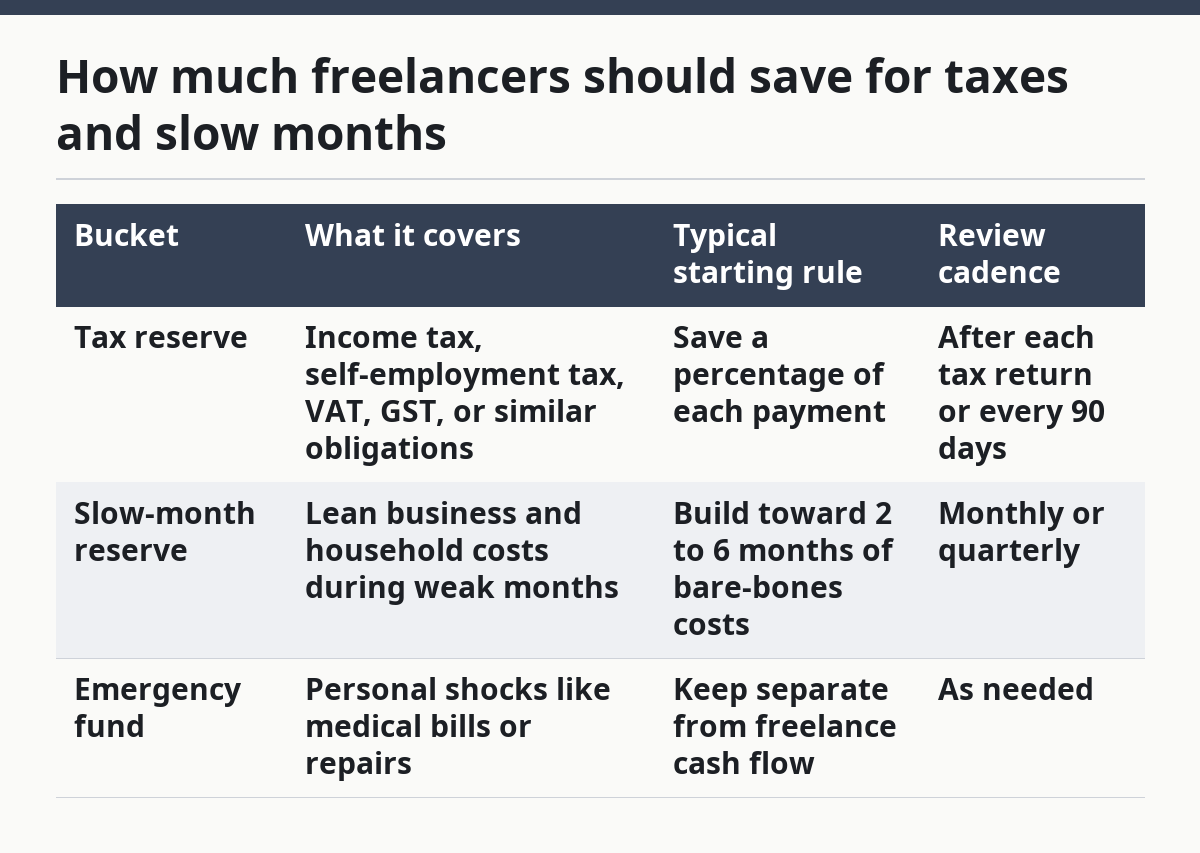
A simple comparison can help:
| Bucket | What it covers | Typical starting rule | Review cadence |
|---|---|---|---|
| Tax reserve | Income tax, self-employment tax, VAT, GST, or similar obligations | Save a percentage of each payment | After each tax return or every 90 days |
| Slow-month reserve | Lean business and household costs during weak months | Build toward 2 to 6 months of bare-bones costs | Monthly or quarterly |
| Emergency fund | Personal shocks like medical bills or repairs | Keep separate from freelance cash flow | As needed |
When should I stop using a simple percentage rule?
You should stop using a simple percentage rule when your tax situation or income pattern is no longer simple. The shortcut works for a solo freelancer with one country of tax residence and ordinary expenses; it breaks when those assumptions disappear.
You have income from more than one tax jurisdiction: Cross-border work can trigger withholding, foreign tax credits, or local registration rules — get country-specific advice before relying on a flat set-aside. A 25% guess can be too low or too high depending on where the work is sourced and where you live.
You receive large one-off payments: A 6-figure project fee or a single quarter of unusually high revenue can push you into a different tax band — hold back more until the return is prepared. Big spikes are where percentage habits fail, because the money that looks like a windfall may mostly belong to tax.
You deduct significant business costs: If software, contractors, travel, or equipment eat a meaningful share of revenue, a gross-income rule may overstate the tax reserve — use net profit instead. The consequence of ignoring deductions is not usually “extra savings”; it is wrong planning that distorts how much cash you think you have.
Your business structure changed: Moving from sole trader or sole proprietor status to an entity with different filing rules changes how money should be split — review the reserve method immediately. What worked for a simple personal filing can be wrong once payroll taxes, distributions, or entity-level filings enter the picture.
You are already behind on taxes: If you owe prior-year amounts, the current-year percentage is no longer enough — separate the old debt from the new reserve and make a repayment plan. Treating back taxes as part of this month’s set-aside can hide the real problem and keep the arrears alive, so it is worth confirming the plan with a tax professional.
Your income is stable enough to forecast 12 months ahead: At that point, a quarterly or annual estimate may work better than a payment-by-payment guess — use a schedule that matches your billing cycle. The downside of switching too late is not complexity; it is unnecessary noise and poor cash visibility.
The mistakes freelancers make with tax reserves and slow months
The most costly mistake is using tax money to cover living costs for 2 or 3 months and promising to catch up later. Later often arrives with penalties, interest, or a smaller pipeline than expected.
Another common error is saving for “emergencies” without defining what an emergency is. A tax bill, a late client payment, and a broken laptop are not the same event. If every shortage pulls from the same pot, the pot can be empty when the next shortage appears.
Here are the failures I see most often:
- Treating gross revenue as spendable income. The consequence is overspending from day one. The better alternative is to base spending on net income after tax and ordinary costs.
- Using one savings pool for everything. The consequence is confusion and missed tax deadlines. The better alternative is separate labels or subaccounts for tax reserve, slow-month reserve, and personal emergency cash.
- Setting the percentage once and never touching it. The consequence is drift as rates, deductions, or revenue changes. The better alternative is a 90-day review.
- Waiting for a “good month” to save. The consequence is that the reserve is always underfilled because the good month gets consumed by new spending. The better alternative is to save on every payment, even the small ones.
- Overbuilding the buffer before handling tax debt. The consequence is that current cash feels safe while older obligations grow. The better alternative is to make the tax reserve current first, then fill the slow-month reserve.
The honest trade-off is that a disciplined reserve can make cash feel tight at first. That is not a flaw in the method. It is the method revealing how much of the income was already committed. If the reserve feels impossible to build, the issue may be expenses, tax complexity, or pricing — not the savings rule itself.
What if my freelance income is too uneven to follow a standard rule?
Then the standard rule still helps, but only as a floor, not as the whole plan. Highly variable income needs a reserve that responds to your lowest predictable month, not your average month.
The first adjustment is to build the slow-month reserve around the last 6 to 12 months of income, using the low end rather than the mean. Averages can hide a brutal quarter. If one big month masks three weak ones, the average will lie to you.
The second adjustment is to keep a larger cash buffer before expanding personal spending. That buffer is not the same as an emergency fund. It is working capital for the business side of freelance life — money that keeps the machine running when invoices lag by 30 to 60 days or a client pays late.
The third adjustment is to decide, in advance, what gets funded first when cash is thin. In a tight month, the usual order is: taxes that are due soon, minimum operating costs, and only then anything discretionary. That order is unpleasant, but it prevents the worst kind of scramble.
There are also cases where the simple monthly framework is the wrong tool. If you have seasonal income that is predictable by quarter, a quarterly reserve plan may be better. If your tax liability is heavily front-loaded or you are subject to estimated payments on a fixed schedule, the reserve should be aligned to those due dates rather than calendar dates.
Drafted with AI; not yet reviewed by a person.
