
Last updated: November 19, 2026
Key Takeaways
- An S corporation is worth considering for a freelancer only when profit is steady, salary is realistic, and payroll won’t create chaos.
- An S corporation mainly splits owner pay into wages and distributions.
- An S corporation is usually not the same thing as an LLC or a sole proprietorship.
- An S corporation starts to make sense when extra admin costs are small compared with the tax effect.
Most freelancers should not form an S corporation right away. An S corp can help only when the tax savings from splitting salary and distributions are large enough to justify payroll, extra filings, and stricter recordkeeping.
This is information, not financial advice. A qualified tax adviser or CPA should review your own situation, because S corporation rules and payroll tax treatment vary by country and change over time; the IRS explains the federal framework on its S corporations page.
As someone who writes about small-business tax setup, I know the real question is not “Can I form an S corp?” but “Does my solo business generate enough net income to make the extra administration worth it?” If the answer is no, a simpler structure usually wins.
The short answer for freelancers

An S corporation is worth considering only for a freelancer whose profit is steady, high enough to support a reasonable salary, and predictable enough to run payroll without creating chaos. For a solo business with uneven income, low profit, or one-off projects, the compliance load usually outweighs the benefit.
That is the main dividing line. The S corp is not a magic tax label; it is a tax election layered on top of a business entity, usually an LLC or corporation, and it changes how the owner is paid. Part of the owner’s income is treated as wages through payroll, and part may flow through as distributions, but a tax professional should confirm whether that split fits your facts. The IRS says owner-employees must take a reasonable salary before taking additional profit as distributions. In other words, the S corp cannot be used as a blank check to avoid payroll taxes by calling all earnings “distribution.”
That rule is the whole game. If you are a solo designer, consultant, developer, copywriter, or marketing contractor with a single-owner operation, your pay must still reflect the labor you personally perform. If the salary is set too low, the IRS can recharacterize part of the distributions as wages, which can create back taxes, penalties, and interest.
The administrative burden is the part many generic articles skip. S corps often require payroll service setup, regular payroll runs, state payroll registrations where applicable, quarterly filings, year-end tax forms, and bookkeeping that cleanly separates owner pay from business profit. None of that is impossible. It is just a real system, not a checkbox. A solo freelancer who hates admin or whose income changes sharply from quarter to quarter may find that system distracting and expensive in time, even before any tax benefit appears.
For a broader setup overview, the hub on freelance tax setup and entity choice is the right companion page.
How an S corporation actually changes your money flow
An S corporation does one important thing: it separates how the owner receives money into wages and distributions.
Wages run through payroll and are subject to payroll taxes. Distributions are not wages, so they are treated differently on the tax return, but a tax adviser or CPA should confirm how that applies in your case. That split is why freelancers look at the S corp in the first place. The IRS expects the owner-employee to take a reasonable salary for the work performed before taking additional profit as distributions. In other words, the S corp cannot be used as a blank check to avoid payroll taxes by calling all earnings “distribution.”
The IRS explains S corporation rules on its S corporations page. That is the place to start for the basic federal framework.
S corporation vs. LLC vs. sole proprietorship for a solo freelancer

An S corporation is usually not a replacement for an LLC or a sole proprietorship in the way people imagine. It is a tax status, not a business model. The real comparison is about simplicity, compliance, and whether you need payroll.
| Criteria | S corporation | LLC taxed as a sole proprietorship | Winner for this condition |
|---|---|---|---|
| Payroll required | Yes, for owner wages | No owner payroll by default | LLC / sole proprietorship for low-admin needs |
| Salary and distributions | Must be separated | No split required | LLC / sole proprietorship for simplicity |
| Annual tax complexity | Higher | Lower | LLC / sole proprietorship for small or irregular income |
| Reasonable compensation rule | Yes | No | LLC / sole proprietorship if you do not want that rule |
| Self-employment tax planning | Potentially more flexible | Less flexible | S corporation if profit is high and steady |
| Bookkeeping burden | Higher | Lower | LLC / sole proprietorship for solo operators |
| State filing friction | Often higher | Often lower, depending on state | LLC / sole proprietorship in many states |
| Owner payment flexibility | More rigid | More flexible | LLC / sole proprietorship for variable income |
| Best fit | Profit-focused solo business | Early-stage or variable solo business | Depends on income stability |
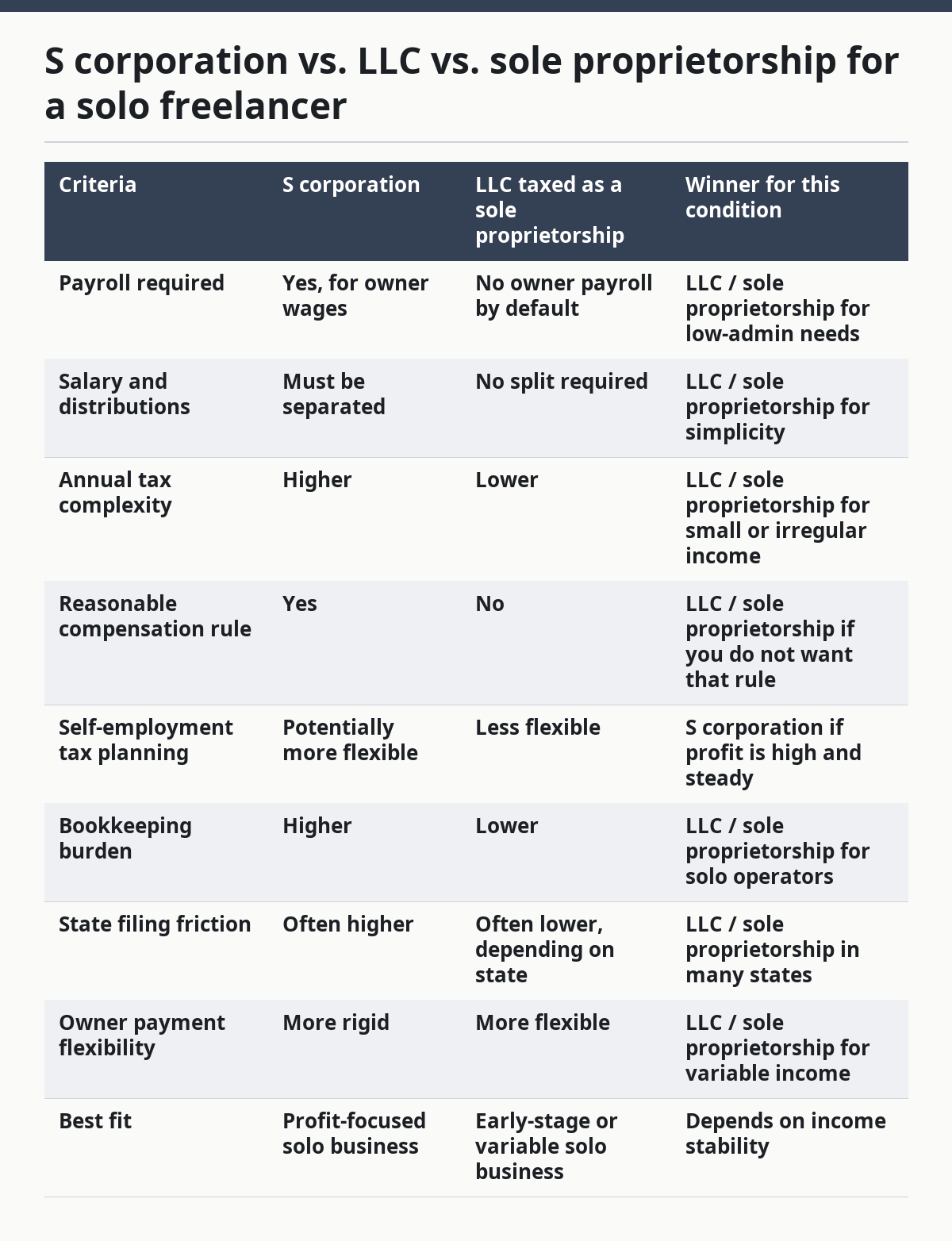
The S corp wins when the business behaves like a business with payroll, not a side hustle with uneven deposits. A freelancer with dependable monthly profit may be able to support the structure without losing sleep over compliance. A freelancer whose income swings from one project to the next usually does better staying simpler.
The LLC, by itself, often wins on flexibility. A sole proprietorship is even simpler, though it offers no entity separation and no special payroll structure. For many freelancers, that simplicity is the point. There is no quarterly payroll software to maintain, no salary calculation to revisit, and no separate wage/distribution accounting. The trade-off is that there is also no S corp-style tax split.
When an S corporation starts to make sense
An S corporation starts to make sense when the freelance business has enough surplus profit that the extra admin costs are small relative to the possible tax effect.
That usually means three things are true at once. First, the business has predictable earnings, not just a lucky run of projects. Second, the owner can support a defensible salary based on the actual work being done. Third, the owner is willing to run payroll or pay a payroll service to do it. If any one of those is missing, the case weakens fast.
The most common profile is a freelancer who has moved from “I have projects” to “I run a real operating business.” Think of a solo consultant with retained clients, a web developer with repeat contracts, or a niche marketing contractor whose revenue is stable enough to forecast across the year. In those cases, the owner can usually budget for payroll, bookkeeping, and tax prep as part of doing business.
A payroll service is often part of this decision. The service does not solve the tax question, but it reduces the mechanical burden of withholding, pay dates, payroll filings, and year-end forms. That matters because an S corp is less about the entity name and more about disciplined execution. If payroll is going to be missed, delayed, or guessed at, the structure can turn into a problem rather than a planning tool.
The key weakness is just as important: an S corp can create busywork that eats up the very savings it was meant to create. If your income is not yet stable, you may spend more on professional help, filings, and admin attention than you gain through the structure. That is the wrong trade for a solo freelancer with modest net profit.
Where the S corporation loses for freelancers
The S corporation loses when simplicity matters more than tax structuring.
It is the wrong move for a freelancer with low or erratic earnings, for a business that is still testing its market, or for someone who does not want another recurring compliance task on the calendar. The structure adds moving parts: payroll dates, payroll tax deposits, year-end reporting, and bookkeeping that must cleanly distinguish wage income from distribution income. If the owner misses that discipline, the structure can become messy quickly.
It is also a poor fit when the owner does not want the reasonable salary rule hanging over every payment decision. That rule is manageable, but it is not optional. A solo freelancer cannot simply move all business income out as distributions and skip wages. That is the kind of shortcut that gets attention for the wrong reasons.
Another overlooked drawback is timing. S corp treatment generally requires planning ahead and filing an election on schedule with the IRS, so a tax professional can help you check the deadline before you rely on it. If a freelancer decides late in the year that the structure might help, the calendar can limit what can be done for that tax year. That makes this a planning decision, not a panic decision.
The S corp is also less attractive when the business has a lot of non-tax friction already. If you are juggling late payments, uncertain income, and client acquisition at the same time, adding payroll often adds stress faster than it adds value. In that scenario, the better move is usually to keep the entity structure simpler and revisit the question after income settles down.
The honest side-by-side: what changes in real life
The real difference is not the form you file; it is the amount of work you create for yourself.
An S corporation is a better fit when the freelancer wants a formal compensation structure and can tolerate extra filings. A sole proprietorship or a basic LLC structure is better when the freelancer values easy administration and flexible cash flow. That is the heart of the comparison.
Because the S corp can make sense when profit is high enough, it gives the owner a way to treat part of the business’s profit as distributions after paying a salary. But the price of that structure is ongoing compliance. A payroll service helps, yet it does not eliminate the need to monitor compensation, keep records, and stay current on filings. If you are already spending time every month reconciling invoices and expenses, adding payroll may feel like a second job.
By contrast, a sole proprietorship or LLC taxed by default is much easier to live with. There is no payroll to run for the owner, and the bookkeeping is generally simpler. The downside is obvious: there is no S corp salary-and-distribution split to explore later. For many freelancers, that trade-off is acceptable because the business is not yet at the scale where the extra complexity pays off.
The comparison is especially useful for solo workers who assume “LLC” and “S corp” are competing entities. They are not. The S corp is a tax election that often sits on top of an LLC. That distinction matters because it means the real choice is usually between staying simple and taking on an election that changes how income is handled.
The verdict: which one should a freelancer choose?
Choose an S corporation if your freelance business has steady profit, can support a reasonable salary, and you are willing to run payroll or pay for a payroll service. Choose a sole proprietorship or a basic LLC if your income is uneven, your profit is still modest, or you want the least administrative drag. Neither if you are hoping the S corp will magically fix weak cash flow or remove tax obligations.
That is the clean answer. The S corporation is a planning tool for a solo business that already has enough stability to justify it. It is not the default answer for every freelancer, and it is not the right next step just because the business formed an LLC.
If the decision still feels blurry, map your current net income, the cost of payroll, the cost of professional tax help, and the amount of time you are willing to spend on compliance. That comparison usually makes the answer clear.
When to reconsider this choice entirely
Reconsider the S corporation if your business has had one strong year but no clear pattern yet.
A single good year is not the same as a stable business model. If your revenue depends on a few large projects, seasonal work, or inconsistent retainer renewals, the structure can be too rigid for the reality of the cash flow.
Reconsider it if you are not ready to separate business discipline from personal spending. An S corp works best when payroll, distributions, and bookkeeping are all handled with care. If the records are sloppy, the tax election can become a liability instead of a benefit.
Reconsider it if you are in the middle of a bigger structural decision. A freelancer still choosing between staying solo, adding contractors, or changing service lines should not let the S corp question outrun the business plan. Entity choice is supposed to serve the business, not the other way around.
Also reconsider it if your state-level rules make the setup more cumbersome than the federal election alone suggests. State treatment can differ, and that is one more reason a local tax professional is worth the conversation before changing structure.
When does an S corporation make sense for a freelancer?
An S corporation makes sense when a freelancer has steady profit, predictable work, and enough income to justify payroll and extra filings. The structure is most useful when salary and distributions can be handled cleanly and the administrative burden does not outweigh the tax planning benefit.
What are the downsides of an S corp for solo workers?
The downsides are payroll, added tax filings, the reasonable salary rule, and more bookkeeping. A solo worker also loses some flexibility in how money is taken out of the business, and a payroll service may still be needed to keep the system current.
Does an LLC have to become an S corporation?
No. An LLC does not have to become an S corporation. An LLC can stay taxed by default, and that is often the simpler choice for freelancers who do not need the salary-and-distribution structure that an S corp creates.
Drafted with AI; not yet reviewed by a person.
