
Last updated: November 19, 2026
Key Takeaways
- Freelancer tax compliance means reporting income accurately, paying on time, and keeping records long enough to support both.
- Start your filing calendar with the first invoice, not with the annual tax return deadline.
- The most important dates are the ones that trigger penalties, interest, or lost deductions and credits.
- A filing system handles irregular income best when it records cash flow as it happens.
Freelancer tax compliance and filing calendar — The Complete Guide is about tracking income, setting aside tax, meeting filing deadlines, and keeping records that support the numbers on a return. The filing calendar depends on the country you live in, where your clients are, and whether you owe income tax, VAT/GST, self-employment tax, or estimated tax payments. This article is information, not financial advice; for your own situation, a qualified tax adviser or accountant should review the rules that apply to you. If you need an official starting point, see the IRS page on estimated taxes and Self Assessment guidance from HMRC.
Who this applies to — and who needs a different approach
This guide applies to independent workers who invoice for services, get paid without payroll withholding, and must handle tax filings themselves or with light professional help. That includes sole traders, freelancers, independent contractors, consultants, creators with business income, and gig workers who receive self-employment income rather than wages. It assumes you know how you get paid, roughly how much you made in the last 12 months, and whether you have a separate business bank account. It also assumes you can find your local tax authority’s website and read the rules that apply to your country.
The guide does not fit every freelancer. If you operate through a company, have employees, sell across borders, or have income in multiple countries, the filing calendar can change in ways that make generic advice risky. A freelancer in the UK filing as a sole trader does not face the same calendar as a contractor in the US who owes quarterly estimated tax and state income tax. A Canadian self-employed worker dealing with GST/HST registration has different thresholds and forms than an Australian sole trader dealing with GST and PAYG instalments. The broad structure is similar, but the dates and forms are not universal.
Because this article is a compliance map, it can help you organize the work, but it does not replace the local rules. If you are behind on filings, have mixed personal and business spending, or have earned money in more than one tax jurisdiction, the right next step is usually not “guess and file.” It is to gather records, identify the authority involved, and get a qualified adviser to check the return before you submit it. In tax work, a 30-minute review can be cheaper than a correction letter later.
What freelancer tax compliance actually means
Freelancer tax compliance means three things: report the right income, pay the right amount on time, and keep records long enough to support both. It is not just “file one annual return.” For many freelancers, compliance also includes estimated payments, sales tax or VAT/GST registration, invoices with required details, and year-round bookkeeping. In some countries, there is a separate rule for business tax registration before your revenue hits a threshold; in others, the duty starts as soon as you begin trading.
The common mistake is to treat tax as a once-a-year event, but tax authorities often expect recordkeeping and payments throughout the year. If you are expected to make quarterly payments and you wait until the annual return is due, you may face interest, penalties, or a cash flow shock. If you should be charging VAT/GST on invoices and you do not, you can end up owing tax out of pocket. If your records do not show business versus personal spending cleanly, deductions can be harder to defend. See the IRS pages on estimated taxes and recordkeeping for general guidance; for your own situation, consult a professional.
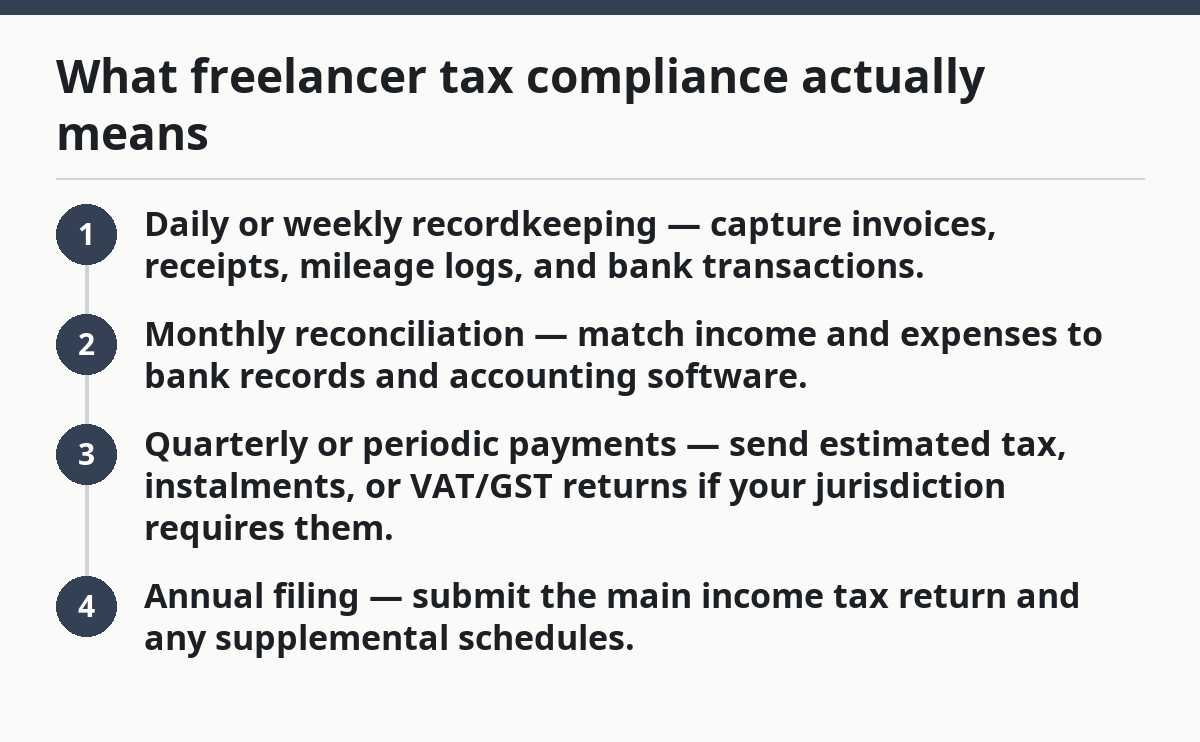
A practical way to think about compliance is as a calendar with four layers:
- Daily or weekly recordkeeping — capture invoices, receipts, mileage logs, and bank transactions.
- Monthly reconciliation — match income and expenses to bank records and accounting software.
- Quarterly or periodic payments — send estimated tax, instalments, or VAT/GST returns if your jurisdiction requires them.
- Annual filing — submit the main income tax return and any supplemental schedules.
The exact forms differ by country, but the logic is the same. A freelancer who keeps records current usually has a manageable filing season. A freelancer who waits until the deadline usually pays in stress, missed deductions, and errors. That trade-off matters because tax authorities generally care about accuracy and timing, not whether the work was done at midnight or on a Sunday.
Your filing calendar, from first invoice to annual return
Your filing calendar should start the day you send your first invoice, not the day the tax return is due. The core job is to turn a pile of payments into a schedule of actions you can repeat every month, quarter, and year. If you do that, tax becomes a routine system instead of an annual scramble.
Here is a step-by-step structure that works across many jurisdictions, with the local dates filled in from your tax authority’s rules:
- Register as a taxpayer or business if your country requires it. Do this before or soon after your first paid job, especially if registration is triggered by income threshold, trading status, or VAT/GST turnover. Verify which authority handles registration and whether you need a tax ID, business number, or sales tax account. A problem shows up if you cannot issue proper invoices or the authority later says you should have registered earlier.
- Set up one business account and one tax savings account. Move all freelance income into the business account and transfer a fixed percentage to the tax account after each payment. The exact percentage depends on your tax bracket and local rates, so use a conservative placeholder until an adviser confirms the number. Verify that the tax account stays untouched for non-tax spending. A problem exists if business and personal cash are mixed so thoroughly that you cannot tell what is owed.
- Choose a bookkeeping method and stick to it for 12 months. Use accounting software, a spreadsheet, or a ledger, but make every entry within 7 days of the transaction. Record the date, amount, payer, category, and payment method. Verify that bank deposits match recorded income and that receipts are attached or stored digitally. A problem appears if the records cannot explain a deposit, a cash payment, or an expense category.
- Track deductible expenses in real time. Keep receipts for software, equipment, subcontractors, professional fees, home office costs if allowed, and travel that is genuinely business-related. For mixed-use items, record the business percentage rather than guessing later. Verify that each expense has a business purpose and a receipt or contemporaneous note. A problem shows up when a deduction has no evidence or the personal portion has not been separated.
- Review your tax exposure monthly. Compare year-to-date profit with your expected tax liability and set aside more if income jumps. Do this at least once every 30 days, because tax surprises usually come from uneven income, not from the final return itself. Verify that the tax reserve covers income tax plus any self-employment, national insurance, or local business tax that applies. A problem appears if your tax reserve is constantly negative.
- Submit periodic filings on the local schedule. If your country requires quarterly estimated tax, VAT/GST returns, payroll filings, or instalments, calendar each due date as soon as the year starts. Put reminders 14 days before each deadline and another 3 days before. Verify that you know the filing period, the payment method, and the cutoff time. A problem appears if a deadline falls on a weekend or holiday and you did not check the adjusted due date.
- Prepare the annual return 30 to 60 days before the deadline. Pull income summaries, expense totals, bank statements, and prior-year filings together early. Reconcile totals before you enter them into the return. Verify that gross income, deductions, and credits all tie back to records. A problem appears if you start the return without complete documents and begin estimating from memory.
- Keep copies after filing. Save the submitted return, payment confirmations, invoices, receipts, and correspondence in both searchable digital form and a backup. Retention periods vary by country, but a common rule of thumb is to keep records for several years, longer if there is an audit or unresolved issue. Verify that you can reproduce the return from the records alone. A problem appears if you cannot show what you filed or why.
A strong filing calendar is built around local due dates, not around a generic “tax season.” In the US, for example, estimated tax installments and annual filing have different dates. In the UK, the self assessment deadline is not the same as the payment deadline. In Canada, GST/HST filing frequency can be annual, quarterly, or monthly depending on registration status and reporting period. The calendar matters because missing one date can affect another. See IRS Publication 505 and HMRC Self Assessment for examples of how deadlines are set.
The best calendar is one you can maintain in 15 minutes a week if your records are already clean and your filing duties are straightforward. If it takes a full day each month to reconstruct your records, the system is too loose. That is usually the point where software, a bookkeeper, or an accountant becomes cheaper than the time lost to cleanup. A freelancer who works irregularly needs an even tighter calendar, because lump-sum income can make estimated tax due faster than expected.
What dates matter most, and why missing one is costly
The dates that matter most are the ones that create cash penalties, filing penalties, or lost access to deductions and credits. For most freelancers, those dates fall into four buckets: registration deadlines, periodic payment deadlines, periodic return deadlines, and the annual income tax deadline. Some countries also have a VAT/GST filing deadline, a local business tax deadline, or a separate social contribution deadline.
The cost of missing a deadline is rarely just one late fee. A missed estimated payment can trigger interest. A missed registration date can force backdated tax collection. A late return can lead to penalty notices, and repeated late filings can draw more attention to your account. In some systems, the return itself may be accepted late, but the payment still counts as overdue. That difference matters because filing and paying are not always the same obligation.
A calendar should also reflect payment due dates, not just return due dates. Many freelancers assume they have until the return deadline to pay everything. That is not always true. In some jurisdictions, payment is due before the return is filed, or at a different time from the paper or electronic filing deadline. If you leave the payment until the last day and the transfer fails, the late payment can be charged even if the return goes through.
A useful way to organize this is by monthly, quarterly, and annual tasks:
- Monthly: reconcile accounts, review revenue, store receipts, and check whether any registration threshold is close.
- Quarterly or periodic: estimate tax due, file VAT/GST if registered, and make scheduled payments.
- Annual: file income tax, update business records, and review whether your estimated payments were accurate.
This is the part of the process that generic tax advice often skips. It says “keep good records” without saying when to act. A freelancer who earns $2,000 one month and $20,000 the next needs a calendar, not a slogan. The calendar is what turns fluctuating income into predictable obligations.
How to build a filing system that survives irregular income
A filing system survives irregular income when it records cash flow as it happens, not after the quarter ends. The structure can be simple: one place for invoices, one place for receipts, one place for bank statements, and one calendar for deadlines. If you want a minimum viable system, this is it.
Start with a chart of accounts or categories that matches your work. Keep income categories narrow enough to be useful, such as design, consulting, coaching, editing, or software subscriptions. Keep expense categories practical: equipment, software, professional fees, home office, travel, advertising, subcontractors, and bank charges. Do not overcomplicate the chart with 40 categories unless your adviser says you need that level of detail.
Then add three rules:
- Record income on the date received or invoiced according to your accounting method. Different countries and systems use cash basis or accrual basis accounting. Cash basis records money when it is received or paid; accrual basis records when it is earned or incurred. Verify which method your filing uses, because mixing them creates mismatches.
- Attach proof to every material transaction. A receipt, invoice, statement, or contract is the paper trail. Verify that the document shows the date, amount, counterparty, and purpose.
- Reconcile at least once a month. Match bank activity to your books and resolve missing items before the next month begins. A 10-minute correction now is cheaper than a 3-hour search 6 months later.
A good system also separates tax reserve money from operating cash. If your tax reserve sits in the same account as working capital, it will be spent by mistake. That is not a morality problem; it is a cash management problem. A dedicated savings account or sub-account reduces the chance of accidental overspending.
For freelancers with foreign clients or payment platforms, a payment log matters too. Record the currency, the gross amount, the platform fee, the exchange rate used, and the net deposit. Exchange-rate treatment varies by country, so do not assume the net bank deposit is the taxable income; consult a professional and check your local rules. The tax return usually wants the amount in your reporting currency, and poor conversion records can distort both income and expenses. For more detail, see the OECD’s guidance on transfer pricing and currencies and your local tax authority’s conversion rules.
Common mistakes freelancers make, and what they cost
Freelancers usually get into trouble in five predictable ways, and each one has a different fix. The cost is not always dramatic at first, which is why these mistakes persist until the tax authority sends a letter or a bank balance goes missing.
1. Waiting until year-end to sort receipts.
The cost is missing deductions, guessing at business expenses, and spending hours reconstructing old transactions. The correct alternative is to capture receipts the same day or at least weekly using a scanner app, email inbox rule, or expense tool.
2. Treating estimated tax as optional.
The cost is a large lump-sum bill, interest, or penalties when the annual return is filed. The correct alternative is to calculate a reserve monthly and pay on the local schedule if your jurisdiction requires instalments. For many freelancers, this means quarterly action, not annual action.
3. Mixing personal and business spending in one card.
The cost is messy records and weak support for deductions. The correct alternative is a dedicated business account and a strict rule that personal charges are kept off the business card. If a mixed-use purchase is unavoidable, record the business percentage immediately.
4. Ignoring VAT/GST or sales tax registration thresholds.
The cost is backdated registration, tax owed out of pocket, and possible penalties. The correct alternative is to monitor turnover monthly and check the threshold rules in your country before you cross them. A threshold can be annual, rolling, or calendar-based, so the measurement method matters.
5. Filing income without matching platform fees and foreign exchange differences.
The cost is overstated income, understated expenses, or a mismatch between books and the tax return. The correct alternative is to record gross income, fees, and conversion separately. Payment processor statements are not a substitute for accounting records; they are source documents.
6. Using one country’s calendar for another country’s return.
The cost is filing on the wrong date or using the wrong form. The correct alternative is to rely on the tax authority where you are resident and, if relevant, the authority where tax is owed. A freelancer with clients in multiple countries should check treaty rules and sourcing rules before assuming the same calendar applies everywhere.
The theme is simple: most mistakes are process failures, not math failures. A system that records transactions within 7 days, reconciles monthly, and checks deadlines quarterly prevents more damage than a better calculator does. That said, once you are behind on filings, the problem is no longer just process. It becomes a cleanup case, and cleanup often deserves professional review.
When you should stop using a generic calendar
A generic calendar stops being enough when the tax situation stops being ordinary. That usually happens in one of these cases:
You operate in more than one country: it means filing residency, source-of-income, VAT/GST, or withholding questions may overlap — get a cross-border tax adviser to map the obligations before you file.
You registered late or may have crossed a threshold months ago: it means backdated filings or voluntary disclosure may be needed — stop guessing and confirm the correction path with a professional.
You have business income and payroll income in the same year: it means withholding, deductions, and return forms may interact — check the combined picture before filing.
You use a company, partnership, or trust instead of operating as an individual: it means the filing calendar and compliance duties can be entirely different — do not use sole-trader timing as a substitute.
You have large foreign-platform income, royalties, or digital-service revenue: it means foreign withholding, tax credits, or reporting rules may apply — verify the treatment before you rely on platform statements alone.
You have not kept records for several months: it means estimates may be too rough to support a clean return — rebuild the books first, then file.
You received a tax notice, penalty letter, or audit request: it means the matter has become procedural and time-sensitive — respond to the authority first and get qualified help if you do not understand the issue.
Your cash flow is too unstable to reserve tax reliably: it means the usual “set aside a percentage” method may not be enough — you may need a month-by-month plan from an adviser.
These are not scare tactics; they are points where generic advice becomes the wrong tool. A simple freelancer calendar works because the facts are simple. Once the facts get messy, the calendar should be checked against the actual rules, not stretched until it breaks. A tax adviser is especially useful when one filing decision can affect another filing period or create a penalty chain.
What a good year looks like for a freelancer
A good tax year for a freelancer is boring. That sounds underwhelming, but boring usually means the system is working. Income is recorded within days, expenses are categorized without guesswork, tax money is moved out of operating cash on schedule, and the return is prepared before the deadline rather than during the final week.
A good year also has fewer surprises in the second half than in the first. If revenue rises sharply, the tax reserve rises with it. If revenue falls, the calendar still holds because the filings are based on dates, not mood. If a country’s threshold is close, the tracking system catches it before registration becomes urgent. If a client pays late, the cash flow problem is visible before the tax due date arrives.
One practical standard is this: at any point in the year, you should be able to answer five questions in under 5 minutes:
- How much did I earn this month?
- How much have I set aside for tax?
- Which filings are due in the next 60 days?
- Which receipts are missing?
- Which returns or payments have been submitted?
If the answers take longer than that, the system is too fragile. That fragility often shows up as unpaid tax, duplicate entries, or a return filed from incomplete records. The fix is not more anxiety. It is tighter routine, better categorization, and, where needed, professional support before the deadline hits.
Freelancer tax questions people ask too late
Freelancers usually ask the right questions only after a deadline has passed or a payment has already landed in the account. The better move is to ask them early, because the answers affect the calendar as much as the numbers.
The first question is whether every payment is immediately taxable. Usually the answer depends on the accounting method, the country, and whether the payment is advance income, a deposit, or a final fee. That is why you should not assume the bank date alone settles the issue.
The second question is whether a side hustle counts as freelancing. Often it does once you are trading regularly for profit, even if it began as occasional work. The filing duties can start before you think of yourself as a business, which is why income tracking should begin with the first invoice.
The third question is whether a small amount of income needs formal filing. In many systems, yes, because filing obligations are often triggered by activity, not only by size. The threshold for registration, the duty to report, and the duty to pay are related but not identical.
The fourth question is whether software can replace an accountant. It can reduce bookkeeping work, but it cannot interpret every local rule, treaty, or threshold. That matters most when income crosses borders, when VAT/GST applies, or when a filing error would be expensive.
The final question is whether a freelancer can do all this without help. Sometimes yes, if the income is local, the recordkeeping is clean, and the return is straightforward. But once there are multiple currencies, multiple countries, late registrations, or notices from the tax authority, qualified advice is often worth more than another spreadsheet.
FAQ
When should a freelancer start a tax calendar?
A freelancer should start the calendar before the first invoice is issued. The moment income becomes business income, deadlines, recordkeeping, and possible registration rules can begin. Waiting until the first tax return is due is how small obligations turn into late filings.
How often should I set money aside for taxes?
Money should be set aside every time you get paid, not once a year. A separate tax account or reserve makes it easier to match actual income and avoid spending money that belongs to the tax authority. The exact percentage depends on your local tax rates and your adviser’s guidance.
Do I need to file quarterly if I’m freelance?
You may need quarterly filings or estimated payments, but that depends on your country and sometimes your income level. Some places require quarterly instalments, others use annual filing with optional prepayments, and some use a different cycle for VAT or GST. Check the rules that apply where you live.
What records should I keep for freelance taxes?
Keep invoices, receipts, bank statements, payment-platform reports, mileage logs if relevant, and any contracts or emails that support the transaction. The goal is to show where the money came from, where it went, and why the expense was business-related. Digital copies are usually easier to organize than paper alone.
What should I do if I missed a filing deadline?
Find the specific filing and payment deadline for your country, then submit the missing return or payment as soon as possible. If the amount is unclear or the filing is complex, get a qualified tax adviser to check it before submission. Late action is usually better than no action, but the correction should be accurate.
Drafted with AI; not yet reviewed by a person.
