

Last updated: November 19, 2026
Freelancer cash flow and budgeting is the system that keeps irregular income from turning into late rent, missed tax payments, and constant panic. The short version of Freelancer cash flow and budgeting is this: budget from your lowest reliable income, separate money by job and purpose, and build a buffer before you raise your spending.
I write about personal finance and small-business cash management, and this is general information only, not financial advice; a qualified adviser should review your own tax, debt, and savings situation. In this guide to Freelancer cash flow and budgeting, the focus is on practical steps that can help you manage uneven income more safely.
Key takeaways
- Budgeting as a freelancer is not about predicting the perfect month; it is about surviving the weak ones without borrowing at bad times.
- The core job is to make irregular deposits behave like a salary by assigning every dollar a purpose the day it arrives.
- A separate tax reserve, a bills buffer, and a personal pay routine do more for stability than a fancy app.
- The right system depends on how uneven your income is, how many clients you carry, and whether you get paid on invoice, milestone, or retainer terms.
- If your monthly spending is already higher than your low-income months can support, the fix is usually not a prettier budget — it is a reset in spending or workload.
What cash flow means when income is irregular

Cash flow means the timing of money in and money out, not just how much you earn on paper. For a freelancer, the problem is that invoices can land 15, 30, or 60 days after work is finished, while rent, software, insurance, and tax deadlines still arrive on fixed dates.
That timing gap is where most budgeting mistakes happen. A freelancer can have a profitable quarter and still run short in week three of a month because one client pays late or two projects finish in the same week. A budget that only tracks monthly averages hides that risk.
The useful rule is to budget from cash on hand, not from expected revenue. If your current balance is $4,000 and your next invoice is “likely” to clear in ten days, the money is still not spendable for fixed costs until it is in the account. That simple discipline can help prevent the most common cash-flow trap, and many accountants recommend checking your own situation with a qualified professional before assuming future income is safe to spend. For official budgeting and cash-flow guidance, see the U.S. Small Business Administration and the Consumer Financial Protection Bureau. That simple discipline prevents the most common cash-flow trap: spending future income before it exists.
A second point matters just as much. A freelance budget is not a guilt exercise. It is a timing system with three jobs: cover your personal bills, reserve money for taxes and lumpy expenses, and tell you when a dry month is becoming a serious problem. If a budget does not do those three things, it is decoration.
How to build a freelance budget that works in real life
A freelance budget that works in real life usually starts with your lowest dependable month, not your best month. That is the number that should shape your baseline spending, because it is the one most likely to keep you solvent when a client delays payment or project work slows.
Start with these four buckets:
-
Personal living costs
Rent or mortgage, utilities, groceries, transport, debt payments, insurance, and any fixed family costs. These are the bills that do not care whether a project is exciting. -
Tax reserve
Set aside a portion of every payment for income tax, self-employment tax, social contributions, or local equivalents. The exact rate depends on country and tax status, so this is where a qualified tax professional matters. The key is to treat tax money as not-yours the moment it lands, though a tax adviser or official guidance should confirm the right reserve rate for your situation. For U.S. freelancers, the IRS estimated tax page is a useful starting point. -
Business operating costs
Software, equipment, subscriptions, phone, internet, professional memberships, contractor help, banking fees, and marketing. Some of these are monthly; others are annual. Annual costs should be divided into monthly sinking funds so they do not ambush you. -
Profit or owner pay
This is the amount that remains after the first three buckets are covered. For a solo freelancer, this is the part that becomes your actual take-home income.
A practical approach is to create a “pay yourself” amount that is smaller than your peak months and consistent enough to cover your life. Many freelancers use a 1–3 month average of historical receipts to estimate a workable pay level, but the correct figure is the one that survives a slower stretch without forcing debt. If you do not have enough history, use the lowest month you can reasonably expect and build from there. For example, a recent three-month average can help you test whether your floor is realistic before you lock it in.
The biggest mistake is to budget from gross invoices as if they were salary. They are not. A $5,000 invoice is not $5,000 of spendable money if a meaningful share must be reserved for tax and another slice belongs to future expenses. The number in your inbox is not the number in your life.
One honest drawback: this method can feel tight at first, especially if you are used to spending when work feels plentiful. That discomfort is the price of stability. If the baseline budget is impossible, the issue is usually spending, pricing, or payment timing — not the budget itself.
Should you use one bank account or separate buckets?

Separate buckets win for most freelancers because they reduce mistakes when income lands unpredictably. The simplest useful setup is not complicated: one place for incoming client payments, one place for spending, and separate reserved pools for tax and future bills.
A single mixed balance makes it too easy to look richer than you are. If rent is due in eight days and your balance includes money reserved for quarterly taxes, the account looks healthy while your actual spending power is lower. Separate buckets fix that by making each dollar visible by purpose.
There are three common structures:
-
One account only
This is easy to set up, but it is the most error-prone. It works only if income is stable and you are disciplined enough to mentally ring-fence money every time a payment arrives. -
Two accounts
One for operating cash, one for reserves. This is the minimum structure that starts to protect you from accidental overspending. -
Three or more buckets
Operating cash, tax reserve, bills buffer, and sometimes a savings reserve. This is the clearest model for irregular income because it mirrors the actual jobs money has to do.
The win here is clarity, not complexity. A freelancer who gets paid by milestone or invoice often has several money events in flight at once. Separate buckets reduce the chance that you spend next month’s tax money on this month’s lunch, software, or travel. For account setup ideas, the FDIC’s budgeting resources and the CFPB’s cash-flow tools can be useful reference points.
The drawback is administrative friction. More buckets mean more transfers, more labels, and more chances to ignore the system if it is badly designed. If you have a very small income base or only a few large payments a year, too many buckets can become a chore. In that case, keep the structure simple enough that you will actually maintain it.
The right choice depends on how messy your cash flow is. If you have weekly or monthly payments, several buckets usually pay off. If you have one or two predictable annual contracts and very low spending, a simpler setup may be enough, as long as tax money is still protected.
How do you handle tax, fees, and lumpy expenses?
You handle them by treating them as part of every payment, not as emergencies when they arrive. That is the whole difference between a freelancer who feels constantly behind and one who stays calm when a bill shows up.
Tax comes first because it is the most dangerous item to ignore. The exact reserve rate changes by country, legal structure, deductions, and income level, so no generic article can name a universal percentage without misleading someone. A tax adviser or official government guidance should set your actual rate. The useful habit is to sweep the tax portion out of your main spending pot immediately after payment.
Lumpy expenses are the next problem. A freelancer may only pay for software annually, replace equipment every few years, or need professional development in a specific quarter. These costs look manageable when they are annual, but they still hit cash flow hard if you have not saved for them. Divide the expected cost by the number of months until the bill is due, then move that slice aside every month. If a $600 annual subscription is coming up in 6 months, the monthly reserve is $100. That method avoids last-minute strain without pretending the bill is small.
Fees matter too. Card processing fees, platform commissions, wire fees, and late-payment penalties all reduce usable cash. A budget that ignores fees can be optimistic in ways that hurt later. If a client pays by card and the platform keeps part of the payment, record the net amount you actually receive, not the invoice total. For broader small-business guidance, the SBA and IRS both explain why cash received is not the same as gross invoiced revenue.
One strong recommendation belongs here: do not rely on “I’ll cover it next month.” Next month is not a plan. It is a hope. If a tax payment, annual renewal, or equipment replacement is known in advance, it should already be being funded in slices.
The main trade-off is that this system reduces apparent free cash today. That can feel restrictive, but it is cheaper than scrambling later, borrowing at the wrong time, or using a credit card to fund a bill that should have been reserved in advance.
What to do in a lean month
A lean month should trigger a written response, not a mood. The right sequence is: protect essentials, slow discretionary spending, accelerate collections, and adjust next month’s plan before the shortfall compounds.
First, cover the basics in this order: housing, utilities, food, transport, minimum debt obligations, insurance, and required tax payments. If your cash cannot cover those items, you need triage, not optimism. Pause nonessential subscriptions, delay optional purchases, and look at payment timing before cutting core needs.
Second, review unpaid invoices. A freelancer often loses time waiting for a client to “get back to finance,” when the fix is a clean follow-up email and a clear due date. If a payment is already overdue, ask for an exact settlement date instead of a vague promise. That is not aggressive; it is normal cash management.
Third, cut variable spending for the rest of the month. That may mean fewer meals out, no new software trials, and no nonessential travel. The point is not austerity for its own sake. It is preserving enough cash so a temporary dip does not become debt.
Fourth, adjust the next month’s budget to reflect reality. A budget that assumes a strong pipeline after a weak month is fragile. If the pipeline is not closed, do not spend as if it is. Keep your baseline tied to money that has cleared, not money that is hoped for.
A lean month is also the time to examine whether the problem is income volatility or an overpriced lifestyle. If your essentials require a level of revenue that your current client mix does not reliably produce, you need either higher pricing, more retained work, or lower fixed costs. Budgeting can only stretch so far. It cannot make a structurally unworkable income pattern stable.
The real difference between a cash buffer and an emergency fund
A cash buffer keeps your freelance operation alive between invoices; an emergency fund protects you from bigger shocks outside normal work timing. They are related, but they are not the same thing.
The cash buffer is usually the first priority for freelancers. It smooths gaps between payment and bills, protects tax money, and gives you breathing room when a client pays late. Without it, even a modest delay can create a chain reaction of missed obligations.
An emergency fund sits farther out. It is for serious disruptions: a medical issue, equipment failure, family event, or a prolonged drop in work. It should not be the thing you keep dipping into every time a client sends a payment two weeks late. If that keeps happening, the issue is cash-flow management, not a true emergency.
This distinction matters because the two funds have different jobs and different refill speeds. A cash buffer may need faster replenishment because it is used more often. An emergency fund should be left alone unless the situation is genuinely outside ordinary freelance life.
The practical rule is to build the buffer first if your income is irregular and your bills are fixed. If you try to create a large emergency fund before solving cash timing, you may still miss a rent payment because the wrong bucket was doing the wrong job. Once the buffer is stable, then build the deeper reserve.
The honest downside: keeping money idle can feel frustrating when work is available. But idle cash is not wasted if it prevents a late fee, a bounced payment, or a panic-driven credit decision. Its value is time.
Which budgeting method fits a freelancer best?
The best method is the one you will use every week, not the one that looks smartest in a spreadsheet. For most freelancers, the strongest default is a zero-based or envelope-style budget built around expected cash receipts and separated reserves.
Zero-based budgeting means every dollar has a job before it is spent. Envelope-style budgeting is the same idea with visible buckets, whether those are digital or in separate accounts. Both methods work because they force a decision the moment money arrives.
A percentage-only budget is simpler, but it can be too loose when income changes quickly. If one month is weak and another is strong, percentages may leave you underfunded for fixed costs or overconfident about discretionary spending. A pure averages method has the opposite problem: it smooths too much and can hide upcoming pain.
A rolling 3-month view is useful for freelancers with uneven receivables. It helps you see whether the next invoice cycle will be enough to cover the next 90 days. That time frame is long enough to catch trouble early and short enough to stay relevant.
The best fit depends on your volume of work and how predictable your payments are. A freelancer with retainers and invoices on fixed dates can use a simpler structure. A freelancer with project work, milestone payments, and variable expenses usually needs more detail. If you invoice only a few times per year, a monthly budget may be less useful than a cash forecast by due date.
One thing a generic article often misses: the method matters less than the cadence. A weekly 15-minute money review beats a beautiful spreadsheet you open once a quarter. If you do not inspect incoming payments, due dates, and reserve balances regularly, the system stops being a system.
The honest side-by-side: which approach fits which freelancer?
The right choice is usually between a simple setup and a segmented setup. Simple wins for very small, steady freelance income; segmented wins for most irregular earners because it protects tax money and bill money from accidental spending.
| Criteria | Simple setup | Segmented setup | Winner for this condition |
|---|---|---|---|
| Income predictability | Easier to manage if payments arrive on a fixed schedule | Better when invoices arrive unevenly or clients pay at different times | Segmented setup for irregular income |
| Risk of overspending | Higher, because all cash sits together | Lower, because tax and bills are ring-fenced | Segmented setup |
| Setup effort | Fastest to start | Takes more discipline and labeling | Simple setup for beginners who need speed |
| Tax handling | Easier to forget reserve money | Cleaner separation for reserved tax funds | Segmented setup |
| Visibility into bills due in 30 days | Weaker unless tracked manually | Stronger because bill money can be isolated | Segmented setup |
| Suitability for one-off projects | Works if income is low and expenses are tiny | Works better when project payments are large or uneven | Segmented setup |
| Ongoing maintenance | Lower day-to-day friction | More transfers and checks | Simple setup for low-complexity finances |
| Buffering late payments | Weak if the same pot funds everything | Stronger because reserves can absorb delays | Segmented setup |
| Best fit by experience level | Good for brand-new freelancers who need a basic start | Better for freelancers with several invoices or variable tax obligations | Depends on complexity |
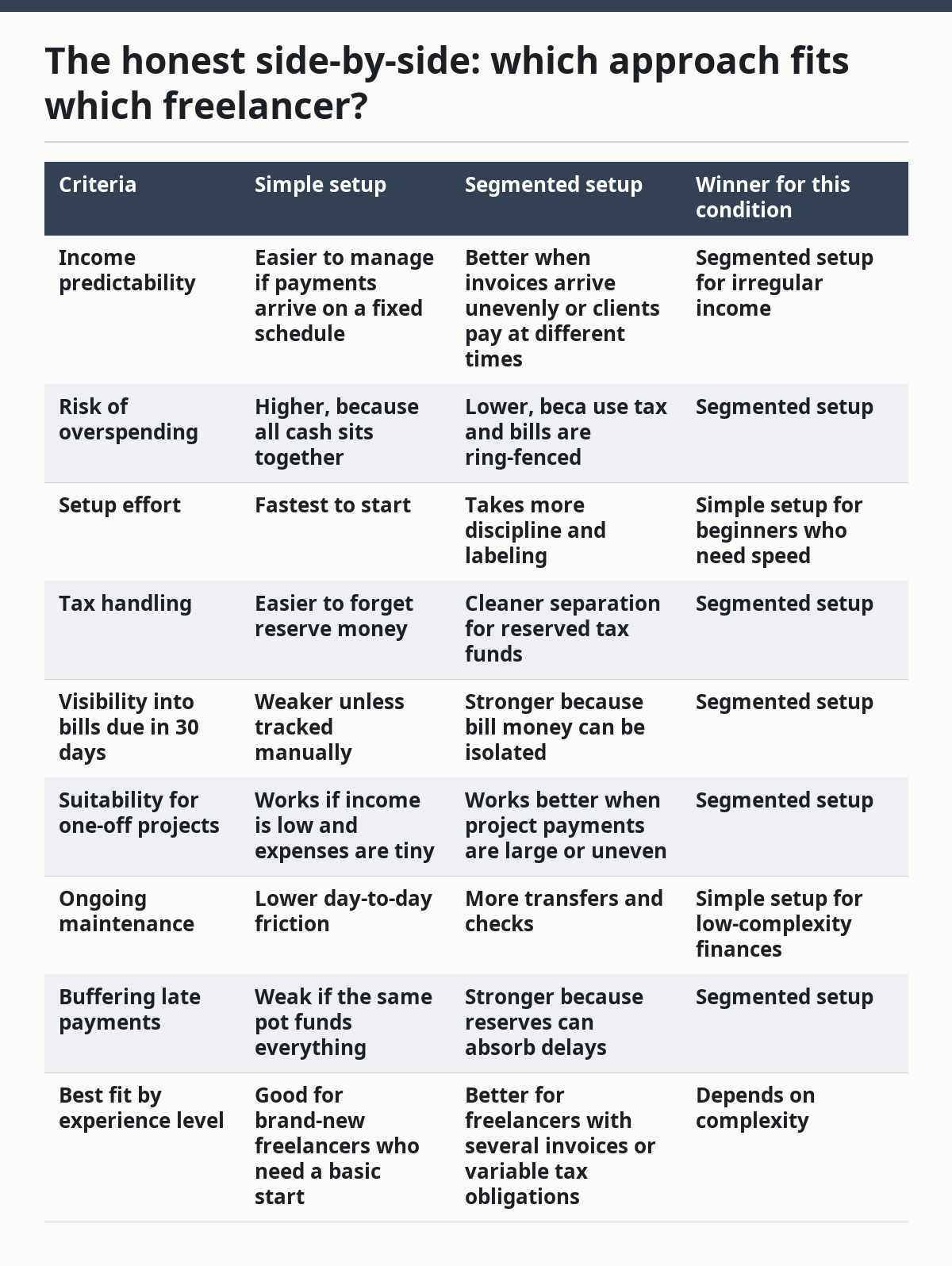
The table makes the main trade-off clear. Simpler is easier; segmented is safer. If your income is small, steady, and almost boring, the extra structure may not be necessary. If your income arrives in chunks, the extra structure is not optional for long-term control.
One number worth remembering is 30 days: that is the time window in which many payment and bill mismatches show up. A system that cannot tell you what is due in the next 30 days is missing the point.
Exception scenarios: when the overall verdict flips
The usual advice flips in a few specific cases. If your expenses are extremely low and your income lands on a fixed monthly retainer, a simple setup can be enough because the timing problem is mild.
If you are carrying high-interest debt, the priority may shift toward paying that debt down while still keeping tax money reserved. In that case, a large cash buffer is not the first target; avoiding interest may matter more, but only if the required minimum reserves are still protected. A debt adviser or qualified financial professional should review the trade-offs.
If you are new to freelancing and have only one or two clients, overengineering the system can backfire. A 5-bucket framework may look smart and still fail if you do not use it. Start simple enough that you can operate it in 10 minutes a week, then add structure after the first few payment cycles.
If you are in a country with irregular estimated tax rules, VAT or GST obligations, or mandatory contribution deadlines, the tax bucket becomes non-negotiable. The exact dates and thresholds differ by jurisdiction, so local guidance matters. A missed deadline can create penalties that have nothing to do with how good your work is.
If your client base is concentrated in one large payer, the risk is dependence, not budgeting technique. One late payment from a major client can distort the whole month. In that scenario, cash flow management needs to include invoicing terms, deposit timing, and backup reserves, not just budgeting software.
The verdict: which system should you use?
Choose the segmented setup if your income changes from month to month, you pay tax from the same receipts that fund your living costs, or you have annual and quarterly bills that arrive out of step with client payments. Choose the simple setup if your freelance income is small, steady, and easy to cover with one monthly balance. Neither if your current spending only works when every invoice clears on time; that is a cash-flow problem, not a budgeting problem.
The reason for that call is practical. Segmentation protects you from your own optimism, and freelancers need that more than they need elegance. A simple setup can still work, but only when the timing of money is calm enough that one pool can safely do several jobs.
The most useful rule is still the plainest one: live on cleared cash, not expected cash. If you do that, budget from the low end, reserve for tax immediately, and keep a cash buffer that can absorb a late payment without forcing a scramble.
What should I do first if I get paid irregularly?
Start by listing your fixed monthly costs and your next known tax or annual bill. Then compare those obligations with your lowest reliable monthly income, not your best month. If the gap is negative, reduce spending or increase income before trying to refine the budget.
How much should I keep aside for tax?
Use the rate that applies to your country, legal structure, and income level, and confirm it with a qualified tax adviser or official guidance. There is no universal percentage that is correct for every freelancer. The safe habit is to reserve the tax portion from every payment before you count the rest as spendable.
Do I need a separate savings account for emergencies?
A separate place for emergency money is useful, but the first priority is usually a buffer for regular freelance timing gaps. If late invoices are your main issue, a payment buffer matters more than a distant emergency reserve. Once the buffer is stable, build the deeper fund.
What if a client pays late and I cannot cover bills?
Cover essentials first, contact the client for a clear payment date, and pause discretionary spending right away. If the shortfall is severe or recurring, review your pricing, payment terms, and reserve system. A professional adviser can help if debt or tax deadlines are at risk.
Is budgeting software necessary for freelancers?
No. A spreadsheet, a notebook, or a simple bank-bucket system can work if you update it regularly. Software helps if you have many invoices, multiple revenue streams, or trouble remembering due dates, but the tool matters less than the habit of reviewing cash weekly.
Drafted with AI; not yet reviewed by a person.
