
Last updated: November 19, 2026
Quick Answer: To send an international freelance invoice correctly, use 7 required details: your legal name, the client’s legal name, invoice number, issue date, due date, one currency, and the exact payment instructions. This article on How to Send International Freelance Invoices shows how to do that without delaying payment.
An international invoice is the document you send when a client in another country needs to pay you for freelance work. To send one correctly, include the right currency, payment details, tax identifiers, and a clear note about cross-border fees before you email it. For How to Send International Freelance Invoices, the goal is simple: make the payment obvious and make the record easy for finance to approve.
Key takeaways
- Use a normal invoice format, but make the payment section much more precise than you would for a local client.
- Put the client’s legal name, your legal name, invoice number, issue date, due date, currency, and payment instructions on the page.
- Add bank details that match the payment rail you want to receive: SWIFT/BIC and IBAN for bank transfer, or the exact PayPal or Wise account details if that is how you are being paid.
- State who covers transfer fees and what happens if the client sends the wrong currency or short-pays the invoice.
- If tax numbers, VAT, or withholding rules are unclear for a specific country pair, check with a qualified tax professional before the invoice goes out.
What you need before you send the invoice
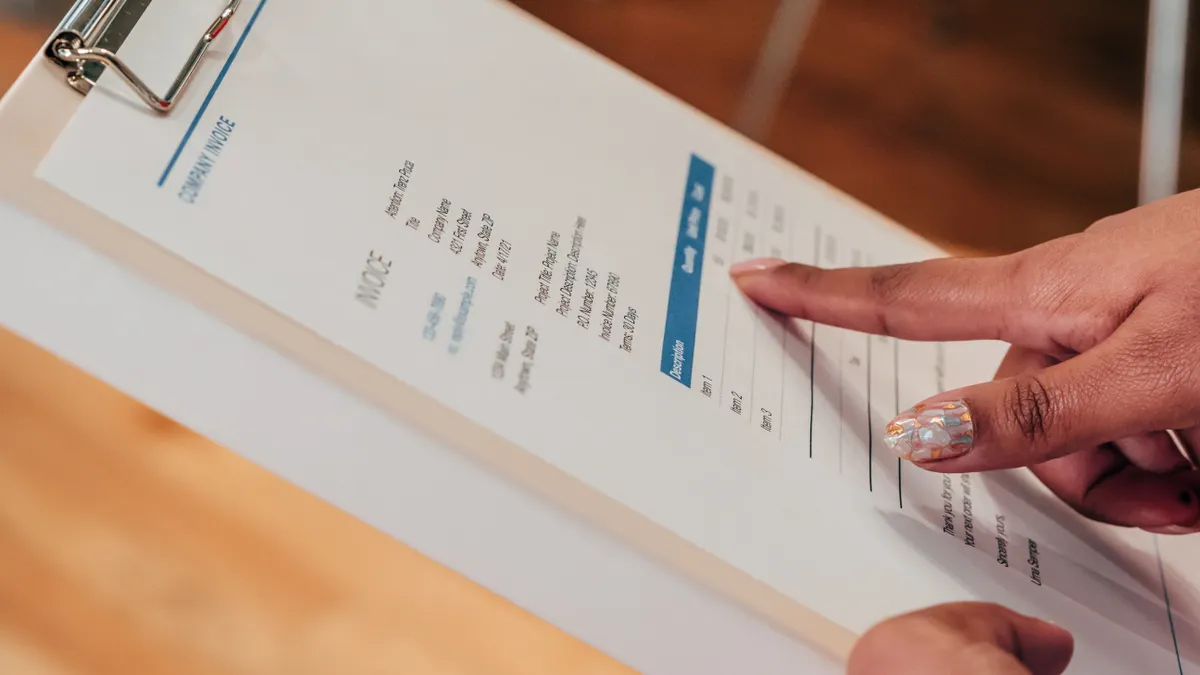
You need the client’s legal billing name, the agreed project amount, the currency, the due date, and the payment method details before you export or email the invoice. A clean international invoice usually takes about 10 minutes to prepare once those items are ready.
If you are missing even one detail, stop and get it before sending. The most common fixable error is a payment section that looks complete but leaves the client guessing which bank rail to use or which currency to send. That guess can cost a week of delay.
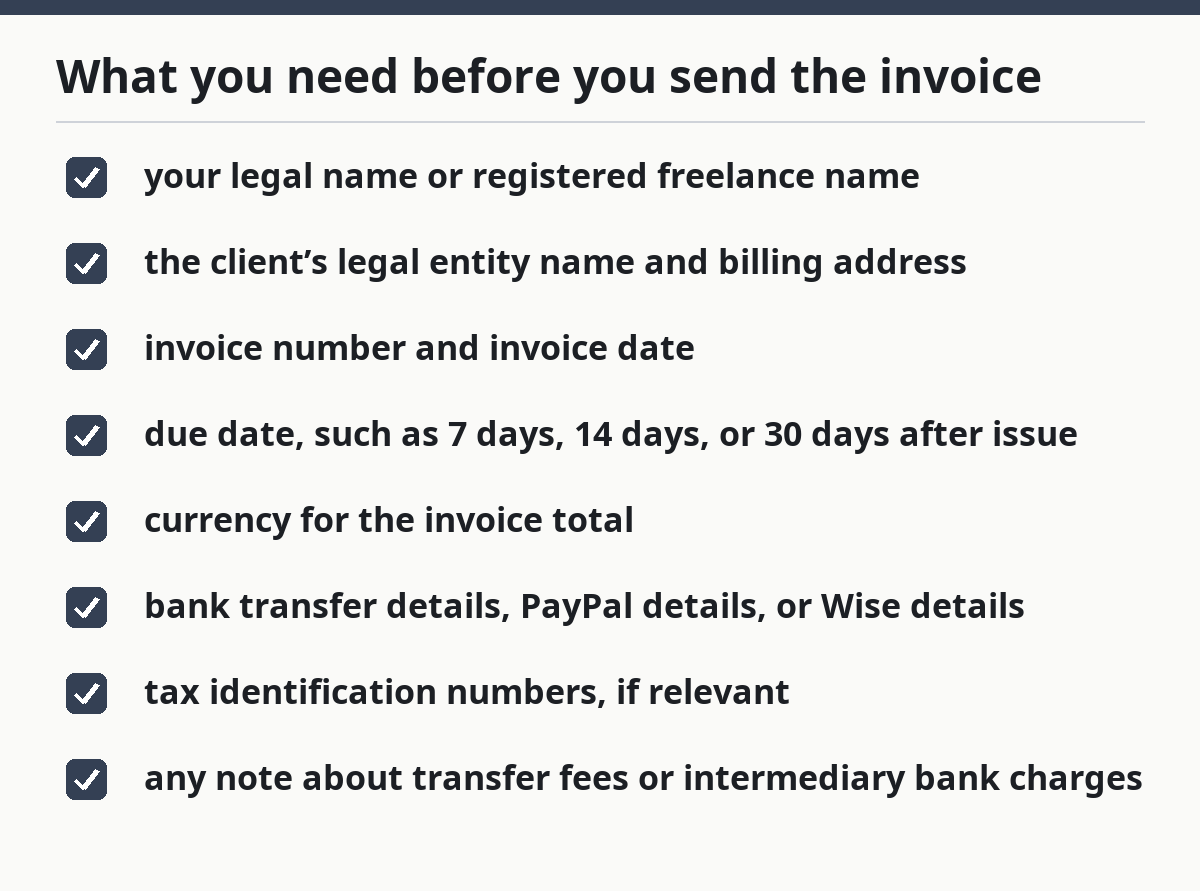
Have these items ready:
- your legal name or registered freelance name
- the client’s legal entity name and billing address
- invoice number and invoice date
- due date, such as 7 days, 14 days, or 30 days after issue
- currency for the invoice total
- bank transfer details, PayPal details, or Wise details
- tax identification numbers, if relevant
- any note about transfer fees or intermediary bank charges
For cross-border invoices, the payment details matter more than the layout. A polished header means little if the client has to email back for your SWIFT/BIC or IBAN. That is why the payment block belongs near the top half of the page, not buried at the end.
How do I send an international freelance invoice?
You send an international freelance invoice by preparing a standard invoice, adding cross-border payment details, then emailing or uploading it in the format your client expects. The invoice should show the amount due in one clear currency, the due date, and the exact bank or wallet details needed to pay it.
Use this order:
-
Confirm the agreed price and currency.
Write the amount in the currency you agreed on, such as USD, EUR, GBP, or CAD. The result should be a total that does not need to be converted by the client. If the client pays in another currency, conversion can move the final amount because banks and payment services do not use the same exchange rate. -
Add your invoice details at the top.
Include a unique invoice number, the issue date, and the due date. A simple format like INV-2026-014 is enough if you use it consistently. The client should be able to match the document to the project in one glance. -
List the client’s legal billing name.
Use the company name exactly as it appears on their finance records. “Acme Ltd.” is not the same as “Acme Marketing Team,” and the wrong name can slow approval inside a company with a 2-step payment check. -
Describe the work in plain terms.
Give a short description of the deliverable, the date range, or the milestone. For example: “Copyediting for landing page set, March 2026” or “Logo refresh concept and revision round.” The client should see why the amount is due without opening another file. -
Place your payment instructions in a dedicated block.
This is where you add SWIFT/BIC, IBAN, account number, bank name, account holder name, or digital wallet details. The block should be impossible to miss. If a client has to hunt for the transfer instructions, they often reply instead of paying. -
State fees and payment handling terms.
Add a line such as “Client covers bank transfer fees” or, if needed, a professionally reviewed note such as “Please send the full invoice amount,” with wording confirmed by a qualified accountant or lawyer for the countries involved. This prevents a partial payment from arriving 20 or 40 dollars short. -
Send the invoice in the format the client asked for.
PDF is often used because it preserves layout, but choose the format the client or procurement team requests. Some clients also want a copy pasted into email text or uploaded to their procurement portal, so check their process and, if needed, ask a finance professional how they want it delivered. If they ask for both, send both in the same hour. -
Follow up after the due date if needed.
A short reminder is normal if the payment has not arrived by the agreed date. Keep the same invoice number in the reminder so the finance team can trace it quickly.
That workflow is the core of the process. The invoice is not just a bill; it is a payment instruction sheet. If the client can process it without asking a single follow-up question, you have done the job right.
What payment details go on an international invoice?

An international invoice needs the payment details the client’s finance team can actually use, and that usually means more than a local account number. For a bank transfer, the usual set includes your bank name, account holder name, IBAN, and SWIFT/BIC if the client is outside the same banking region.
For bank transfers, include:
- bank name
- account holder name
- IBAN, if you have one
- SWIFT/BIC
- local account number, if your bank uses it
- bank branch or address only if the client specifically requests it
For PayPal or Wise, include the exact email, username, or receiving detail the service uses. Do not paste a random profile name and assume it will work. A payment can fail simply because the sender used the wrong identifier or chose the wrong currency route.
A strong invoice also says what to do with fees. International transfers often involve at least one intermediary bank or conversion step, and that can reduce the amount you receive. If you want the full agreed amount, say so plainly. A line such as “All transfer and intermediary fees must be paid by the client” is short and hard to misunderstand.
You should also include a reference line if your client’s finance team uses one. Examples include purchase order number, project code, or department code. That one field can save days of internal searching when the client has a 5-person approval chain.
One more detail matters: match the name on the invoice to the name on the receiving method. If the invoice says one name and the bank or payment profile says another, the client may pause payment while they verify it. That is common with sole traders, trade names, and registered entities that differ by a single word.
Should the invoice be in my currency or the client’s currency?
The currency you agreed to in writing is the safest default, and that is often your own currency. If you agree to invoice in the client’s currency instead, spell out the total and the conversion rule before you send the invoice, because the final amount can change with exchange rates and bank fees.
If the client is in the euro area and you quote in EUR, the invoice is easier for them to process. If your bank charges for incoming foreign currency or the client’s finance system only pays invoices in one currency, the client’s currency may be cleaner. The trade-off is simple: client convenience versus predictable receipt value.
A good invoice avoids mixed signals. Do not show one total in USD in the header and another total in EUR in the payment notes unless you are intentionally quoting both and one is clearly labeled as informational. Mixed currency layouts create extra review work and can delay approval by a full payment cycle.
If you choose to invoice in a foreign currency, use one currency as the primary total and keep all support lines consistent with it. The client should not need to do a conversion to know what is due. If you want to protect yourself from exchange-rate movement, agree on the currency before the work starts, not after delivery.
This is one place where a quick clarification with the client pays off. A 2-line email before invoicing can prevent a 2-week delay after invoicing.
How do I write the invoice so clients abroad can read it fast?
You write it in simple invoice language, with labels the client’s finance staff will recognize in 30 seconds. The best version usually uses plain English plus the business terms the client’s country expects, such as “invoice number,” “due date,” “VAT ID,” or “tax number” if those apply.
Keep the wording short and standard:
- Invoice number
- Issue date
- Due date
- Bill to
- Description of services
- Quantity or milestone
- Unit price
- Total due
- Currency
- Payment instructions
- Tax note
Use the client’s preferred business language if they ask for it. Some clients want the invoice in English only; others want bilingual text or a local language heading with English payment details underneath. If you need to do that, keep the payment block identical in both languages so no one has to compare versions to find the same IBAN or SWIFT/BIC.
Tax identifiers belong on the invoice when they are relevant. That can include your VAT number, GST number, or other local tax registration number. If you do not have one, do not invent a placeholder. Leave it out and keep the line clean.
A common mistake is over-explaining. Finance teams do not need a paragraph about the project. They need a page that can be entered into their system without interpretation. A one-line service description and a total are usually enough unless the contract says otherwise.
If you work across borders often, keep a reusable invoice template with fixed sections and just swap the figures and dates. That saves time and reduces formatting mistakes on every new invoice.
What mistakes cause cross-border invoice delays?
The biggest delays come from missing bank details, unclear currency, and tax fields that do not match the client’s records. Each mistake costs time because someone on the client side has to stop, ask a question, or re-enter the invoice. Even a single missing SWIFT/BIC can push payment to the next processing run.
Common errors include:
- no IBAN on an invoice that needs one
- wrong SWIFT/BIC
- invoice total shown in two currencies without a clear primary one
- client legal name missing or abbreviated incorrectly
- no due date
- no tax identification number where one is required
- payment notes that do not say who pays transfer fees
- invoice sent as an editable file instead of a PDF
The fix is straightforward: standardize your invoice template and review the payment block before every send. A 60-second check can catch a wrong digit in an IBAN or a currency mismatch between the invoice header and the payment section.
One limitation to be honest about: not every cross-border payment problem is on the invoice. Some delays come from the client’s internal approval process, bank cut-off times, or compliance checks. Still, a clean invoice removes the avoidable part of the delay.
If you work with clients in several countries, keep a note beside each client with the exact payment details they use. That way you do not rely on memory when an invoice is due on the 15th and the finance person asks for the same reference again.
For a broader look at how freelance income is organized across the whole process, link this page to the hub on freelance income and payment operations.
Where can I check the payment format before I send it?
You can check the payment format against your bank’s instructions and the rules of the payment rail you are using. For international bank details, SWIFT says the BIC identifies the financial institution, while IBAN is the standardized account format used in many countries; that is the structure your invoice should mirror. See the SWIFT organization’s BIC information and the IBAN registry used in many regions for the current format names. For payment methods and reference details, see the payment guidance from your bank and the provider’s own help pages.
If you use PayPal or Wise, check the exact recipient detail those services ask for before you copy anything onto the invoice. The invoice should repeat the destination information exactly as the client will enter it. Check official guidance before sending, because names, spacing, or characters can require manual review.
A practical final check is to read the invoice as if you were the sender. Could you pay it in under 2 minutes without asking a follow-up question? If the answer is no, the client will probably need help too.
Do not send a cross-border invoice with guessed banking data. A wrong digit or an incomplete field is enough to break the transfer. If the receiving details are uncertain, confirm them first, then issue the invoice once.
Should I invoice in my currency or the client’s currency?
Invoice in the currency you agreed to in writing, and choose the client’s currency only if both sides want the same result. The main issue is predictability: exchange rates and bank fees can change what you actually receive if the invoice is issued in a currency you did not plan for. If the amount is sensitive, confirm the currency before sending.
What payment details go on an international invoice?
Include the payment details the client can use without asking follow-up questions. For a bank transfer, that usually means bank name, account holder name, IBAN, and SWIFT/BIC; for PayPal or Wise, include the exact receiving identifier those services require. Add a reference number if the client’s finance team uses one.
How do I avoid mistakes on cross-border invoices?
Use one standard template and check the currency, client name, invoice number, due date, and payment block before you send it. A missing IBAN, wrong SWIFT/BIC, or vague fee note can delay payment by days. Reading the invoice once from top to bottom usually catches the error that causes the hold.
Drafted with AI; not yet reviewed by a person.
