
Last updated: November 19, 2026
Key Takeaways
- Keep your first reminder brief and send it 1 to 3 business days after the due date.
- Ask for one next action in your late payment email: pay, confirm a date, or explain the delay.
- Only charge a late fee if the contract allows it and the invoice is past due under those terms.
A late freelance payment needs a calm follow-up, a written record, and a clear next step if the client still does not pay. This guide to How to Handle a Late Freelance Payment Step by Step starts with a short reminder, then escalates in writing, then enforces the late fee clause in your client contract if you have one. The steps below settle what to send, when to wait, and when to stop chasing politely.
What to do first when an invoice is overdue
Picture this: you’ve finished the work, sent the invoice, and the due date has passed with no payment in sight. You don’t need a long speech. You need a clean overdue invoice process that starts with the facts on the page: invoice number, due date, amount, and the contact who handles payment.
Therefore, the first move is simple: check whether the invoice was delivered to the right person and whether the terms on the invoice match the client contract. If the invoice says net 15 and the contract says net 30, fix that mismatch before you argue about timing. If the invoice was sent to a project manager instead of accounts receivable, resend it to the right inbox the same day.
Use this quick check before you send a reminder:
- Confirm the invoice number and due date.
- Re-read the client contract for payment terms and any late fee clause.
- Confirm the amount due matches the work delivered.
- Check whether the client has a known approval or payables process.
- Save the sent copy, the PDF, and any email receipt.
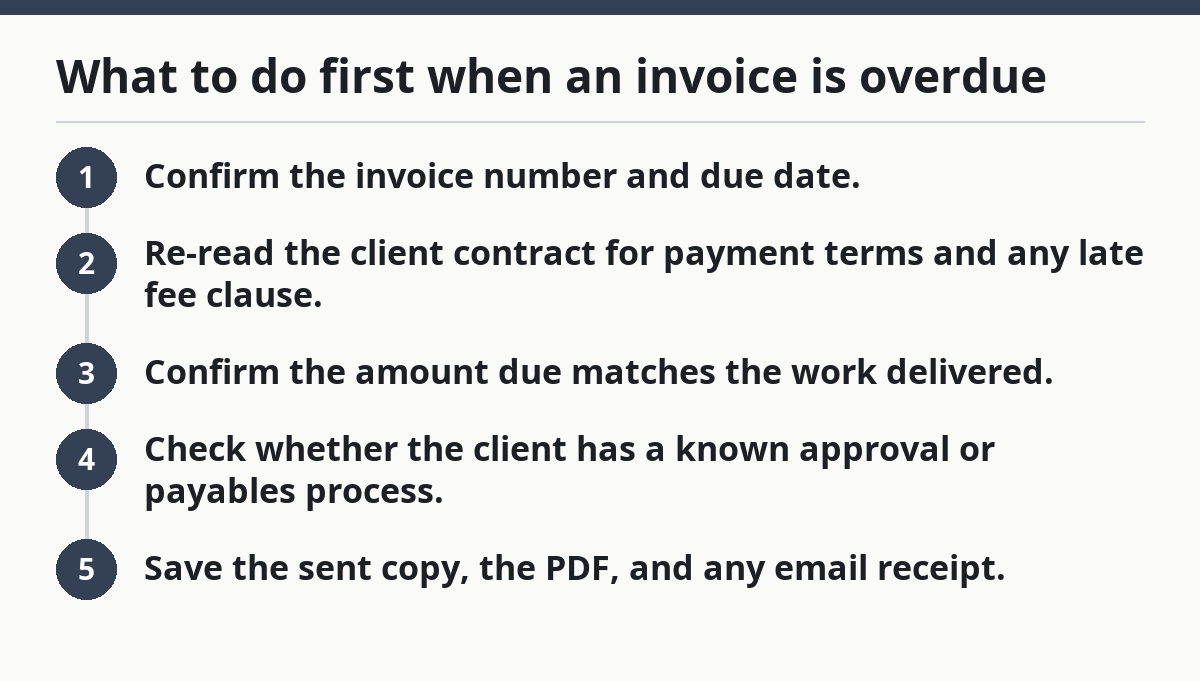
If all five line up, you have enough to move forward.
A clean record matters because late payment problems often turn into “I never got it” or “We were waiting on approval.” A neat paper trail stops that excuse from dragging on for 30 days. It also makes collections escalation easier later, because you can point to dates, not feelings.
How to send the first payment reminder
Send the first payment reminder within 1 to 3 business days after the due date, and keep it short enough to read on a phone. The goal is not to threaten the client. The goal is to make it easy for them to pay the invoice now.
Start with the basics: invoice number, amount due, original due date, and a direct request for payment status. If the client uses accounts receivable, copy the address they gave for billing questions. If they have a payables portal, mention that you are happy to re-upload the invoice there.
A good reminder has four parts:
- A one-line subject such as “Invoice 2048 past due”
- The invoice number and amount
- The due date that passed
- A plain request: “Please confirm payment status or send the payment date”
Keep the tone firm and neutral. Avoid sarcasm, guilt, or long backstory. A reminder is not a diary entry. It is a service message.
You can also add one sentence that points to the next step: “If there is a problem with the invoice, reply today and I’ll fix it.” That gives the client one clean path forward. It often works better than asking “What happened?” which can invite silence.
Here’s the catch: if the first reminder gets a vague reply like “I’m checking,” ask for a specific payment date. A date is useful. A feeling is not. If the client cannot give one, move to the second reminder in 3 to 5 days.
How do you write a late payment email that gets a reply?
Write a late payment email that asks for one clear action: pay, confirm the date, or explain the hold-up. The strongest version is usually under 120 words and includes the invoice number, the overdue amount, and the exact date it was due.
A practical format looks like this:
- Subject: Invoice [number] past due
- Opening line: “Hi [name], I’m following up on invoice [number] for [amount], which was due on [date].”
- Middle line: “Please send payment or confirm the date it will be paid.”
- Closing line: “If you need the invoice resent, I can send it again today.”
If the client says they “missed it,” answer with the invoice attached again and one sentence that restates the amount due. If they say the approver is away, ask who is covering the approval. If they say the bill is wrong, ask them to name the line item and put the dispute in writing.
Use these rules so the email does its job:
- Send it from the same email address already on file.
- Attach the PDF again.
- Keep the subject line identical or very close.
- Ask one question only.
- Save the sent email in your records.
A short email is easier to forward inside a company, which helps when the person you are chasing is not the one who writes checks. That matters more than sounding polite. Polite is fine. Clear wins payment.
When should you add a late fee?
Add a late fee when your client contract already allows it, and only after the invoice is past due by the time stated in that contract. If the contract says a fee starts after 10 days late, do not invent a different timeline because you are frustrated.
The late fee clause is there to back up the invoice, not to start a fight. If you want to use it, quote the clause in the reminder and show the math clearly. For example: “Per our agreement, a late fee applies after 10 days past due. As of today, the balance due is [amount].” Keep the wording plain and factual.
Some freelancers skip the fee even when the contract allows it. That can be the right move if the client is valuable and the delay is short. It can also be a bad move if the client is ignoring every message and using silence as a payment strategy. The clause only works if you use it.
Here’s what to watch for:
- If the contract has no late fee clause, don’t add one after the fact.
- If the contract gives a grace period, count it exactly.
- If the fee makes the total unclear, show the original balance and the added charge separately.
- If the client disputes the fee, point back to the signed agreement.
The truth is, a late fee is a tool, not a threat. Used early and cleanly, it often gets attention. Used late and sloppily, it just gives the client another reason to stall.
What if the client keeps delaying payment?
Escalate after 2 to 3 reminders if the client keeps delaying payment and still offers no firm date. That is the point where a polite chase becomes a collections issue, not a customer service issue.
Start by moving the conversation up one level. If you were talking to a project lead, contact billing or accounts receivable. If you were already talking to billing, ask for the manager who handles overdue invoices. Keep the message short and factual: the invoice number, the amount, the dates you contacted them, and the response you received.
If the client says “we’re waiting on approval” for a second or third time, ask for the approver’s name and the date the approval will happen. If they say “the system is down,” ask when the next processing run is scheduled. Vague delays should get a specific date back.
Use this escalation ladder:
- First reminder: 1 to 3 business days after due date.
- Second reminder: 3 to 5 days after the first reminder.
- Escalation email: after 2 to 3 unanswered reminders.
- Formal notice: if the contract or local rules require one before collections.
- Collections step: only if you are prepared to pursue it and the amount justifies the effort.
Therefore, this is also the time to stop talking on the phone unless you follow up in writing. A phone call can be useful, but a written note is what protects you. After any call, send a short email that repeats the date promised and the amount owed.
On the flip side, do not blast the client with daily messages. That usually burns goodwill without speeding payment. A spaced follow-up sequence shows that you are serious and organized, not desperate.
How to keep records so the next step is easy
Keep a single file for the overdue invoice so you can prove the timeline in under 5 minutes. If you ever need collections escalation, a dispute log, or a contract review, the file is what saves time.
Your recordkeeping should include:
- The original invoice PDF
- The client contract or signed terms
- The date the invoice was sent
- Each reminder email
- Any reply with a promised payment date
- Notes from calls, with date and time
- Proof of delivery if you have it
Put the documents in one folder with a simple name like “ClientName_Invoice2048_PastDue.” That sounds boring. Good. Boring files are easier to find when someone asks for them two months later.
A clean record also helps you spot patterns. If the same client always pays 20 days late, the problem is not random. It is part of how they operate. That matters when you decide whether to keep working with them, require a deposit, or tighten your payment terms on the next job.
The best part is that good records make your reminders shorter. Instead of rewriting the full story every time, you can say, “I’ve attached the invoice, the original due date, and my earlier messages.” That sentence is hard to argue with.
When should you stop chasing and use collections?
Use collections only after the reminder sequence has failed and the balance is large enough to justify the cost, time, and damage to the relationship. For a small invoice, a collections step can cost more than the money you recover.
Before you go that far, review the client contract and any late fee clause one more time. If the agreement says the client must pay collection costs, keep that language ready. If it does not, do not assume you can add them later. If the invoice is tied to a larger project, check whether there is a final delivery file or usage right you still control under the contract.
A practical final warning signs list looks like this:
- The client ignores 2 to 3 written reminders.
- They stop answering after promising a date.
- They challenge the invoice only after repeated follow-up.
- They keep asking for more work while the past due balance sits unpaid.
That last one is a hard no. Do not pile new work on top of an unpaid invoice unless you are willing to repeat this cycle. It usually gets worse, not better.
If the amount is meaningful, the agreement is clear, and the client still will not pay, that is when collections escalation becomes a business decision rather than a patience test. At that point, the clean file you built earlier is what gives you options. For more on protecting payment terms, see the freelance contracts guide and invoice payment terms article.
This article sits inside the larger freelance income and payment operations system, where invoice timing, payment follow-up, and cash flow all connect. Handle one overdue bill well, and the next one gets easier. For related guidance, you can also review the freelance pricing guide.
When should I send a late payment reminder?
Send the first reminder 1 to 3 business days after the due date. That timing is early enough to catch a missed approval or a lost invoice, but not so early that you look impatient. If the client is known for slow payables, keep the tone firm and ask for a payment date right away.
Can freelancers charge late fees?
Yes, if the client contract already allows it. The fee should match the agreement, not your mood on the day the invoice goes overdue. If there is no clause, do not add one after the fact. Put the original balance and the fee on separate lines so the client can see the math.
What do I do if a client ignores invoices?
Escalate in writing after 2 to 3 reminders, then move the issue to the client’s billing contact or manager. Keep every email, note every call, and restate the invoice number, amount, and due date each time. If the client still ignores you, decide whether collections makes sense for the amount owed.
Sources
Drafted with AI; not yet reviewed by a person.
