
Last updated: November 19, 2026
Quick Answer: A single-member LLC operating agreement gives one freelancer a dated record of ownership and management, and it can be drafted in about 1 page.
In How Freelancers Set Up an Operating Agreement for a Single-Member LLC, the goal is to create the paper trail that shows you own the LLC and how it is run.
It helps with banking paperwork, ownership records, and state-law recognition without turning this page into formation filing or tax choices.
The steps below show what to gather, what to write, and what a bank or other third party should be able to see when it’s done.
Key Takeaways
- It is a short record that shows who owns the LLC and how it is managed.
- Gather the legal name, formation state, your name, and the effective date.
- Name the LLC, state that you are the only member, set the management rule, and sign it.
- The ownership and management sections should clearly show one owner and one person with authority.
What a single-member LLC operating agreement is for
A single-member LLC operating agreement is the document that proves you are the member and sets out how the LLC is managed, even when you are the only owner.
Picture this: you’ve filed the LLC already, and now a bank asks for something that shows who can sign, who owns the company, and how the company is managed. That’s where the agreement does its work. It gives the paper trail that a freelancer needs for an LLC bank account, ownership records, and routine admin.
The truth is, a lot of freelancers skip this document because no partner is waiting to argue over terms. That shortcut can cost time later when a bank, payment platform, landlord, or client wants a clean record. The agreement is not about drama; it’s about proof.
Here’s why.
- It identifies the member and the LLC by name.
- It says the LLC is member-managed or manager-managed.
- It shows the member’s authority to sign.
- It helps line up the paperwork a bank wants to see.
- It can help satisfy state law and internal recordkeeping needs.
A generic template often leaves out the part a freelancer actually needs: a clear statement that this is a single-member LLC. That line matters because some forms assume more than one owner unless you say otherwise. Use the full legal name of the LLC, the state of formation, and the date the agreement is signed. For a broader setup overview, see freelance business formation and setup.
What you need first
You need the LLC’s exact legal name, the state of formation, your name as the only member, and the date you want the agreement to take effect.
Picture this: you’re sitting down with the filing confirmation, the LLC name from the state record, and a blank document. At that point, you’re not guessing anymore — you’re just filling in the facts that already exist. That makes the agreement cleaner and easier to use later.
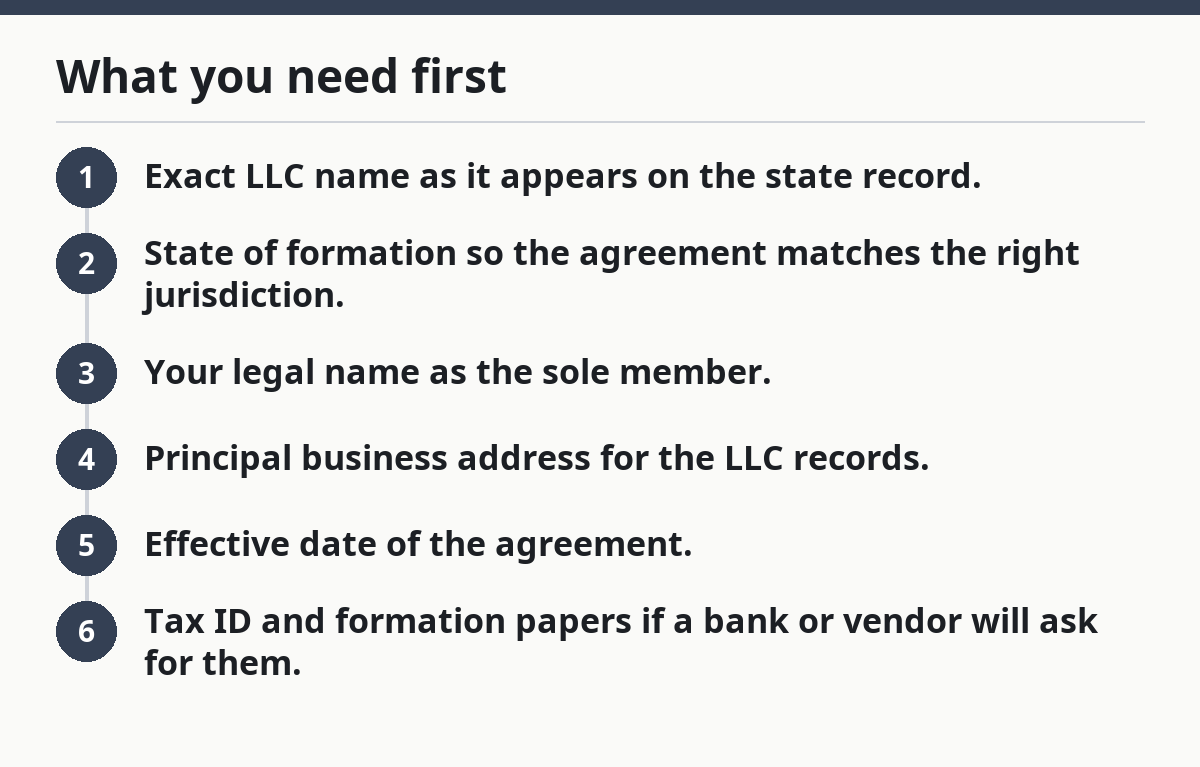
Before you draft anything, gather these items:
- Exact LLC name as it appears on the state record.
- State of formation so the agreement matches the right jurisdiction.
- Your legal name as the sole member.
- Principal business address for the LLC records.
- Effective date of the agreement.
- Tax ID and formation papers if a bank or vendor will ask for them.
The catch is that this document should match the real company, not the version you use on invoices or social media. If your LLC is registered as “North Shore Writing LLC,” don’t shorten it to “North Shore Writing” in the agreement. That kind of mismatch can slow down onboarding at a bank or create questions when you show ownership records.
For state-specific formatting, a quick check of the state law rules or a state filing office page is smart. A lot of states do not require filing this document, but the details still need to fit the state where the LLC exists. If you want a broader setup map, the hub on freelance business formation and setup should sit alongside this page, not replace it. For official guidance, see the IRS page on limited liability company (LLC) and your state filing office.
How to write the operating agreement step by step

You write it by naming the LLC, stating that you are the only member, setting the management rule, and signing a dated copy for your records.
Picture this: you’re drafting a document that may never be filed anywhere, but still has to be precise enough to show ownership and authority. That means every line should do a job. A one-page agreement can work if it includes the right facts and leaves no doubt about who runs the LLC.
- Start with the title and opening clause. Use “Operating Agreement of [LLC Name]” and state the state of formation. When this works, a reader can tell in the first line exactly which LLC the paper belongs to.
- Name the sole member. Identify yourself by full legal name and say you are the only member of the LLC. This should leave no gap for a bank or vendor to wonder who owns the company.
- State the management structure. Say whether the LLC is member-managed or manager-managed. For a freelancer, member-managed is often the simplest wording because the owner handles the work, contracts, and sign-off.
- Describe ownership and authority. Say that 100% of the membership interest belongs to you and that you can sign contracts, open the LLC bank account, and handle routine company matters. The result should be a clear authority trail.
- Cover records and separateness. State that the LLC keeps its own books, records, and assets separate from the member’s personal records. That helps when a third party wants proof that the LLC is a distinct entity.
- Add tax and dissolution language if needed. You can note that the LLC will be taxed under the member’s chosen federal and state treatment and say how the company ends if the member closes it. This keeps the document from feeling half-finished.
- Sign and date the agreement. Sign your name, print it, and add the date. Keep a copy with the formation papers so you can show it quickly when asked.
The best part? You do not need five pages of legal language to make this useful. A short agreement that accurately names the member and the management structure often serves a freelancer better than a long form full of clauses no one will read. Still, don’t cut the essentials. No signature, no date, no proof. For a related setup step, you can also keep your LLC bank account setup paperwork aligned with the same names and dates.
What should the ownership and management sections say?
The ownership section should say that the single-member LLC is owned 100% by one person, and the management section should say who has authority to act for it.
Picture this: you need to hand a clean document to a bank, payment processor, or landlord, and the first thing they look for is who owns the company and who can sign. If those answers are buried or fuzzy, the paper loses its value. Simple language wins here.
Use plain statements like these:
- “The LLC is owned by one member.”
- “The sole member holds 100% of the membership interest.”
- “The LLC is member-managed.”
- “The sole member has authority to enter contracts and open financial accounts in the LLC’s name.”
- “The sole member may appoint a manager if needed.”
Those lines do two jobs at once. They show ownership records and they show control. That matters because a freelancer often needs the agreement to support a banking file, not just a file drawer.
Here’s the catch: do not say the LLC has “partners,” “owners,” or “members” in plural if it doesn’t. A stray plural can make the document look copied from a template and can raise questions during account review. Also avoid vague wording like “the owner may do business as needed.” That’s too soft for a document meant to prove authority.
If your state has a preferred format or your bank gives you a checklist, mirror that language where it doesn’t conflict with the real facts. A clean page with the right names and dates usually beats a fancy template with gaps. For more on the legal distinction between an LLC and its owner, see the SBA’s choose a business structure page.
What do banks and vendors usually want to see?
They usually want a signed agreement, the LLC’s exact legal name, and enough detail to connect the member to the company.
Picture this: you’ve already formed the LLC, and now the bank wants proof that the company is real and that you’re the person allowed to act for it. The operating agreement does not replace formation papers, but it often sits beside them as the ownership document. That is the point of having one.
A typical file may include:
- The signed operating agreement.
- Articles of organization or a state filing confirmation.
- Your EIN notice, if the bank asks for it.
- A government ID for the member.
- Any bank-specific resolution or signature card.
The exact packet varies, but the agreement should answer the basic question: who owns this LLC and who can handle its affairs? If the document says you are the sole member and authorized signer, that’s the heart of it. For related paperwork, a freelancer tax setup checklist can help keep the same business name and EIN details in one place.
Do not stuff the agreement with banking procedures. You are not writing a bank manual. You are giving the company a governance paper that can support a llc bank account application and similar paperwork. If a bank asks for an extra form, fill out the extra form. Keep the operating agreement focused on ownership and authority.
A lot of freelancers also use this document to keep business records tidy for clients, platforms, and future vendors. That is not a filing requirement in every state, but it is a practical paper trail. The cleaner the agreement, the less time you spend explaining the structure later.
Common mistakes that cause delays
The biggest mistakes are using the wrong legal name, leaving out the signature, and copying a multi-member template into a single-member company.
Picture this: you think the document is done, but a reviewer spots a name mismatch or a clause that talks about voting between members. Now the file gets parked while you fix something that should have taken 5 minutes. Small drafting errors create the kind of delays freelancers hate.
Watch for these problems:
- Wrong LLC name. Cost: bank or vendor confusion. Fix: copy the name exactly from the state record.
- No effective date. Cost: uncertainty about when the agreement starts. Fix: add a clear date on the first page or signature page.
- Plural language. Cost: the document looks copied and careless. Fix: replace “members” with “member” where appropriate.
- Missing authority clause. Cost: weak support for account paperwork. Fix: say the sole member may sign and manage the LLC.
- No record copy. Cost: you lose time hunting for proof later. Fix: save a signed PDF and a printed copy.
The truth is, many freelancers make the agreement too fancy. They add pages of clauses about meetings, votes, and transfers that never happen in a one-person company. That does not make the document stronger. It makes it harder to read.
A better move is to keep the agreement short, accurate, and easy to file with your records. If your state or bank requests extra wording, add it. If not, don’t inflate the document just because a template offered you 20 sections. For a related business-record workflow, keep your freelance invoice template aligned with the same company name.
Can I write my own operating agreement?
Yes, you can write your own operating agreement if it is accurate, complete, and matches your state’s rules.
Picture this: you are staring at a blank document and wondering if a template is enough. For many freelancers, the answer is yes — if the template is edited carefully and the final version reflects the real LLC, not a generic example. That said, a sloppy self-drafted agreement can create more trouble than it solves.
A self-written agreement works best when:
- The LLC has one member.
- The management setup is simple.
- No investor, lender, or partner needs custom terms.
- The state does not require unusual clauses.
- You can keep the wording plain and specific.
You may want a professional review if the LLC owns expensive gear, signs larger contracts, or will take in another member later. That is not because the document is exotic. It is because the consequences of bad wording are larger when the company gets bigger.
One practical rule helps: if a sentence does not explain ownership, authority, records, or exit terms, delete it. That keeps the agreement focused on the job it is supposed to do. A freelancer needs a document that proves the structure, not a mini law school outline.
For state recognition, check the filing office guidance or a licensed business attorney in your state if the wording matters for a specific transaction. The page here is about setup, not legal advice, so the safest path is to keep the document factual and simple. If you are still building the business around it, the self-employed business setup guide can sit beside this page without replacing the agreement itself.
Do single-member LLCs need an operating agreement?
They often should have one, even when the state does not force it.
Picture this: you are the only owner, so it feels odd to draft an agreement with yourself. That feeling is common. The document still serves a real purpose because it shows the LLC exists as its own entity and gives a clean record of who controls it.
Why it still helps:
- It documents state recognition of the LLC’s structure.
- It helps separate the LLC from your personal records.
- It supports opening or updating an LLC bank account.
- It clarifies that one member owns and manages the company.
- It gives you a dated record if someone asks how the LLC is run.
The main trade-off is that this document takes a little time now for less friction later. That is usually worth it for freelancers who invoice clients, hold deposits, or sign vendor forms. It is less useful only if the company is dormant and never needs formal paperwork.
If you want the shortest possible version, keep the document to the essentials: name, member, management, authority, records, date, and signature. That is enough for many one-person companies. Anything beyond that should earn its place.
FAQ
Do single-member LLCs need an operating agreement?
They often do, even if the state does not require one.
A single-member LLC operating agreement gives you a written record of ownership and authority. It can help with bank paperwork, company records, and showing that the LLC is separate from the member.
What should an LLC operating agreement include?
It should include the LLC’s legal name, the sole member’s name, the management structure, ownership language, authority to act for the company, and the signature date.
Those details are the core of a useful agreement for a freelancer. If the document leaves out ownership or management, it loses much of its value.
Can I write my own operating agreement?
Yes, many freelancers can write their own if the company is simple and the wording is accurate.
A template can work, but it has to match the LLC, the member, and the state record.
Drafted with AI; not yet reviewed by a person.
