

Last updated: November 20, 2026
Key Takeaways
- An IP clause sets ownership, use, copying, editing, and resale rights for custom work.
- A solid clause names the owner, the transfer point, the granted rights, and any reserved portfolio or reuse rights.
- A copyright assignment is often clearer for custom freelance work, while work made for hire fits narrower cases.
- The clause should spell out client use rights and whether the freelancer may show the work in a portfolio.
Freelancers need an intellectual property clause when custom work will be handed to a client, because ownership does not sort itself out after payment. How Freelancers Write an Intellectual Property Clause for Custom Work is the topic here, and the question is usually settled in one clause. The clause below settles who owns the deliverables, whether copyright transfers, whether the work is licensed, and what happens to portfolio use and source files.
What an intellectual property clause has to decide
An intellectual property clause answers one job: who can own, use, copy, edit, and resell the custom work. If that sounds broad, it is. A clean clause usually has to cover copyright assignment, work made for hire, license terms, and source files in the same paragraph or two.
The catch is that “custom work” can mean different things. A 12-page white paper, a logo file, a photography set, and a software handoff do not need the same rights language. The clause has to match the deliverable, not the mood of the deal.
A direct way to think about it is this:
- Copyright assignment means the freelancer gives up ownership, usually in writing.
- Work made for hire is a specific legal label, and it does not fit every kind of work.
- License means the freelancer keeps ownership but grants use rights.
- Deliverables are the finished items, and sometimes the source files too.
A clause that says only “all rights transfer on payment” is thin. It leaves room for arguments about edits, future reuse, and whether the client got the raw files or just the final PDF. That gap gets expensive.
For freelancers, the real question is not “Can I write something short?” It’s “Can I write something clear enough that the client knows what they’re buying, and I still keep the rights I meant to keep?” The answer is yes, but only if the clause is specific.
How do you write an IP clause for freelance contracts?
You write an IP clause by naming the owner, the transfer point, the exact rights granted, and any rights you keep for portfolio or reuse. That structure turns a vague promise into a usable contract term.
Picture this: you’ve finished a custom deliverable and the client wants the source files, the right to edit the work, and a clean ownership handoff. You need wording that covers all three without giving away more than you intended. A license or assignment can do that, but the clause has to say which one it is.
Therefore, start with the ownership model in the contract draft — assignment, work made for hire, or license — so the clause begins with the right legal structure.
Then name the deliverables in the statement of work or exhibit, so the clause only covers the actual custom work and not every draft or unrelated file.
Next, state when rights move — for example, on full payment, on delivery, or on signing — so the transfer point is not left to argument.
Then list the rights included, such as use, reproduction, editing, adaptation, publication, and sublicensing, so the client knows the scope of use.
Finally, reserve what you keep, like pre-existing tools, templates, code snippets, and portfolio display rights, so you do not accidentally assign more than you own.
A solid clause is plain enough to read once and still hold up in a real handoff. It should not force the reader to guess whether the client got ownership, a limited license, or only the final export.
A short clause can work well after the scope of work, as long as the rights are named cleanly. A 2-sentence clause can be enough for simple writing work. A complex brand or software project may need more detail.
Should you use work made for hire or a copyright assignment?

A copyright assignment is usually the safer, clearer choice for custom freelance work, while work made for hire only fits in narrower situations. That difference matters because the words are not interchangeable.
The truth is, many freelancers see “work made for hire” in a template and assume it means the client owns the work automatically. That can be risky. In the U.S. system, that phrase has a specific meaning, and it does not apply to every freelance job just because both sides wrote it down. If the work does not fit the rule, the label alone may not do the job.
A copyright assignment is simpler to understand. It says the freelancer transfers ownership of the copyright to the client, usually after payment or delivery. If the clause says that in clear words, there is less room for confusion.
Use this decision rule:
- Use assignment when the client wants ownership and the deliverable is a custom piece you are willing to transfer.
- Use license when you want to keep ownership but let the client use the work in a defined way.
- Use work made for hire only when the deal truly fits that setup and the contract language matches the legal standard.
Now, you might be wondering whether a clause can include both a work-made-for-hire statement and an assignment fallback. It often can. That is common in contract drafting, because the fallback helps if the first label does not stick. The clause usually says the work is made for hire to the extent allowed, and if not, the rights are assigned anyway.
That backup language is not decoration. It closes a hole. A contract that depends on only one label can leave ownership unclear if the label does not apply.
What should the clause say about usage rights and portfolio use?
The clause should say exactly what the client can do with the work and whether you can show it in your portfolio. Those are separate rights, and mixing them up causes most of the headache.
Picture this: the client needs broad use rights for a brochure, but you still want to show the finished piece on your website after launch. A clause can handle that split. A license can grant broad use while still reserving a limited portfolio right. An assignment can do the same if the clause says so.
A good clause answers these usage questions:
- Can the client reproduce the work in print and digital form?
- Can the client edit, crop, translate, or adapt it?
- Can the client sublicense it to affiliates, printers, or platform vendors?
- Can the client claim exclusive rights, or only use rights?
- Can the freelancer display the work in a portfolio after public release?
If you do not say yes or no, someone will assume the answer that favors them.
The portfolio piece deserves special handling. Some freelancers reserve the right to show the final work, a cropped image, or a low-resolution sample after the work has gone live. Others agree to wait until publication or to ask before posting. A clause can handle either approach, but it should not be vague.
One useful line is the timing. If the client wants an embargo, the clause can say no public display before launch or within a set period after delivery. A 30-day wait is common in practice, but the exact timing is negotiable. If no waiting period is stated, the dispute usually comes later, when the work is already online.
How do source files fit into an IP clause?
Source files need their own sentence because the final deliverable and the editable working file are not the same thing. A PDF, a flattened image, a layered design file, and a native code file each carry different value.
The catch is that many freelancers hand over the final product but keep the working files unless the contract says otherwise. That is a normal business choice. The clause should say whether source files are included, excluded, or available for an extra fee.
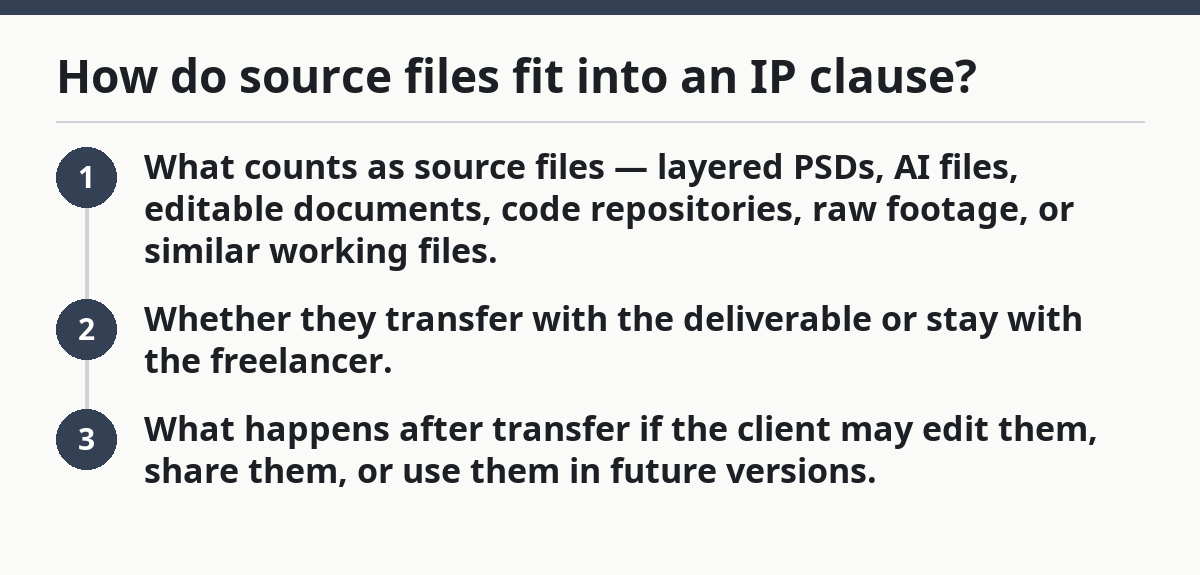
A clear source-file line usually covers three points:
- What counts as source files — layered PSDs, AI files, editable documents, code repositories, raw footage, or similar working files.
- Whether they transfer with the deliverable or stay with the freelancer.
- What happens after transfer if the client may edit them, share them, or use them in future versions.
This matters because source files can expose your process, templates, and reusable pieces. If the contract gives them away without saying so, you may lose more than the final work. If the contract keeps them back but the client expected editable files, trust can break fast.
A good middle ground is to separate the final deliverable from the source files in both the scope and the IP clause. Then state the handoff plainly. For example, the client receives the final export and, if agreed, the editable file format listed in the contract. If not, the clause says the source files remain the freelancer’s property.
That is a clean boundary.
A simple clause template you can adapt
A short clause is better than a fancy one if it says the right things. The exact wording should match the deal, but the structure below gives you a usable model for custom work.
Picture this: you need a clause for a logo, article, deck, or website asset, and you want language that covers ownership without turning into a wall of text. Keep the sentence order tight and the rights list specific.
Use this model as a base:
Upon full payment, freelancer assigns to client all copyright and related rights in the final deliverables created specifically for this project, except for freelancer’s pre-existing materials, tools, and templates. To the extent any deliverable cannot be assigned as work made for hire, freelancer assigns all transferable rights to client. Client may use, reproduce, modify, publish, and distribute the deliverables for its business purposes. Freelancer may display the final work in a portfolio or case study after public release, unless the parties agree otherwise in writing. Source files are included only if the contract states that they are part of the deliverables.
That can be written more than one way, but it covers the main points. A 5-line clause can do real work if it names assignment, fallback language, usage rights, portfolio rights, and source files.
Here’s what not to do:
- Do not say “all rights” without naming what rights are included.
- Do not use “work made for hire” as the only ownership sentence.
- Do not forget to reserve pre-existing tools and templates.
- Do not promise source files unless you mean to hand them over.
- Do not leave portfolio rights implied.
If the job is highly technical, a lawyer should review the clause. This page gives a drafting framework, not legal advice. Contract law can turn on small wording choices, and the right structure depends on the project and jurisdiction.
Common mistakes that make IP clauses weak
A weak clause usually fails because it tries to be short in the wrong places. The sentence gets shorter, but the risk gets bigger. That is the trade-off.
One common mistake is using a broad phrase like “client owns everything” when the freelancer has reused a template, a stock element, or a prebuilt tool. That can create a false transfer. The fix is to separate custom deliverables from pre-existing materials and state the reservation in plain language.
Another mistake is forgetting the trigger date. If the clause never says when ownership moves, payment and delivery can get tangled. A clause that transfers rights only after full payment gives the freelancer leverage. A clause that transfers on signing gives the client more certainty. Pick one.
A third mistake is ignoring the license-versus-assignment choice. If the client only needs to publish the work, a license may be enough. If the client wants exclusive ownership, an assignment may be the better fit. Mixing both ideas in one muddy sentence leaves the deal open to argument.
Here’s a quick check before you send the draft:
- Is the deliverable named?
- Is the ownership model named?
- Is the transfer trigger named?
- Are portfolio rights named?
- Are source files named?
For broader contract structure, this page sits inside the freelancer contracts and client policies hub, where the rest of the agreement can be built around the IP language instead of against it.
FAQ
Who owns freelance work after payment?
Ownership depends on the contract, not the invoice. If the clause assigns copyright or uses a valid work-made-for-hire setup, the client may own the work after payment. If the contract only grants a license, the freelancer usually keeps ownership and the client gets use rights.
Should I transfer copyright or license the work?
A transfer fits when the client wants ownership and full control of the custom deliverable. A license fits when you want to keep copyright and still give the client the right to use the work in a defined way. For many freelancers, the cleaner choice depends on whether the work is one-off or meant for future reuse.
What should an IP clause say in a freelance contract?
It should say who owns the work, when rights move, what rights the client gets, whether source files are included, and whether the freelancer can show the work in a portfolio. If the clause leaves out any of those points, it usually leaves room for disagreement later.
Drafted with AI; not yet reviewed by a person.
