

Last updated: November 20, 2026
Quick Answer: a freelancer can draft a workable non-compete and non-solicitation clause in 5 narrow parts: restricted activity, restricted clients or contacts, time limit, governing law, and carve-outs. A freelancer writes a non-compete and non-solicitation clause that holds up by keeping it narrow, tied to a real client need, and shaped to the right jurisdiction. The draft should limit time, scope, and the people covered, then pair the non-compete with a tighter non-solicitation clause inside the independent contractor agreement.
Key takeaways
- A broad ban can make the clause brittle.
- The clause works better when it protects a specific client asset, not a vague fear of competition.
- Non-solicitation is usually the cleaner restriction; non-compete is the harder one to justify.
- Jurisdiction matters as much as wording, because enforceability changes by place.
- A freelancer who writes for a 12-month global block is asking for trouble.
What does this clause need to do?
This clause needs to protect a client’s real business interest without turning the freelancer into an employee in all but name. A one-page add-on can do that if it names the restricted activity, the restricted client group, and the time limit in months, not vague language that reaches forever.
A generic clause fails because it tries to stop too much. If it says the freelancer cannot work “in the same industry” for 24 months, it can swallow ordinary freelance work and look punitive rather than protective. A tighter clause aims at one client relationship, one type of work, or one named market segment.
The cleaner move is to treat the non-compete as the narrowest tool in the box; if the draft is uncertain, a lawyer or contract professional should review it, and the FTC’s rulemaking on noncompetes is a useful source for context. The non-solicitation clause often does the real work: it bars the freelancer from directly poaching named clients, prospects, or staff for a set period, often 6 to 12 months in contract drafting practice. That is easier to defend than a total ban on future work.
This is also where employee-style restrictions cause trouble. If the clause reads like a staff handbook rule, the agreement starts to look like an employment contract instead of an independent contractor agreement. That shift can matter when a dispute lands in court or before a reviewer in a specific jurisdiction.
How do I draft the clause step by step?
You draft it by starting with the business risk, then trimming the language until only the risk remains. The steps below keep the clause focused enough to survive review in many common contract settings, while leaving room for a lawyer to adapt it to the right jurisdiction.
- Name the exact client interest in the independent contractor agreement, such as client lists, active accounts, or confidential campaign plans, so the clause protects a real asset rather than “competition” in general.
- Limit the restricted work to a defined category, such as work for a direct competitor or work that uses the same confidential material, and keep the category to one narrow line of business.
- Set the time period in months, not years, so the clause reads as a temporary protection instead of a permanent restraint.
- Define the people covered by the non-solicitation clause, such as named clients, recent prospects, or team members the freelancer met through the project.
- Add the jurisdiction clause so the agreement points to one governing legal system instead of leaving the dispute to guesswork.
- Check the language for overlap, because a non-compete and non-solicitation clause that repeat each other can look broader than needed.
A useful draft gives the reader three things in one glance: who is covered, what activity is blocked, and for how long. If any of those is missing, the clause starts to wobble. A 2-year blanket bar may sound strong, but it often creates more enforceability risk than protection.
The better version also uses clear verbs. “Solicit,” “hire,” “induce,” and “perform” tell a court or reviewer something concrete. Words like “interfere with business relationships” can be too loose unless the rest of the clause pins them down.
What belongs in a non-compete and non-solicitation clause?
A workable clause belongs in the same document as the rest of the freelancer terms, and it should stay close to 5 parts. Those parts are the restricted activity, the restricted clients or contacts, the time limit, the jurisdiction, and the carve-outs for work that does not touch the protected interest.
Here is a simple structure that fits an independent contractor agreement without turning it into a wall of text:
| Clause piece | What it does | What to keep narrow |
|---|---|---|
| Restricted activity | Blocks the specific work | One service line, not an entire industry |
| Restricted people | Names the client group covered | Named accounts or direct contacts, not the whole market |
| Time limit | Sets how long the restriction lasts | A short, defined period in months |
| Jurisdiction | Chooses the legal rule set | One governing law, not a mix |
| Carve-outs | Protects normal freelancing | General portfolio work and unrelated clients |
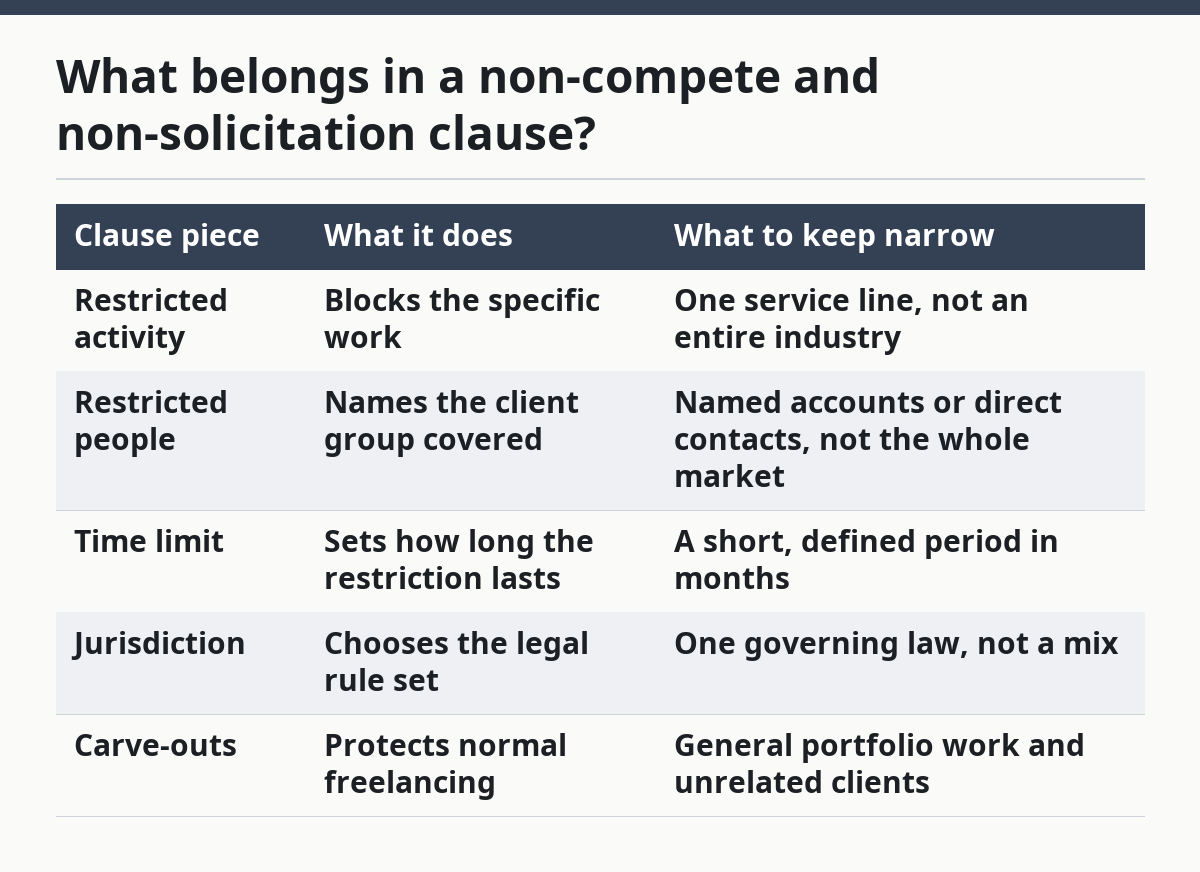
The non-compete part should usually be the shortest section. If it runs longer than the non-solicitation clause, the draft may be overreaching. The non-solicitation clause, by contrast, can be more specific because it aims at conduct the client can actually identify later, such as direct outreach to a named client list.
This is also the place to avoid employee-style language. A freelancer is not being told where to sit, when to clock in, or how to take leave. The clause should stay on competition and contact, not on daily control.
What makes the clause more likely to hold up?
The clause is more likely to hold up when it is narrow, specific, and tied to a real relationship in a known jurisdiction. Courts and reviewers tend to dislike restraints that look larger than the harm they are trying to prevent, especially if the clause blocks broad market entry for 12 months or longer.
The cleanest way to improve enforceability is to match the restriction to the client’s actual risk. If the freelancer sees a list of 8 major accounts, the non-solicitation clause can focus on those contacts instead of every person the client has ever met. If the freelancer only handled one campaign, the ban should track that campaign, not every project in the business.
The second rule is to keep the restraint proportionate. A clause that bars work for “any competitor anywhere” often looks like a hidden employment lock-in. A clause that blocks the freelancer from using confidential information, soliciting named clients, or taking over the same project for a direct competitor has a better chance of being seen as a protection, not a punishment. For background on how noncompetes are treated in the United States, see the Federal Trade Commission and the U.S. Department of Labor, which both help frame the risk around restraint and worker classification.
The third rule is to align the clause with jurisdiction from the start. A clause that might pass in one place can fail in another, so the same wording should not be copied into every contract without review. That is why a freelancer working across borders should treat the governing-law line as a core term, not a formality; if the clause crosses borders, a lawyer should check the governing law and local enforceability rules before signature.
For a broader view of contract structure, the hub on freelancer contracts and client policies is the right place to start before adding this kind of restriction.
What mistakes make the clause weak?
The biggest mistake is writing a clause so broad that it tries to control the freelancer’s whole career. That can cost the client enforceability and cost the freelancer future work. A clause that bans “any related services” for 24 months often reads like overreach, and overreach is where many disputes begin.
A second mistake is skipping the difference between a non-compete clause and a non-solicitation clause. If the goal is to stop the freelancer from taking the client’s clients, the non-solicitation clause is the better tool. If the draft uses only a broad non-compete, it may block lawful work while still missing the real risk.
A third mistake is forgetting the jurisdiction. A restriction that looks tidy in one legal system can be hard to defend in another, so the agreement needs a governing-law clause that matches the place where enforcement would matter. Without that, a 3-line restriction can turn into a 3-page argument.
A fourth mistake is copying employee language into contractor terms. Words like “exclusive,” “full-time,” or “at-will discipline” can pull the agreement away from freelancer work and toward an employee-style arrangement. That can create confusion about the relationship itself, not just the clause.
A final mistake is making the clause so vague that no one can tell what is blocked. If the wording cannot tell a freelancer which 2 clients are off-limits, the clause is already weak. Precision is not a style choice here; it is the difference between a usable restraint and a dispute magnet.
How do I keep it narrow without making it useless?
You keep it narrow by choosing the smallest restriction that still protects the client’s known risk. That usually means defining the covered work, limiting the covered contacts, and setting a short time period that does not outlast the project itself by a wide margin.
A good test is to ask whether the client would still be protected if the clause covered only the named client list and the exact service line from the project. If the answer is yes, the broader wording is probably unnecessary. If the answer is no, the draft may need one more factual hook, not one more blanket ban.
The clause also works better when it makes room for unrelated freelance work. A designer can often still do unrelated branding work for another business, even if the current client wants protection from direct poaching. A writer can often still write in the same broad subject area, as long as the clause stops direct solicitation of named contacts or misuse of confidential plans.
This is where honest trade-offs matter. A very tight clause protects enforceability, but it may leave some risk unblocked. A very broad clause blocks more conduct, but it is more likely to be challenged. For a freelancer, the better draft is often the one that blocks less but stands a better chance of surviving.
When is this the wrong tool?
This is the wrong tool when the client wants a general loyalty promise or a total ban on future work. A non-compete and non-solicitation clause is for a specific relationship and a specific risk, not for suppressing ordinary freelance competition across an entire field.
It is also the wrong tool when the jurisdiction makes broad restraints difficult to defend. In that case, the draft should get shorter and more precise, or the client should rethink whether the restriction belongs there at all. A 1-size-fits-all clause is risky when the legal setting changes from place to place.
It is not a good fit when the freelancer has no access to client lists, confidential plans, or direct contacts. If the freelancer only does isolated production work and never touches the client’s relationships, a non-compete may do more harm than good. The clause then becomes a drag on the contract instead of a shield.
A careful draft is better than a forceful one. That is the core rule for freelancers who want a clause that lasts long enough to matter and narrow enough to survive scrutiny.
Should freelancers use non-compete clauses?
Freelancers should use non-compete clauses only when the client has a real, limited risk that non-solicitation alone does not cover. A broad restriction is often too much for routine freelance work, especially when the job does not involve client lists, pricing strategy, or confidential project plans.
The safer default is to start with a non-solicitation clause and add a narrow non-compete only if the project justifies it. A 6-month restriction tied to one named account is very different from a 2-year ban on all similar work. The first may be defensible; the second often invites trouble.
What is the difference between non-compete and non-solicitation?
A non-compete stops the freelancer from doing certain competing work, while a non-solicitation clause stops the freelancer from actively approaching specific clients, prospects, or staff. The first targets work itself; the second targets contact and outreach.
That difference matters because non-solicitation is usually easier to narrow. A clause that bars direct outreach to 10 named accounts for 12 months is more focused than a clause that blocks all similar work in a field. For many independent contractor agreement drafts, the non-solicitation clause does the most useful work.
Are non-compete clauses enforceable for freelancers?
Non-compete clauses can be enforceable for freelancers, but only when they are drafted narrowly and fit the jurisdiction. A clause that is too broad, too long, or too close to an employee-style restriction is much easier to challenge.
The real question is not just whether the clause exists, but whether it is reasonable in scope, time, and purpose. A freelancer who signs a broad restraint without checking the governing law is taking a risk. Because enforcement rules vary, legal review is wise before the clause goes into a live contract, and state-law resources such as the National Conference of State Legislatures can help you confirm how different places treat restraints.
Drafted with AI; not yet reviewed by a person.
