

Last updated: November 19, 2026
Quick Answer: In about 10 clauses, a written freelance contract and a clear client policy can stop most scope, payment, and revision disputes before work starts. Freelance contracts and client policies can leave you unpaid, undercut, or stuck in scope creep if they are vague. The fix is a written contract plus a clear policy sheet that spells out scope, payment, revisions, rights, and the process for changes. The sections below settle what each one should cover and where beginners usually go wrong in Freelance contracts and client policies: Complete Guide.
Key Takeaways
- A contract sets the legal and business terms; a policy sheet sets day-to-day rules.
- A vague scope, payment timing, and revision limits can cost you money.
- Good paperwork does not need to be long, but it does need to be specific.
- A client policy works best when it explains how you work before anyone hires you.
- Some situations need extra clauses, like deposit terms, late fees, or rights transfer.
I write on freelance agreements, service terms, and fee disputes for a living, and the same pattern shows up again and again: the writer who defines the job in writing gets paid faster and argues less.
What belongs in a freelance contract?
A freelance contract should cover the job, the money, the timeline, the rights, and the exit path. That sounds plain, but each of those pieces needs hard wording, not a friendly email thread.
Picture this: you are about to start a project, the client says “just a few small edits,” and the draft has already changed direction twice. A contract stops that drift by naming the deliverable, the revision cap, and what counts as extra work.
At minimum, a solid contract should include:
- Parties and project name
- Scope of work
- Deliverables and file format
- Deadlines and review windows
- Fee, deposit, and payment timing
- Revision limits
- Ownership or license terms
- Kill fee or termination terms
- Approval process
- Dispute handling
A generic one-page agreement fails when it leaves out the part that causes the fight. A detailed clause about “services” is useless if it never says how many rounds of edits are included or when the final invoice is due.
The truth is, the contract is not there to impress anyone. It is there to answer the ugly questions before they become expensive.
How is a client policy different from a contract?
A client policy explains how you work; a contract explains what both sides must do. The contract is binding and project-specific. The policy is broader and usually stays the same across jobs.
Picture this: you send a proposal, the prospect agrees in principle, and then asks how you handle rush requests, meetings, or source files. That is client policy territory. It lets people self-select before you spend an hour rewriting the same rules in email.
A useful policy usually covers:
- Communication channels
- Office hours or response windows
- Meeting rules
- File handoff rules
- Revisions and change requests
- Payment expectations
- Content or conduct boundaries
- Emergency or rush-work handling
A contract without a policy can still work, but it forces every small rule into every new agreement. A policy without a contract is just a nice document nobody has to follow.
Here’s the catch: the policy does not replace the contract. It supports it. If a policy says you do not work weekends, the contract should still say what happens if a weekend deadline is requested and accepted.
What should every payment clause say?
A payment clause should say what you charge, when you invoice, when payment is due, and what happens if payment is late. If that clause is fuzzy, the rest of the agreement is on weak ground.
Picture this: you finish the work, send the invoice, and the other side says they thought payment was due after final publication, not after delivery. If the contract does not say “due on receipt” or “Net 15,” you are now negotiating from scratch.
A clean payment clause usually includes:
- Total fee or pricing method
- Deposit amount, if any
- Due date for deposit and final balance
- Accepted payment methods
- Late payment consequences
- Work pause trigger for overdue invoices
- Refund terms, if any
If you use milestone billing, tie each invoice to a named deliverable. If you use retainers, say whether the retainer is refundable and whether unused hours roll over. If you want a deposit before work begins, say that the project starts only after the deposit clears.
Simple payment terms reduce awkward follow-up. They also make it easier to chase late invoices without sounding personal, because the rule was there from the start.
How do you define scope so it does not explode?
Scope control starts with a deliverable list, not a vague promise to “help with content.” If you do not define the edges, every extra ask sounds reasonable in the moment.
Picture this: you are hired to write a landing page, then asked to rewrite the homepage, add SEO meta copy, build a content calendar, and sit in on two strategy calls. Each request looks small alone. Together, they are a different job.
A scope section should name:
- The exact deliverable
- Word count, page count, or file count when relevant
- What is included
- What is excluded
- Who provides source material
- How change requests are approved
- What counts as out of scope work
The wording should be blunt enough to prevent confusion. For example: “Project includes one 800-word blog post and one revision round. Research beyond provided source notes is billed separately. If you need more depth, consult a legal or business professional before relying on the clause.” That sentence can prevent a mess later, but you should still get professional advice if the project has legal or financial stakes, and a source such as the U.S. Small Business Administration or your local bar association can help.
If you do this well, the scope section gives you a clean answer when someone asks for “just one more thing.” It also gives the client a fair boundary to rely on.
What revision policy keeps the work moving?
A revision policy should limit the number of rounds, define what counts as a revision, and set a deadline for feedback. Without that, the same draft can circulate for weeks while nobody feels responsible for the delay.
Picture this: you send version one, get notes from three people, and each one wants a different direction. A revision policy turns that chaos into a process with one decision-maker, one feedback window, and one limit on free changes.
A strong revision policy names:
- Number of included rounds
- What a revision round covers
- Feedback deadline
- Who can approve the final version
- Extra revision fee or hourly rate
- What happens if feedback is late
It helps to separate “revision” from “new work.” Fixing a typo is not the same as changing the angle, tone, or target audience. A policy that says so saves you from free reinvention.
A common mistake is using soft language like “reasonable revisions included.” That sounds friendly and usually fails in practice. Reasonable to whom? One person’s “minor tweak” is another person’s total rewrite.
The honest side-by-side: contract vs. client policy
A contract wins when the question is, “What are the legal and money terms for this project?” A client policy wins when the question is, “How do I work with you day to day?” You need both if you want fewer surprises.
Picture this: a new prospect wants to know whether they can call you on weekends, and an existing client wants to know whether a rush fee applies. The policy answers the first. The contract answers the second when a rush job turns into billable scope.
| Criteria | Contract | Client Policy | Winner for that condition |
|---|---|---|---|
| Legal force | Binding project agreement | Guideline or standing rule | Contract |
| Changes by project | Usually tailored each time | Often reused across jobs | Contract |
| Explains how you work | Limited | Direct and practical | Client policy |
| Handles payment disputes | Yes | Not by itself | Contract |
| Covers response times | Can, but often awkwardly | Ideal place for it | Client policy |
| Covers revisions | Yes | Can describe process | Contract |
| Sets meeting habits | Possible | Better fit | Client policy |
| Works before a hire | Sometimes, if sent early | Yes, as screening material | Client policy |
| Best use | Prevents broken promises | Prevents bad-fit jobs | Depends on the problem |
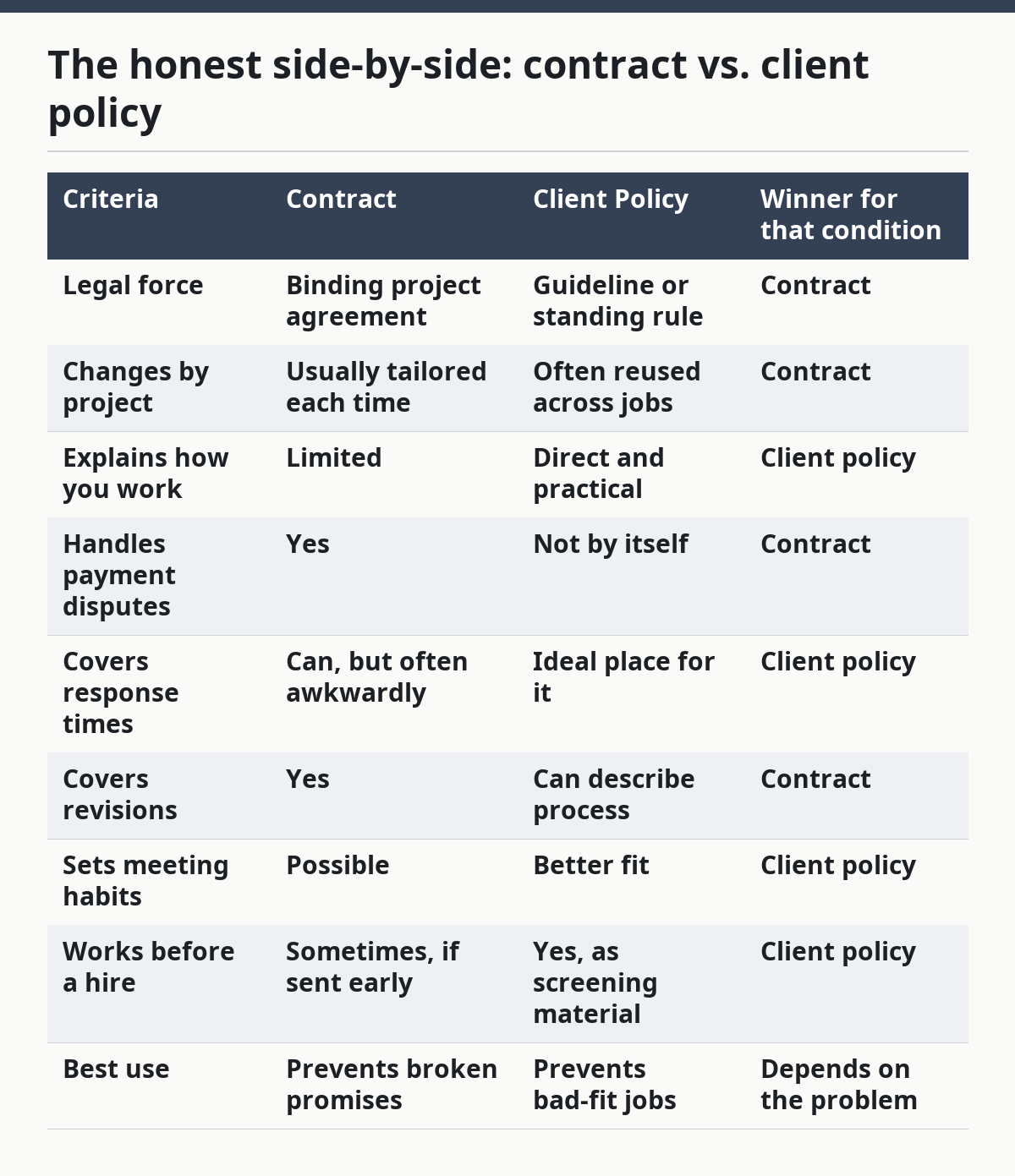
The contract should carry the consequences. The policy should carry the habits. If one document is doing both jobs badly, the work gets messy fast. For more on small-business structure, see the U.S. Small Business Administration.
Which clauses do beginners forget most often?
Beginners forget the clauses that feel rude to ask for, then pay for that politeness later. The most missed items are ownership, approval timing, and what happens if the project stops halfway through.
Picture this: the draft is nearly done, the other side goes quiet for two weeks, then returns with a fresh set of decision-makers. If your paperwork does not address silence, pause, or abandonment, you are left guessing how long to wait.
The clauses that get skipped most often are:
- Kill fee or cancellation fee
- Nonpayment pause clause
- Source material responsibility
- Approval deadline
- Rights transfer timing
- Expense reimbursement
- Confidentiality, if needed
A kill fee matters because lost time is real loss. A pause clause matters because work should stop when invoices go stale. Approval timing matters because a project cannot sit open forever while someone “circles back.”
A good rule: if a delay, change, or cancellation would cost you time or money, write it down. If it would not cost you anything, you probably do not need a special clause. For contract language and rights basics, consult an attorney and review resources from the American Bar Association.
What should a first-time freelancer put in a policy sheet?
A first-time freelancer should keep the policy sheet short, plain, and easy to scan. One page can be enough if it covers the rules that actually shape the work.
Picture this: a prospect reads your policy before booking and immediately sees your office hours, feedback window, and payment schedule. That does more screening than a long pitch ever will, because it tells them how the relationship will feel.
A practical first policy sheet can include:
- Communication hours
- Preferred email or project tool
- Typical response time
- Meeting limits
- Turnaround expectations
- Payment schedule
- Revision rules
- Rush-work policy
Do not bury the rules in friendly paragraphs. Use short headings and plain sentences. A reader should be able to find the answer in 10 seconds.
If you need to state what you will not do, put it here. No weekend calls. No unlimited revisions. No work before the deposit clears. The “no” is part of the service, not an apology for it.
When do you need more than a template?
You need more than a template when the project has money at risk, rights at stake, or multiple decision-makers. A template is a starting point. It is not a substitute for thinking.
Picture this: you are handling brand work, white-label work, or a long engagement with recurring deliverables. One template copied into every job is too blunt for that kind of work, because the failure points are different each time.
You should customize or seek legal review if the deal includes:
- IP assignment instead of a license
- Confidential material
- Large upfront deposits
- Ongoing retainers
- Team approvals
- Multi-step deliverables
- Cross-border payment terms
A template also breaks down when the project includes work you do not usually sell. If you normally write blog posts but are suddenly managing strategy, interviews, and publishing, the old contract will miss important edges.
The safe move is to edit the template for the actual job, not the job you wish it were. That sounds basic. It is also where most mistakes start.
What are the real trade-offs of being strict?
Being strict with contracts and policies reduces chaos, but it can also scare off people who want a casual, undefined arrangement. That is not always a bad thing.
Picture this: a prospect balks at a deposit, asks for open-ended revisions, and wants a verbal agreement instead of written terms. The paperwork is doing its job if that person walks away. They were a likely problem, not a missed opportunity.
The trade-offs are real:
- Strong terms can slow the sales process.
- Short policies can feel less warm.
- Clear revision caps may exclude clients who want broad collaboration.
- Deposit requirements can lose bargain shoppers.
- Firm scope control can cost you some quick, messy jobs.
Still, those losses often protect your calendar and your cash flow. The goal is not to win every lead. The goal is to win the right ones.
If your wording is too stiff, soften the tone without softening the rule. A kind sentence can still be a hard line.
Which document should you send first?
Send the policy first when you want to screen fit, and send the contract first when the project is already agreed and ready to start. That order keeps the process simple and avoids surprise.
Picture this: a prospect is still comparing vendors, and you want them to understand your work style before they ask for a quote. A policy sheet is the better first touch. It explains the rhythm of the relationship without locking anyone in.
Use this order:
- Share the policy during early talks or on your site.
- Use the contract after the scope is agreed.
- Collect the deposit.
- Start work only after both are accepted.
That sequence keeps the policy as a filter and the contract as the binding record. If you reverse them, people may sign before they understand your working rules, then act surprised later.
The order matters because confusion at the start gets expensive at the end. A clean sequence lowers that risk.
What does a strong freelance agreement look like in practice?
A strong freelance agreement is short enough to read and specific enough to enforce. It does not need legal drama. It needs clean terms that match the job.
Picture this: the contract says the deliverable is one 1,200-word article, two revision rounds, final payment due within 14 days, and source interviews must be scheduled within one week. That is clear enough to run the project without a dozen follow-up emails.
A practical agreement usually has:
- A clear project name
- Exact deliverables
- Payment schedule
- Deadline and review window
- Revision limit
- Ownership terms
- Cancellation terms
- Signature or acceptance line
If you work in a specialized niche, add the niche rules. For example, a design job may need file ownership terms, while a writing job may need publication approval language. The base structure stays the same, but the details shift.
This is the point where a lot of beginners overcomplicate things. They add legal filler and miss the operational basics. Simpler is usually better, as long as the simple version names the real risks. For additional consumer and contract guidance, see the Federal Trade Commission.
What should you do if a client pushes back?
If a client pushes back on your contract or policy, ask which clause is the problem and why. Do not rewrite the whole document in the first reply.
Picture this: someone objects to the deposit, the revision cap, or the payment deadline. That objection tells you something useful. It may mean the person has a real process issue, or it may mean they were hoping for looser terms.
Then use this sequence:
- Identify the exact objection.
- Explain the reason for the clause.
- Offer one narrow adjustment if it does not raise your risk too much.
- Walk away if the request removes your protection.
You do not need to make every clause negotiable. If a term protects your time or cash flow, it deserves a firm line. A good prospect may ask questions; they usually do not demand that your whole system disappear.
The blunt truth is that pushback reveals fit. Some objections are fair. Some are a warning.
FAQs
Do I need both a contract and a client policy?
Yes. The contract handles the legal and financial terms of the job, while the policy explains how you run the relationship. If you only use one, you either miss the day-to-day rules or leave too much to chance.
Can I use a template for freelance contracts?
Yes, but only as a starting point. A template works best when you edit it for the actual deliverable, payment timing, revision limits, and rights terms. If the project has unusual stakes, a template alone is too thin.
What is the most important clause in a freelance contract?
The most important clause is the one that matches your biggest risk, but payment and scope usually matter most. If those two are vague, the rest of the contract has a weak foundation. A clear revision rule also saves a lot of trouble.
Should my client policy be public?
It can be, and that often helps. A public policy filters bad-fit leads before they reach your inbox. Keep it readable and short, with the rules that affect how people will work with you.
What if the other side refuses to sign?
If they refuse to sign a contract, do not start the work. That refusal usually means they want flexibility without accountability. A serious project needs a written record before time or money changes hands.
Drafted with AI; not yet reviewed by a person.
