
Last updated: November 19, 2026
Key Takeaways
- Invoice payment terms set the payment clock, not the invoice’s appearance.
- Net 7 suits quick jobs; net 15 works well for many standard freelance projects with a short review window.
- Net 15 terms should state the invoice date, due date window, and any late-fee trigger in one plain sentence.
- Late-fee clauses should explain when the fee starts, how it is calculated, and whether it applies once or per billing period.
Freelancer invoice payment terms tell the client when to pay, what counts as late, and whether a deposit or partial payment is due.
Net 7 and net 15 are short payment windows; late fees only work when the terms are clear in writing.
The sections below settle which term fits which job, how to word due dates, and where deposits and milestone billing belong.
What invoice payment terms actually control
Invoice payment terms control the clock on your money, not the look of the invoice. They set the invoice due date, the payment window, and any late fee language tied to missed payment.
Picture this: you finish a project, send the invoice, and the client asks, “When is this due?” If the terms say net 15, the answer is simple. If they only say “due upon receipt,” you’ve left room for a dispute. That gap can cost time.
A clean term tells the client three things:
- When the timer starts
- How long they have
- What happens after the due date
The most common freelancer terms are net 7, net 15, and net 30. Net 7 means payment is due 7 days after the invoice date. Net 15 means payment is due 15 days after the invoice date. The number is the whole point.
Use this page as the wording guide for your billing terms, then link readers to the broader freelance billing and client payment systems hub for the bigger process around invoicing and getting paid.
Common mistakes show up fast:
- Writing “due ASAP” instead of a day count
- Using “upon receipt” for every client, even when they ask for a real window
- Saying “late fees apply” without saying when late starts
Those gaps can turn a clear bill into a negotiation.
Not ideal.
Net 7 vs net 15: which one fits the job?
Net 7 fits small, fast jobs; net 15 fits most standard freelance work where the client needs a short review period before releasing payment. The right choice depends on how quickly you need cash and how much admin the client’s AP team needs.
Picture this: you’ve just sent a $500 design invoice to a solo founder. Net 7 keeps the cycle tight. Now picture a marketing team that routes payments through accounts payable, and a 7-day window can feel rushed because someone else has to approve it.
That’s the trade-off.
Here’s the practical difference:
- Net 7: payment due 7 calendar days after the invoice date
- Net 15: payment due 15 calendar days after the invoice date
- Net 30: common in larger companies, but slower for freelancers
A shorter term helps cash flow. A longer term may reduce back-and-forth with clients who need internal approval. If you work on quick-turn writing, editing, or one-off design tasks, net 7 or net 15 usually makes sense. If your client is a larger business with an AP queue, net 15 often lands better.
For many freelancers, the term that fits the client’s normal approval cycle is the one that causes the fewest delays. If a client’s usual cycle is 14 days, asking for 7 can create friction for no real gain.
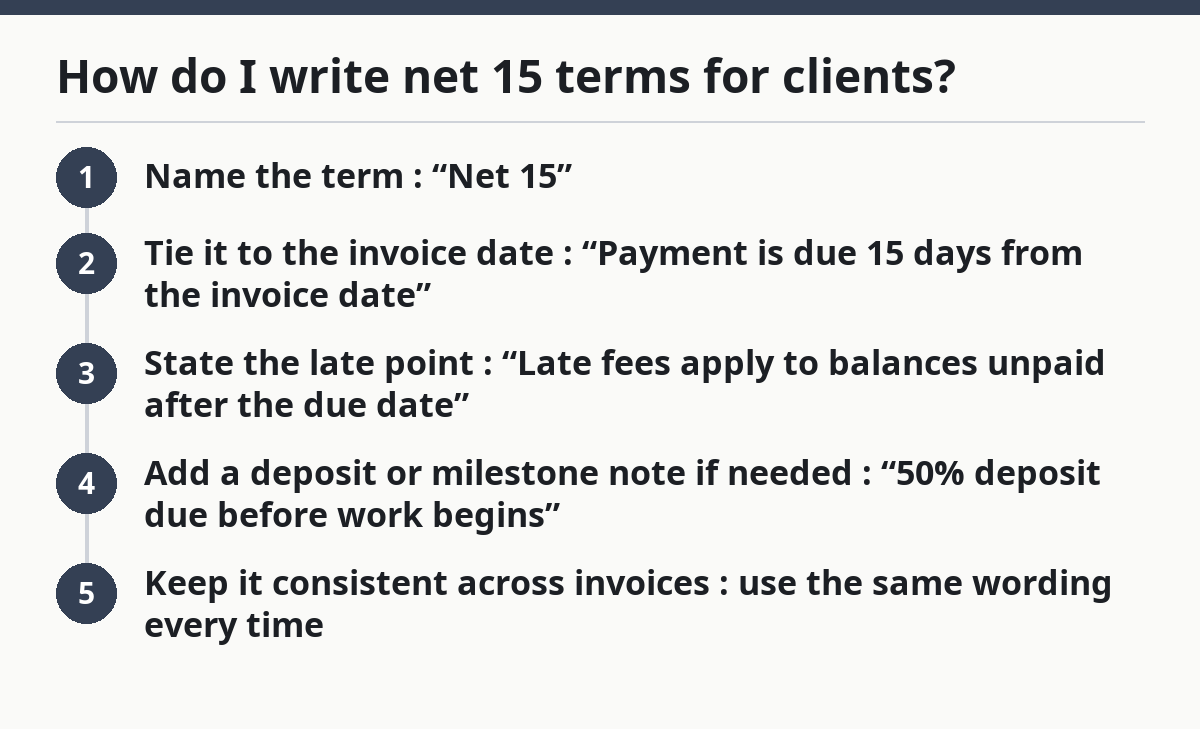
How do I write net 15 terms for clients?
Net 15 terms should say the invoice date, the due date window, and any late fee trigger in one plain sentence. That keeps the meaning obvious and avoids guesswork later.
Because the wording needs to stay simple, you can still keep the line short. The style matters less than the clarity. A client should be able to read it in 5 seconds and know exactly what to do.
A simple structure looks like this:
- Name the term: “Net 15”
- Tie it to the invoice date: “Payment is due 15 days from the invoice date”
- State the late point: “Late fees apply to balances unpaid after the due date”
- Add a deposit or milestone note if needed: “50% deposit due before work begins”
- Keep it consistent across invoices: use the same wording every time
That’s the skeleton. The exact sentence can be plain-English:
- Payment due net 15 from the invoice date.
- Payment due 15 days after invoice date.
- Deposit due before work starts, balance due net 15 after delivery.
If you handle milestone billing, spell out each milestone’s due date separately. A milestone invoice should not leave a client guessing whether the 15-day clock starts at kickoff, draft delivery, or final approval. That ambiguity is where disputes hide.
A small detail matters here: if the invoice date is May 1, net 15 usually means payment is due May 16. If you mean 15 business days instead, say that directly. Do not assume the client will count the same way you do.
Late fee clauses: what to include and what to avoid
Late fee clauses should say when the fee starts, how it is calculated, and whether it applies once or every billing period. A vague “late fee may apply” is weak; a clear clause is harder to ignore.
Picture this: your client is 10 days past the due date, and the invoice only says “late fees may be charged.” That line is too soft to do real work. A late fee clause should answer three questions:
- When is the invoice late?
- What fee is added?
- Does the fee repeat or stop after one charge?
A usable clause often includes:
- Trigger date: “Balances unpaid after the due date are late”
- Fee type: a flat fee or a percentage-based fee
- Frequency: one-time, monthly, or per billing cycle
- Balance rule: whether the fee applies to the full invoice or only the unpaid amount
That’s the structure. Without it, the phrase “late fee” is just noise.
There are real drawbacks to late fees, though. Some clients push back hard if the clause feels aggressive. Some accounts payable systems won’t process a fee that was never agreed to in advance. And if your wording is sloppy, the fee can look like a surprise charge instead of a term of sale.
Who Should Skip This: freelancers working with very small solo clients who pay by personal transfer and rarely miss due dates may do better with a simpler net 7 or net 15 term and no fee line at all.
Buy this if: you invoice businesses that expect formal terms and you want a clear late-payment signal.
Skip this if: you work only with friends, tiny one-off gigs, or clients who reject added charges.
Deposit requirements, partial payments, and milestone billing
Deposit requirements, partial payments, and milestone billing belong in the payment terms because they change when money is due, not just how much is owed. If the job is large or stretches over several weeks, one final invoice may be the wrong structure.
Picture this: a $3,000 project starts now, but the work lands in three stages over 6 weeks. A deposit reduces the risk of doing the full job before any money moves. Partial payments and milestones keep the project tied to real progress.
Use these patterns:
- Deposit: a portion due before work starts
- Partial payment: one or more interim invoices during the project
- Milestone billing: payment due after each defined stage, such as outline, draft, and final delivery
The terms need to say exactly when each payment is due. For example, “50% deposit due before project start, 50% due on delivery” is clear. So is “30% due at kickoff, 40% due after draft approval, 30% due on final files.” The reader should not have to guess whether approval or delivery starts the clock.
For larger jobs, milestone billing only works if the milestones are specific. “Halfway through the project” is vague. “After first draft delivery” is better. “After final approved design files” is better still.
This structure helps with larger jobs, custom work, and projects where the client wants checkpoints. It is also useful when a freelancer needs material costs covered early. A deposit can protect the cash flow without making the whole invoice look harsh.
Due dates and wording that keep the clock clear
Due dates should be tied to one starting point, one counting method, and one clear end date. If those three pieces are not obvious, the term is weak.
Picture this: the invoice says “due in 15 days,” but the client thinks that means business days while you meant calendar days. That mismatch can turn into an awkward email chain. Use the words that end the argument before it starts.
A clean due-date line usually includes:
- Invoice date: the day the invoice is issued
- Payment window: net 7, net 15, or another fixed term
- Calendar rule: calendar days unless you say business days
- Due date: the exact date if your invoicing system calculates it
A few examples of clear wording:
- “Payment due 7 days from invoice date.”
- “Payment due net 15 from invoice date.”
- “Payment due on or before June 16.”
If you invoice on the 1st of the month, the due date should not be buried in a paragraph. Put it where the client sees it. That is the point of terms: less reading, fewer excuses.
Avoid “immediate payment” unless you really mean it and your client understands it. It sounds forceful but says almost nothing about timing. “Upon receipt” is clearer, but it still needs to be used carefully because some clients treat it as same-day and others as a soft request. Consult a professional if you want to rely on “upon receipt” in a contract or terms sheet, because its practical meaning can vary by client and jurisdiction. See the FTC’s guidance on billing and payment practices and the NFIB’s overview of invoice payment terms for context. FTC | NFIB
Common mistakes that make payment terms weak
Weak payment terms usually fail because they are vague, inconsistent, or impossible to enforce. The fix is simple: make the term specific enough that a client can repeat it back without guessing.
Picture this: one invoice says net 15, another says due on receipt, and a third says “due within two weeks.” That mess is exactly how payment disputes start. You do not need a legal maze. You need one format and one rule.
The most common mistakes:
- Mixing terms on the same client relationship
- Leaving out the due date
- Using “late fees may apply” without the trigger
- Forgetting deposit language on large projects
- Using business days by accident when you meant calendar days
Each mistake costs something real. Inconsistent terms can delay payment. Vague due dates can create arguments. Missing deposit language can leave you financing the project yourself for 30 days or more.
The simplest fix is to pick one core structure, keep it short, and use the same language on every invoice. For example, “50% deposit due before work begins; balance due net 15 from invoice date; unpaid balances are late after the due date.” That one line does more work than a page of soft phrasing.
Freelancers often try to sound flexible and end up sounding unclear. Clear beats polite here.
How invoice payment terms fit into the rest of your billing system
Invoice payment terms fit into the rest of billing by setting the rules after the work is done; they do not replace a contract, an invoice number, or a follow-up process. Think of them as the payment clock, not the whole system.
Picture this: the job is finished, the invoice is sent, and the client asks why the balance is due now instead of later. If your terms are solid, the answer is already on the invoice. If they are not, you are back in explanation mode.
A good billing setup usually separates four parts:
- Contract terms: what the work includes
- Invoice terms: when the money is due
- Deposit or milestone terms: when money is collected during the project
- Late fee clause: what happens after the due date
That separation matters because each part does a different job. A contract can say a deposit is required, while the invoice states the exact due date. A late fee clause belongs in the payment terms, not buried in a random note.
If you want the broader system, this page fits under the freelance billing and payment hub. This article only handles the wording of payment terms themselves.
For a broader look at invoicing and payment timing, Stripe’s invoicing guide and QuickBooks’ explanation of payment terms provide useful background.
What payment terms should a freelancer use?
The best payment terms are the ones that fit the client and the project. For many freelancers, net 7 or net 15 is the cleanest default, with a deposit for larger projects and a late fee clause only when the client is likely to accept it.
If you work on small jobs with fast turnaround, net 7 keeps cash moving. If you work with businesses that need internal approval, net 15 is often the better balance. For larger or custom work, add a deposit or milestone billing so you are not waiting until the end for every dollar.
Should I put late fees on my invoice?
Yes, if you want to charge one, the late fee should be written clearly before the invoice is late. A vague note is weak; a specific clause tied to the due date is much better.
The fee should say when it starts and how it applies. If you do not want pushback from small clients, you can skip late fees and keep the terms simple with net 7 or net 15. That is often the cleaner choice for low-risk work.
How do I write net 15 terms for clients?
Write net 15 as a short, exact sentence tied to the invoice date. A plain version is: “Payment due net 15 from invoice date.” If you want more detail, add the late point and any deposit or milestone rule in the same terms block.
Keep the wording consistent across invoices. If you mean 15 calendar days, say that. If you mean business days, say that too. The goal is to remove guesswork, not add more lines.
Drafted with AI; not yet reviewed by a person.
