

Last updated: November 19, 2026
Quick answer: 3 buckets—spending money, tax money, and a reserve for slow-paying clients—are often the simplest way to manage freelance cash flow and payments, though a qualified professional can help you set the right split for your situation. Freelance cash flow breaks when invoices sit unpaid, money lands late, or taxes get ignored. The fix is a simple system: invoice fast, require a deposit on larger jobs, separate tax money, and chase overdue payments on a schedule. The steps below settle how to keep money moving without turning every project into a collection problem in freelance cash flow and payments: The Complete Guide.
Key takeaways
- Cash flow is about timing, not just income. A freelancer can be profitable on paper and still run short on rent money.
- The safest setup is often three buckets: spending money, tax money, and a reserve for slow-paying clients.
- Payment terms work best when they are written before the job starts, not argued over after delivery.
- Deposits, milestone billing, and late fees do more than protect income; they filter out clients who expect free financing.
- The right payment tool depends on deal size, client location, and how fast you need the money to clear.
- A strong process beats a long to-do list. Send, track, follow up, and escalate on the same schedule every time.
I write about freelance business systems and payment workflows, so I know where cash flow gets messy: the handoff between finished work and actually getting paid in freelance cash flow and payments.
Why freelancers run out of cash even when work is coming in
Freelancers run out of cash because bills are due on a calendar and clients pay on their own schedule. A busy month can still end in a shortfall if two invoices land 30 days late and one client “has to process payment” for another week.
Picture this: you finish three projects in ten days, but one client pays by bank transfer in 14 days, another waits until the end of the month, and a third asks for revisions before approving the invoice. Your pipeline looks healthy. Your checking account does not.
Here’s the catch: cash flow is not the same as revenue. Revenue is what you earn; cash flow is what is actually available on the day rent, software, insurance, and tax payments hit.
- Fast work, slow payment: a quick turnaround does not help if your terms say net 30 and the client uses every day of it.
- Uneven project sizes: one large project can distort the month if the payment is tied to delivery.
- Seasonal demand: the gap between busy months and quiet months can be wider than a freelancer expects.
- Tax confusion: if you spend gross income as if it were take-home pay, the tax bill becomes a shock later.
Because of that, a useful rule is to treat every payment as split money the moment it lands; if you are unsure how to divide it, consult a qualified tax professional or accountant and follow local guidance. One share is for tax, one is for operating costs, and one is for your own pay. That rule keeps you from spending tomorrow’s bill today in freelance cash flow and payments.
What payment terms should a freelancer use?
The best payment terms are usually the ones that let you get paid before the work becomes hard to recover, while still staying fair and clear. For most freelancers, that means a written agreement, a deposit on larger projects, a clear due date, and a late-payment clause.
Picture this: a client wants a website, a report, or a batch of edits. You want to start work, but the invoice has not been sent, the scope is still fuzzy, and nobody has agreed on what “done” means. That is where payment problems start.
The truth is, payment terms should do three jobs at once: set expectations, reduce risk, and make collection easier. If a term does not help with one of those, it is probably decorative.
Use terms that answer these questions in plain language:
- How much upfront? Many freelancers ask for a deposit before work begins, especially on custom work.
- When is the balance due? Choose a fixed date, a milestone, or delivery-based trigger.
- What counts as completion? Put revision limits and approval steps in writing.
- What happens if payment is late? State the reminder schedule and any late fee you are willing to enforce.
- What payment methods do you accept? List them in the contract or proposal so no one guesses.
If a job is large enough to hurt your month, do not let all the risk sit at the end. Split billing is often safer than one final invoice. A 50% deposit and 50% on delivery is a common custom-work arrangement because it gives you money up front and reduces the chance of disappearing clients.
Avoid vague language like “payment upon completion” if the client can delay sign-off. Better language is “balance due within 7 days of final delivery” or “invoice due on milestone approval.” Shorter terms help cash flow. Longer terms help the client. They are not the same thing.
How do you invoice so you get paid faster?
You get paid faster by making the invoice easy to approve, easy to process, and hard to ignore. A clean invoice with the right details beats a polished one with missing data.
Because the work is done, the client likes it, and you send an invoice with a vague project title, no PO number, no due date, and no tax ID where they expect one, the payment can sit in someone’s inbox while you wait.
That waiting time is expensive. It can turn a 15-minute billing task into a two-week delay. Small errors matter because many client finance teams are not judging your quality; they are checking boxes.
A strong invoice usually includes:
- Your business name and contact details
- The client’s legal name and billing contact
- Invoice number and invoice date
- A specific description of the work
- The amount due and currency
- Due date or payment terms
- Payment instructions or a payment link
- Tax details where required
Keep the line items clear. “Marketing support” is weaker than “4 blog posts, 2 rounds of revisions, and keyword brief.” Specificity makes approval easier and reduces back-and-forth.
Send the invoice the same day the work is finished, or the same day a milestone is hit. Do not wait until the end of the week if the project is ready now. That delay can push payment into the next billing cycle.
- Best habit: invoice within 24 hours of delivery or milestone approval.
- Best file name: use the client name, invoice number, and date.
- Best format: PDF plus a payment link if your processor supports it.
- Worst habit: sending a new invoice after every tiny change in scope without a system.
If a client asks for revisions after invoicing, send a change order or a revised milestone note. Do not bury extra work inside the old invoice. That muddies the record and makes disputes harder to resolve later.
Which payment methods are safest and fastest for freelance cash flow and payments?
The safest and fastest payment method is usually the one that matches the size of the job and the client’s location. For many freelancers, card payments and bank transfers solve different problems, and neither is perfect.
Picture this: a local client wants to pay from a business bank account, an overseas client wants to use a card, and a startup asks if you can wait for accounts payable. Each method changes the timing, fees, and risk.
The best part is that you do not need one method for every client. You need a small menu with clear rules.
Common payment methods and what they do well
| Method | Fastness | Fees | Strength | Weak point |
|---|---|---|---|---|
| Bank transfer | Often fast once sent | Usually lower than cards | Good for larger invoices and direct payment | Can be slow across borders |
| Card payment | Fast for the payer | Often higher | Easy for clients who expect online checkout | Chargebacks and processing fees can hurt |
| Payment platform invoice | Fast and simple | Varies by platform | Good for one-off projects and quick setup | Platform rules can change |
| ACH / direct debit | Often steady | Usually modest | Useful for recurring retainers | Settlement can take a few days |
| Wire transfer | Usually fast for large sums | Often higher | Common for cross-border or business payments | Bank fees and admin friction |
| Check | Slow | Low on paper | Familiar for some corporate clients | Mail delays and deposit waits |
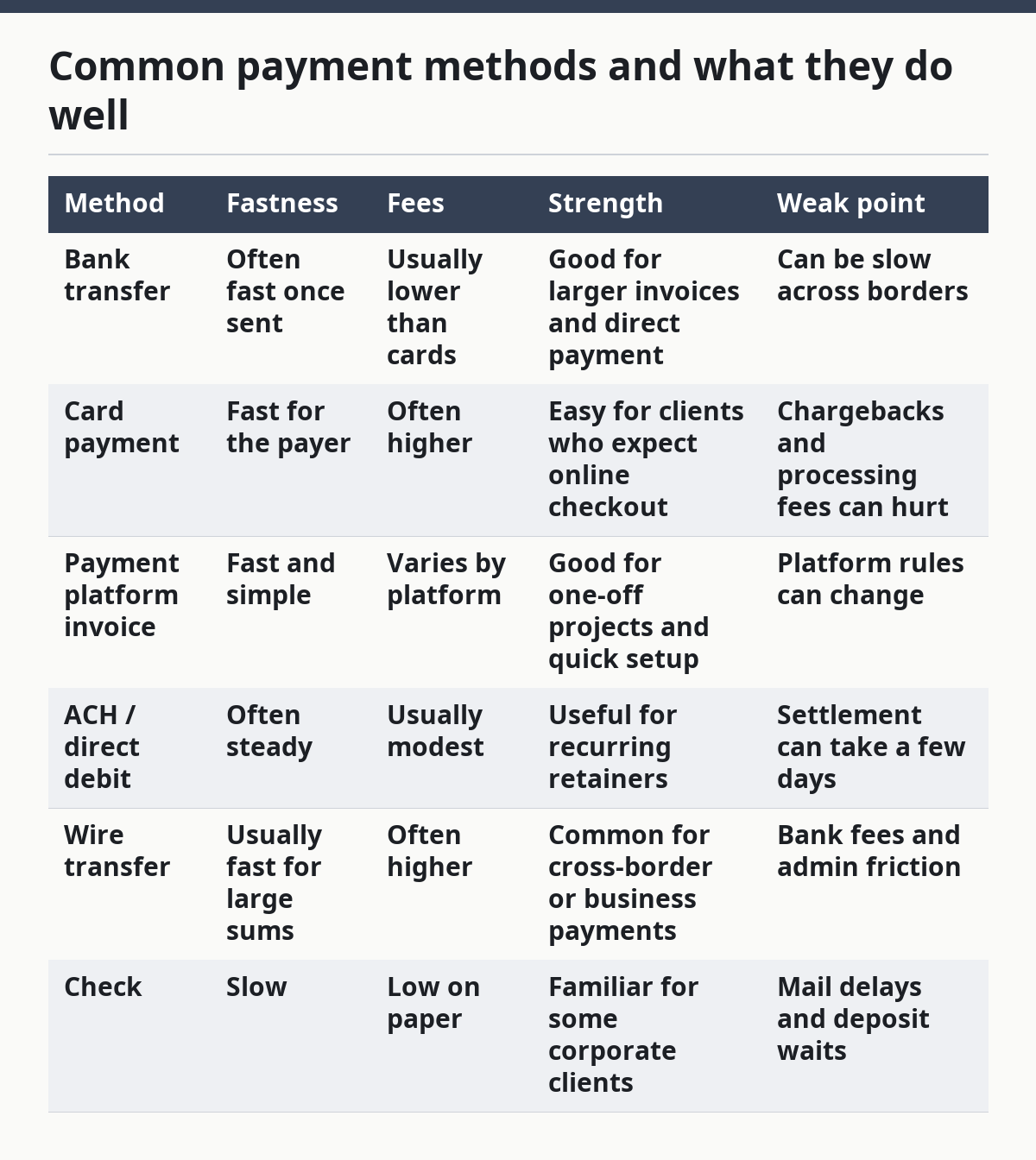
Here’s the catch: the “best” method is not always the cheapest. A low-fee method that pays three weeks late is worse for cash flow than a pricier method that clears quickly.
Use cards or invoice platforms when speed matters more than fee savings. Use bank transfers for larger B2B work where the client already pays that way. Use recurring billing for retainers so you are not chasing the same payment every month.
If your clients are international, check the currency, transfer cost, and who pays the conversion fee. A payment can look large in one currency and shrink after transfer costs and exchange rates. That gap can wreck your margin if you do not plan for it. For payment processing basics, see the U.S. Small Business Administration, and for card-scheme fee and dispute rules, see your processor’s documentation as well as guidance from the Consumer Financial Protection Bureau.
How should you handle late payments without burning the client relationship?
You handle late payments by acting fast, staying calm, and following the same sequence every time. The best collection system is professional, visible, and boring.
Picture this: the due date passes, the client says they “just need to get it approved,” and you are tempted to wait because you do not want to seem pushy. That delay helps the client, not you.
A late-payment process works best when it starts before the invoice is overdue. At the contract stage, tell the client what happens if payment is late. Then follow that rule exactly.
A practical follow-up sequence:
- Send the invoice with the due date clearly shown.
- Send a polite reminder 3 to 5 days before the due date if the client tends to pay slowly.
- Send a first overdue reminder the day after the due date.
- Follow up again a few days later with the invoice attached.
- Escalate to a phone call, billing contact, or project manager if needed.
- Stop work on new tasks if the contract allows it and payment is still missing.
Keep the language short. “Just checking in” is too soft when money is late. Say what is due, when it was due, and how the client can pay.
A late fee can help, but only if you are willing to enforce it. If you never apply it, it is not a term; it is decoration. Use it sparingly and only if it fits the relationship and the contract.
- Good reminder tone: factual and brief
- Bad reminder tone: apologetic or angry
- Best evidence to include: invoice number, amount due, due date, payment link
- Worst move: starting new work while the old invoice is still unpaid
If a client repeatedly pays late, stop extending credit. Shorten terms, require a deposit, or move to milestone billing. Chronic lateness is a cash flow problem, not a personality quirk.
How do you separate tax money from spendable cash?
You separate tax money by moving it out of sight the day income arrives. If you wait until tax season, the money will already be gone.
Picture this: a payment lands, your balance looks great, and you treat the whole amount as income you can spend. Three months later, the tax bill shows up and the account is thin.
This is where many freelancers get trapped. They see gross income and spend like employees. Freelance income is different because taxes, business costs, and your own pay all come out of the same inflow.
A simple three-account setup works well:
- Operating account: for software, tools, ads, and business costs
- Tax account: for income tax and self-employment tax set-asides
- Owner pay account: for your own draws or transfers to personal spending
Move a set percentage into the tax account each time a client pays. The exact percentage depends on your location, tax bracket, and business setup, so use guidance from a qualified tax professional or your local tax authority. The point is not the exact figure; the point is to make the money unavailable for daily spending.
Some freelancers also keep a buffer account. That reserve covers gaps between projects and late invoices. Even a modest reserve can make the difference between calm and panic when one client slips by two weeks.
The U.S. Small Business Administration and the IRS both publish guidance on business taxes and recordkeeping; the details depend on your setup, so check the current rules rather than guessing. In the UK, HMRC has similar guidance for self-employed tax and recordkeeping.
Do not wait for “extra” money to start reserving tax funds. Reserve from the first invoice. If your cash flow is tight, the reserve has to be built from habit, not leftovers.
What changes when a client wants net 30, 60, or 90 terms?
Long payment terms shift risk from the client to you, and that is the whole problem. Net 30 is manageable for many freelancers; net 60 and net 90 can strain cash flow unless you have reserves or repeat business.
Picture this: a corporate client offers solid work, but the contract says payment comes 60 days after invoice date. The job itself may be easy. Financing that delay may not be.
The longer the term, the more you are acting like a lender. That is fine if you can afford it. It is dangerous if you cannot.
Net terms can work when:
- The client is reliable and pays on schedule
- The project value is large enough to justify waiting
- You have cash reserves
- You already have recurring income from other clients
- The client’s purchasing process requires it and the deal is worth the delay
Net terms are a bad fit when:
- You need the money to cover living costs
- The client is new and untested
- The project is custom work with little resale value
- You are already waiting on other invoices
- The client is asking for net terms instead of offering any deposit
If a client wants net 60, try to shorten the risk somewhere else. Ask for a deposit, split billing, or a milestone payment before final delivery. You do not have to accept the entire delay just because the client’s procurement team likes it that way.
A freelancer with thin reserves should treat net 60 as a warning light, not a routine term. It may still be worth it for the right client, but not if it creates a chain reaction across the rest of the month.
Exception scenarios: when the usual advice flips
The usual advice flips when the work is recurring, the client is very reliable, or the project is too small to justify heavy process. Those cases are real, and they change the math.
Picture this: you have a monthly retainer, a long-term client, or a tiny one-off task that takes 20 minutes. The same billing structure that protects a large project can slow down a small one.
-
Monthly retainer with a trusted client
Autopay can beat manual invoicing. If the same amount is billed every month and the client rarely disputes it, automated billing reduces admin time and lowers the chance of missed invoices. -
Very small project, low risk
A deposit and a long contract may be overkill if the job is tiny and the loss would not hurt your month. A simple invoice and quick payment link may be enough. -
Highly regulated or procurement-heavy client
Large companies often need purchase orders, vendor setup, and specific invoice fields. In that case, compliance matters more than speed, and the correct process can reduce delays. -
International client with currency risk
If exchange rates or transfer fees are a real concern, the payment method matters as much as the due date. A slower method in the right currency can beat a faster method that destroys margin.
These are exceptions, not defaults. If your revenue is uneven or your cash reserve is thin, keep the stronger protections in place.
The verdict: which payment system should a freelancer use?
Choose deposit-plus-milestone billing if you do custom work, carry project risk, or have clients who pay slowly. Choose simple invoicing with fast online payment if most jobs are small, repeatable, and paid by reliable clients. Neither if you are pricing work without written terms or mixing tax money with operating cash.
That is the clean answer. The right system is the one that keeps you from financing client projects with your own rent money.
Use the stronger setup when:
- Your project is larger than your monthly comfort zone
- The client is new
- The scope can change
- The payment delay would hurt your cash flow
- You need to protect time as well as money
Use the lighter setup when:
- The client is recurring and dependable
- The invoice is small
- Payment is automated
- The admin work would cost more than the risk
The worst setup is no setup at all. If terms are vague, invoices are late, and tax money stays in the main account, cash flow will keep breaking no matter how much work you book.
What should I do first if my cash flow is already tight?
Start with the fastest leak: overdue invoices. Send every outstanding invoice again today with the amount due, the due date, and a direct payment link. Then separate the next payment into tax, operating, and personal buckets as soon as it lands.
If the gap is still too wide, shorten future payment terms, ask for deposits, or pause work for slow-paying clients until old invoices are cleared. Tight cash flow needs a collection plan, not more optimism.
Should I charge late fees?
Charge late fees only if you are willing to enforce them and the contract already allows it. A late fee can nudge payment behavior, but it is not a rescue plan for weak pricing or weak client screening.
For many freelancers, a clearer due date and a stricter work pause policy matter more than the fee itself. If you do use one, keep it simple and tell the client about it before the work starts.
Is a 50% deposit normal?
A 50% deposit is common for custom freelance work because it lowers your risk and proves the client is serious. It is especially useful when the project takes time, the scope can change, or the work cannot be reused for another client.
For smaller or repeat jobs, a deposit may not be needed. For larger bespoke work, no deposit means you are funding the job yourself until the final invoice clears.
What if a client insists on net 60?
If a client insists on net 60, ask for a deposit, milestone billing, or a shorter term on part of the project. Net 60 is easier to swallow when the work is spread out and the client is reliable.
If the project is big, the client is new, and you do not have reserves, net 60 is a bad trade. The work may be valuable, but the cash timing can still break your month.
Drafted with AI; not yet reviewed by a person.
