

Last updated: November 19, 2026
If you freelance, you may need a business license from your city, county, or state before you start invoicing clients. Quick answer: sometimes yes, sometimes no; the right office depends on where you work and what kind of service you sell. This Freelancer Business License Basics: When You Need One and Where to Get It guide covers the local office, the permit type, and the check you need first.
The sections below sort out where to check, what each office usually handles, and how to tell a license from a home occupation permit or a professional license.
Information only. License rules affect money and legal rights, and they vary by location, so a qualified local adviser or licensing office should handle your specific situation.
Key Takeaways
- A freelancer may need a license at the city, county, or state level, depending on local rules.
- A business license is not the same as a professional license, and a home occupation permit is often a separate approval.
- The right starting point is usually the city clerk or county licensing office where you do business, not a generic internet form.
- Some freelancers only need one local registration; others need a city license plus a professional board approval.
- If your work is regulated, the license question can change even when you work alone from home.
Do freelancers need a business license?
A freelancer may need one if the city, county, or state where they work requires it for their type of activity. Picture this: you’re taking your first paid client, and the real question is not “Do I need paperwork?” but “Which office expects it, and for what kind of work?”
Here’s the catch: “business license” is a broad label. Some places mean a general local business tax certificate. Others use the term for a standard operating permit. A few states require a separate registration for certain trades, while others leave most freelancers to local rules.
What changes the answer is usually this:
- Where you work: city limits, unincorporated county land, or both
- What you do: general freelance writing, design, consulting, tutoring, or a regulated service
- Where you work from: home office, shared office, or client site
- Whether your work is licensed by a board: design work usually is not; some health, finance, or legal-related work can be
The fastest way to waste time is to assume the first form you find online covers everything. It often doesn’t.
Where do you get a freelancer business license?
You usually get it from the city clerk, the county licensing office, or a state agency that handles the specific license. Picture this: you’re staring at three tabs and trying to guess which one is “the one.” The answer depends on which government layer regulates your work and your address.
Start with the local office where your business is physically based. In many places, that means the city clerk if you work inside city limits. If you live or work in an unincorporated area, the county licensing office may be the right place. If your work is regulated by profession, the state may add another step.
A practical order helps:
- Check the city website for a business license page
- Check the county if you are outside city limits
- Check the state board if your work has a professional license
- Ask whether your home office needs a home occupation permit
- Confirm whether the office wants a renewal every year
If the local office can’t tell you whether you need one, ask for the department that handles business tax or licensing. Don’t guess from a form title alone. A “business license” and a “business tax registration” can sound similar but mean different things.
What the city, county, and state each handle
The city usually cares about local operation. The county often covers unincorporated areas. The state usually steps in when the work itself is regulated. Picture this: you’re not applying to one giant permission slip. You’re dealing with three separate rulebooks, and each one can ask a different question.
A city office may ask for your business name, address, and type of work. It may also look at zoning or neighborhood rules. A county licensing office can do the same for areas outside city limits. A state office is more likely to care about qualifications, exams, or board registration for a licensed occupation.
That means the same freelancer can face different rules depending on location:
- City license: common for general local operation
- County registration: common in unincorporated areas
- State license: common for regulated professions
- Home occupation permit: common when you work from home
- Professional license: required for some fields, not for all freelance work
A graphic designer may only need local registration. A bookkeeper may need local paperwork plus compliance with the rules that apply to financial services in that jurisdiction. A therapist, attorney, or other regulated professional usually faces a different licensing path entirely.
How do you check what you need, step by step?
You check by matching your address, your work type, and your local rules before you file anything. Picture this: you’re about to submit forms, but one wrong assumption can send you to the wrong office or leave you out of compliance. The goal is a clean path, not a fast guess.
- Write down your exact business address. Use the street address, not just a mailing address. Verify whether it sits inside city limits or in an unincorporated county area. A problem shows up if the location crosses a border, because that can change the office you deal with.
- Describe your work in plain terms. State the service you sell, such as editing, web design, consulting, or bookkeeping. Verify whether the description points to a regulated field. A problem shows up if the work sounds like a licensed profession, even if you work alone.
- Check the city clerk’s business license page. Look for local licensing, business tax certificates, or operating permits. Verify whether the page names a renewal cycle, often annual. A problem shows up if the page only covers storefronts and never mentions home-based services.
- Check the county licensing office. Do this if you are outside city limits or if the city says the county handles your area. Verify whether the county requires its own registration. A problem shows up if the county and city both expect filings and you only planned for one.
- Check for a home occupation permit. If you work from home, ask whether zoning rules require this approval. Verify whether the permit limits signs, visitors, parking, or storage. A problem shows up if your lease, HOA, or neighborhood rules block business use at home.
- Check the state board for your profession. Search only the board that covers your field, such as a board for real estate, accounting, or health work. Verify whether a state license is separate from local business licensing. A problem shows up if you assume a local license replaces a professional one.
- Ask what proof the office wants. Many offices ask for an ID, address, business name, and fee payment method. Verify whether they need a certificate, notary, or supporting document. A problem shows up if your paperwork lists a trade name that the office has not approved.
- Confirm renewal dates and display rules. Some licenses must be renewed yearly, and some must be kept on file at the business address. Verify whether the office sends reminders. A problem shows up if a lapsed license leads to penalties or a forced stop order.
If the office’s instructions are vague, call and ask for the exact category your business falls under. Clear answers beat a stack of wrong forms every time.
What is a home occupation permit?
A home occupation permit is a separate approval for running a business from your home. Picture this: you’re using a spare room as your office and assuming that makes you invisible to local rules. It doesn’t. Home-based work can still trigger zoning limits.
A home occupation permit usually focuses on the property, not the profession. The office may care about foot traffic, parking, noise, signs, deliveries, or how much of the home is used for business. That is different from a business license, which is about the right to operate as a business in that place.
This is where people get tripped up:
- A business license can be required even if you never meet clients at home
- A home occupation permit can be required even if your work is online
- A landlord, HOA, or lease can add another layer of limits
- A permit may be needed even when no state license is involved
The practical test is simple. If your work uses a residence as the base, check local zoning before you assume the home office is automatically allowed. That check can save a rejected application and a month of back-and-forth.
What is the difference between a business license and a professional license?
A business license lets you operate a business; a professional license lets you practice a regulated occupation. Picture this: you’re holding one form and hoping it covers every part of your work. It usually doesn’t, because the two approvals answer different questions.
A business license is often local. It tells a city or county that you are running a business there. A professional license usually comes from a state board and proves you meet education, exam, or ethics rules for a licensed field.
That difference matters a lot:
- A freelance writer may only need local registration
- A self-employed designer may need a city or county license, depending on location
- A licensed therapist or attorney may need state board approval before taking work
- A consultant in an unregulated field may need only local paperwork, if that
The safest way to read any form is to ask: “Is this for the place I work, or for the kind of work I do?” If it’s the latter, you’re probably looking at a professional license, not a general business license.
When does the standard answer not apply?
The standard answer changes if your work is regulated, your city has special rules, or your county treats home-based businesses differently. Because of that, check the local office first, and if the rule is unclear, consult a qualified local licensing professional or attorney before you file. Picture this: you’ve found a normal-looking form, but your situation has one extra twist. That twist is what changes the outcome.
Your work is licensed by a state board: This means local paperwork may not be enough — check the state board first, because the professional license can come before any general business filing.
You work from home in a restricted zone: This means a home occupation permit may be required — check zoning rules, because the business can be allowed in theory but blocked at your address.
You serve clients in more than one city: This means more than one local office may have a claim — ask which location counts as the “place of business,” because duplicate filings are a common trap.
You use a trade name: This means the name on the form must match local naming rules — verify whether the city or county wants the legal name, the trade name, or both.
You work across state lines: This means the answer may change by state — check each jurisdiction, because one local license rarely covers a second state.
The principle is simple: if the work, the address, or the regulator changes, the license question changes too.
What mistakes do freelancers make with business licenses?
The biggest mistakes come from assuming one form covers everything. Picture this: you want to get started, so you file fast. The trouble starts when the office that matters is not the one you contacted.
Common errors and what they lead to:
- Checking only the city: You may miss county requirements. The fix is to verify both if you live near a city boundary.
- Assuming home-based work is exempt: You may skip a home occupation permit. The fix is to check zoning rules before you open shop at home.
- Mixing up business and professional licenses: You may file the wrong paperwork. The fix is to identify whether the rule is about the location or the occupation.
- Using a mailing address only: You may confuse the office about jurisdiction. The fix is to use the actual business location.
- Ignoring renewal dates: You may let the license lapse. The fix is to keep the renewal month on your calendar and save the office notice.
- Trusting a generic checklist: You may get advice that fits another city or state. The fix is to rely on the local city clerk, county licensing office, or state board page.
A mistake here usually does not mean one dramatic event. It means delays, extra fees, and the unpleasant surprise of fixing paperwork after you’ve already started working.
Where should a new freelancer start?
Because the first step is usually local, a new freelancer should start with the city clerk or county licensing office for the address where the work will be based. Picture this: you’re opening the first tab on the right website, not the one that sounds busiest. That first call or search often answers half the question.
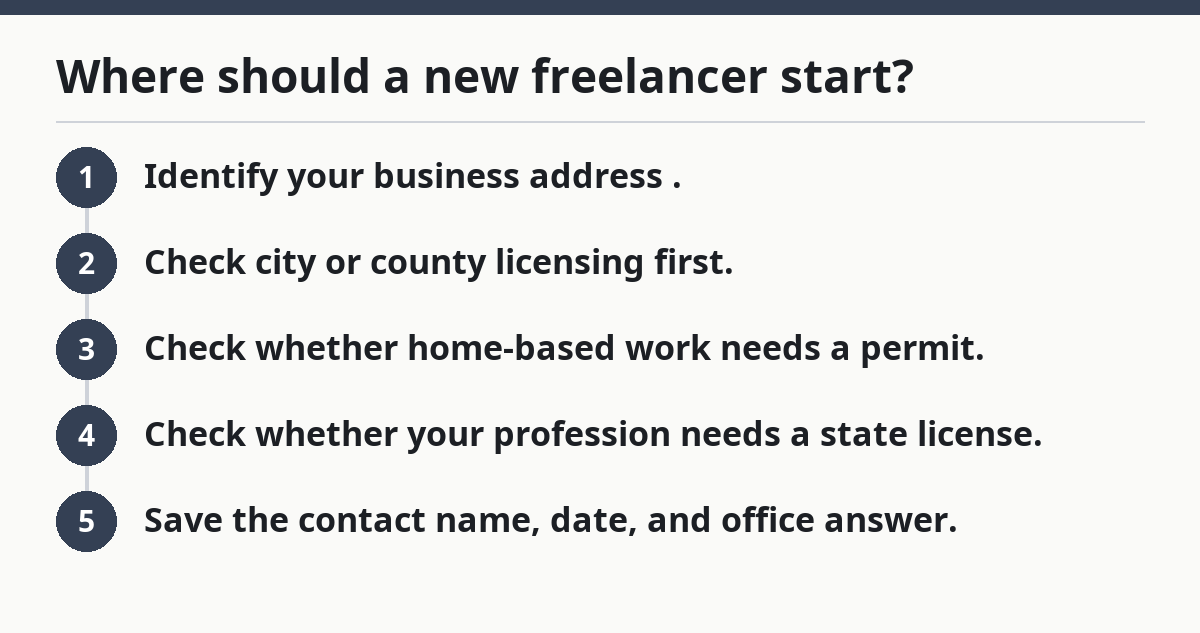
Use this order:
- Identify your business address.
- Check city or county licensing first.
- Check whether home-based work needs a permit.
- Check whether your profession needs a state license.
- Save the contact name, date, and office answer.
This approach keeps the process local and practical. It also fits the rest of your setup work, which the broader freelance business formation and setup guide covers in more detail. That broader page belongs to the structure of the business; this page stays on the license question.
A clean answer usually comes from the office that enforces the rule, not from a forum thread. If the office says “no license needed,” keep that answer in writing if you can. If it says “yes,” ask exactly which license and which renewal cycle apply. For more context, check the U.S. Small Business Administration’s local licensing pages, the IRS page on business structures and self-employment tax, and your city or county licensing office.
Do all freelancers need a business license?
No, not all freelancers need a business license. Some cities and counties require one for nearly every business, while others only require registration in certain cases or for certain addresses. The real answer depends on your location and whether your work is regulated by a state board.
Is a city license different from a state license?
Yes, a city license is different from a state license. A city license usually lets you operate in that local area, while a state license usually covers a regulated occupation such as a licensed profession.
Drafted with AI; not yet reviewed by a person.
