

Last updated: November 19, 2026
Key Takeaways
- A clear revision policy limits delays by stating what is included, when feedback is due, and what happens after the final approved round.
- Freelancers add a revision policy by naming the included rounds, the feedback deadline, the approval process, and the fee for extra changes in the contract language itself.
- The wording works best in one short clause with plain terms, not a page of lawyer-speak.
- The right number is the smallest number that still fits the job and the budget.
Freelancers need a revision policy in the contract because it caps endless edits and sets the rules before the first draft goes out. This article explains how freelancers add a revision policy to a client contract, where to place it, what to say, and how to keep scope creep from turning one project into five. A quick answer: most freelancers can start with 1 to 3 revision rounds, a 3- to 5-day feedback window, and written sign-off before final delivery.
What a revision policy has to do in a freelance contract
A revision policy has to define the review rounds, the feedback deadline, the sign-off point, and any fee for work outside scope. Picture this: you finish a 12-page website copy draft, and the other side sends back round after round of tiny changes for three weeks. A clear revision policy stops that drag by saying what is included, when feedback is due, and what happens after the last approved round.
A revision policy is not filler text. It is the part of the contract that sets the number of review rounds, the feedback deadline, the sign-off point, and any fee for work outside scope. Here’s the catch: if you leave any of those pieces vague, the project can slip into scope creep fast. The U.S. Small Business Administration recommends clear written agreements for managing client expectations, and the American Bar Association also emphasizes clear contract terms for business risk.
The best version is usually short, plain, and tied to the work itself. For a logo job, that may mean 2 rounds. For a long-form article package, it may mean 1 round of consolidated notes plus 1 final polish. The exact number matters less than the fact that it is written down.
- It tells the buyer when edits stop.
- It tells the freelancer when the draft is done.
- It gives both sides a clean line between included work and extra work.
- It keeps the contract usable when memory gets fuzzy later.
How do freelancers write a revision policy?
Freelancers write a revision policy by naming the included rounds, the deadline for feedback, the approval process, and the fee for extra changes in the contract language itself. That sounds simple because it is, but the order matters.
Start with the work itself. A 3-page landing page does not need the same review structure as a 40-slide pitch deck. Then decide what “revision” means. If one round includes only changes from the draft, say that. If it also includes fact checks or tone changes, say that too. For a practical overview of plain-language contract terms, see the FTC’s guidance on clear business communication and the Cornell Legal Information Institute on contract basics.
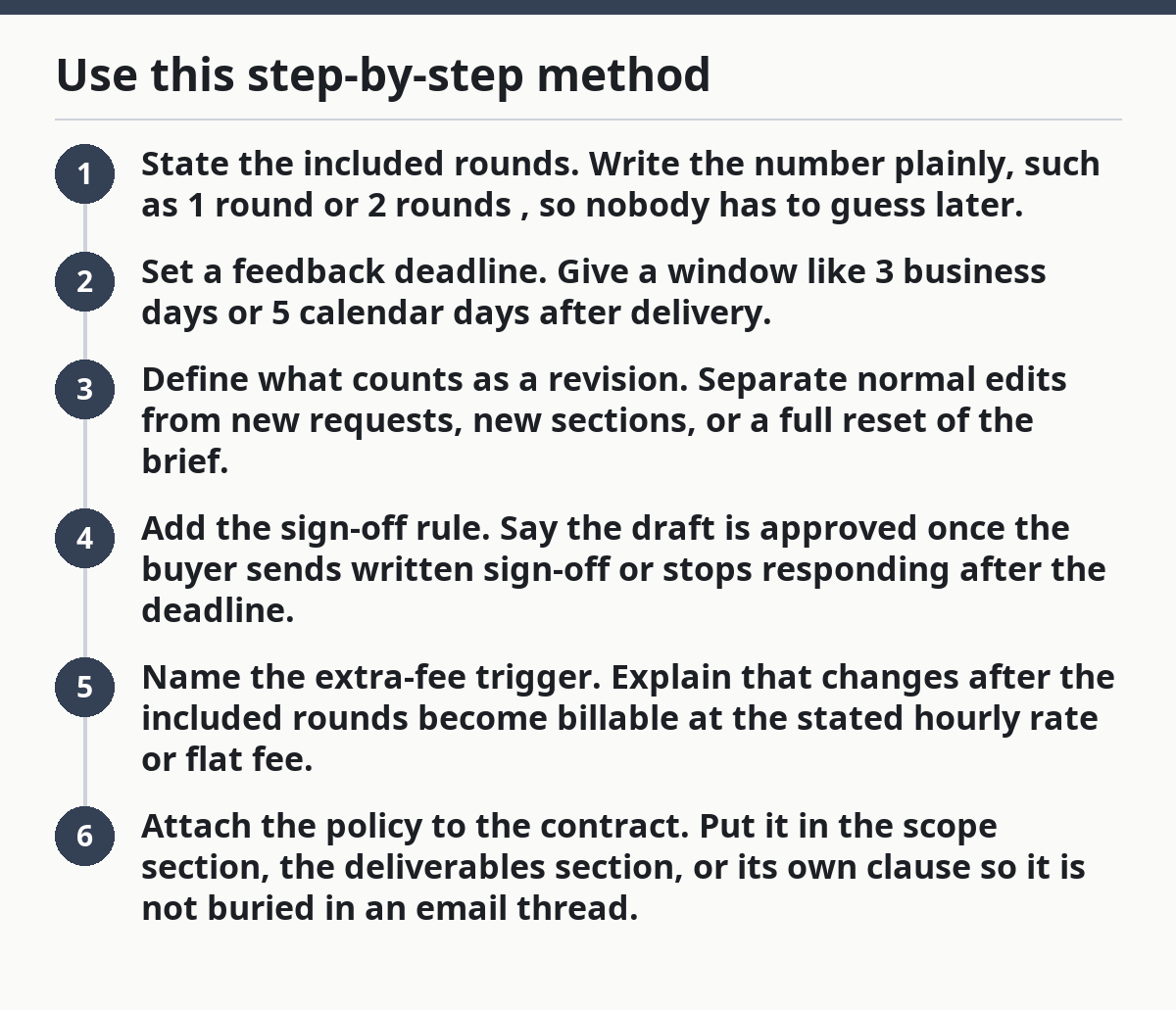
Use this step-by-step method
- State the included rounds. Write the number plainly, such as 1 round or 2 rounds, so nobody has to guess later.
- Set a feedback deadline. Give a window like 3 business days or 5 calendar days after delivery.
- Define what counts as a revision. Separate normal edits from new requests, new sections, or a full reset of the brief.
- Add the sign-off rule. Say the draft is approved once the buyer sends written sign-off or stops responding after the deadline.
- Name the extra-fee trigger. Explain that changes after the included rounds become billable at the stated hourly rate or flat fee.
- Attach the policy to the contract. Put it in the scope section, the deliverables section, or its own clause so it is not buried in an email thread.
The best part is that you do not need legal drama to make this work. Clear writing and a firm sequence solve most of the problem.
What wording belongs in the clause?
The wording belongs in one short clause that uses plain terms, not a page of lawyer-speak. A revision clause works best when it says what is included, what is excluded, and what happens after the included rounds end.
A strong clause usually contains four pieces: the number of rounds, the response window, the approval rule, and the extra-fee rule. For example, a draft can say “This project includes 2 rounds of revisions. Feedback must be returned within 5 business days of delivery. Additional revisions or new directions will be billed at the agreed rate.”
That structure matters because it closes the loopholes. “Revision” alone can mean a typo fix, a structural rewrite, or a fresh direction that changes the whole job. The contract should not leave that open.
A useful clause does this:
- names the number of rounds
- gives a deadline for notes
- says who must approve the work
- states what happens after approval or silence
- separates new requests from revisions
On the flip side, a vague line like “reasonable revisions included” invites argument. “Reasonable” sounds friendly and fails on contact.
How many revision rounds should a freelancer include?
The right number is the smallest number that still matches the job and the budget. A freelancer often includes 1 to 3 rounds, but the real answer depends on the type of work, the number of decision-makers, and how much draft-stage uncertainty the project has.
A one-person buy-in is simpler than a committee. If one person is approving a one-page bio or a 500-word article, 1 round may be enough. If a marketing team, brand lead, and founder all want different things, 2 rounds may still feel tight. More rounds sound generous, but they often hide a weak brief.
This is where scope creep starts. Extra rounds can become a workaround for unfinished decisions, not real edits. That costs time on both sides and can wreck the schedule for other paid work.
- Use 1 round for small, low-risk deliverables with clear direction.
- Use 2 rounds for most standard freelance projects.
- Use 3 rounds only when the work is complex and the brief is still being shaped.
- Avoid “unlimited” unless the project is tiny and the price already assumes that load.
The truth is, unlimited revisions are rarely free. They just move the cost into your calendar.
How freelancers charge for extra revisions
Freelancers charge for extra revisions by tying the added work to a clear fee in the contract, either as an hourly rate, a flat add-on, or a new mini-project. The cleanest version says the included rounds are free and everything after that is billed separately.
The pricing model should match the kind of work. An hourly rate fits open-ended edits, especially when a note set could take 15 minutes or 3 hours. A flat fee works better when the extra round is easy to define, like one more pass on a homepage or one more edit batch on a proposal. For work that changes direction, a new scope line is often smarter than a revision fee.
Here’s the catch: if the contract says extra revisions are billable but never says how billing works, the clause is weak. The reader should know whether the fee starts at the first hour, the first half-hour, or a set flat amount. If there is a minimum charge, write that down too.
A clear fee clause can say:
- extra revisions are billed after the included rounds
- the rate is the same as the project’s agreed hourly rate
- new requests beyond the approved scope require a new estimate
- work begins only after written approval of the added cost
That keeps the project from turning into unpaid cleanup.
What causes scope creep, and how does the policy stop it?
Scope creep happens when the work keeps growing after the contract is set, and a revision policy stops it by drawing a bright line between edits and new work. That line is the difference between a normal project and a job that quietly doubles.
The usual causes are easy to spot. A buyer gives scattered feedback from three people. Someone changes the brief after seeing the first draft. A late-stage “small tweak” turns into a new section, a new voice, or a new design direction. Each of those can eat hours.
A revision policy helps because it gives the freelancer a way to say, “That is outside the included rounds.” It also gives the buyer a fair way to ask for changes without guessing what is free. The policy works best when it defines the size of the feedback window and the number of decision-makers allowed to comment. For more context on preventing scope creep, PMI’s project-management guidance and the Freelancers Union both stress written boundaries.
A solid policy cuts off creep by requiring:
- one consolidated feedback message
- a fixed deadline, such as 48 hours or 5 business days
- one approval path, not a chain of side comments
- written sign-off before final delivery
- a new estimate for new work
When should sign-off happen?
Sign-off should happen after the last included revision round and before final handoff, because that is the point where the draft becomes the approved version. Once sign-off is given, the freelancer should not keep revisiting old notes unless the contract says so.
A sign-off line can be very simple: “Final approval must be given in writing by email or project message.” That language is enough for most freelance work. If no reply arrives by the feedback deadline, the contract can say silence counts as acceptance. That is useful, but only if the policy says it clearly.
The sign-off stage matters because it ends the edit loop. Without it, a finished draft can sit in limbo while one more idea keeps surfacing. That costs time and makes delivery dates slippery.
A good sign-off rule should answer three questions:
- Who approves the work?
- How is approval given?
- What happens if the deadline passes with no reply?
If the contract answers those three things, the last step feels clean instead of fuzzy.
Common mistakes freelancers make with revision policies
Freelancers make the biggest mistake when they treat the revision policy like a throwaway line. If you are unsure whether a clause is enforceable in your jurisdiction, consult a qualified attorney or other licensed professional. The fix is not fancy. It is specificity.
Another common mistake is mixing revisions with new scope. If the buyer asks for a fresh section, a different format, or a full rework after approval, that is not a normal revision. It should trigger a new estimate or a change order. The cost of missing that line is time lost to work that should have been billed.
A third mistake is skipping the deadline. Without a 3-day, 5-day, or other clear response window, notes can arrive weeks later and restart the whole job. That turns one project into a moving target.
Watch for these traps:
- Unlimited revisions with no price adjustment
- feedback from multiple people with no single approver
- no written sign-off step
- vague words like “minor changes” with no definition
- no extra-fee language for post-approval edits
The best contract language is boring in the best way. It leaves no room for guessing.
A sample structure you can adapt
A simple structure keeps the policy easy to read and hard to miss. For most freelancers, the revision language can sit in a 4-part clause near the deliverables section, where it is visible before anyone signs.
A practical structure looks like this:
- Included revisions: “This project includes 2 rounds of revisions.”
- Deadline: “Feedback is due within 5 business days of delivery.”
- Approval: “Final sign-off must be sent in writing.”
- Extra work: “Any revisions requested after approval or after the included rounds are billed at the agreed rate.”
That is enough for many contracts. If the work is larger, add one sentence that defines what a revision is and what counts as new scope. If the work is smaller, keep the clause tight and short.
This page belongs in the larger freelance contracts and client policies hub, because revision rules work best when they sit next to the rest of the working agreement. The contract should read like one system, not a pile of disconnected rules.
A good revision policy does one thing very well: it makes the end of the project obvious.
How many revisions should a freelancer include?
A freelancer should include the smallest number of revisions that fits the job, the budget, and the level of uncertainty in the brief. For many projects, 2 rounds is a fair middle ground, while small jobs can use 1 round and more complex work may need 3 rounds.
Should revisions be unlimited in a contract?
Unlimited revisions should almost never be the default in a contract. They make it hard to define when the job ends and they invite scope creep. If a project truly needs open-ended changes, the price and timeline should be built for that load from the start.
How do I charge for extra revisions?
Charge for extra revisions by naming the billing method in the contract before work starts. Use an hourly rate, a flat add-on, or a new project estimate, and say exactly when the extra fee starts. The reader should know whether the extra work begins after the second round, after approval, or after the deadline passes.
Drafted with AI; not yet reviewed by a person.
