

Last updated: November 19, 2026
Quick answer: Freelancers usually choose a registered agent for an LLC by checking three things first: state compliance, privacy, and mail handling. If you want the shortest path, pick the option that has a real street address in your state, accepts service of process during business hours, and sends compliance notices quickly. In the language of How Freelancers Choose a Registered Agent for an LLC, that usually means a commercial service if you want your home address off public records.
Freelancers choosing a registered agent for an LLC need one thing that works in their state, keeps their home address off public records when possible, and handles legal mail without missing a deadline. In short: pick a registered agent that is available during business hours, accepts service of process in your state, and sends compliance notices fast enough for you to act on them. The steps below show how to check that before you file.
Key takeaways
- Your registered agent is the point of contact for legal and state mail, not a marketing extra.
- Privacy matters because the agent’s address can appear in public filing records in many states.
- Compliance mail handling matters more than a slick website; missed notices can snowball into late fees or a state problem.
- A cheaper service is not always the safer choice if it is weak on scanning, reminders, or in-state coverage.
- You can change agents later, but it usually means another filing and another state fee.
What a freelancer should want from a registered agent

Picture this: you’re filing an LLC for freelance work, and you want your home address to stay out of public view while state notices still reach you on time. A good registered agent for a freelancer does three jobs well: it has a real street address in your state, it accepts legal mail and service of process during normal hours, and it gets you scanned documents or alerts fast enough to act.
Because of that, the service you pick should match the job you actually need done. Some services are built for privacy. Others are good at compliance mail but weak on follow-up. A few are just a filing add-on. You want the one that fits your state rules and your workflow.
Look for these basics:
- A physical street address in the state where your LLC exists; no P.O. box.
- Coverage during normal business hours, usually 9 to 5 on weekdays.
- Clear handling for service of process and state mail.
- A system for scan-and-upload or same-day notice when papers arrive.
- A way to update your contact info if you move or change email.
If you’re building the rest of your freelancer setup, this choice sits inside the larger plan for your LLC. The hub page on freelance business formation and setup covers the bigger picture; this page stays focused on the registered agent piece.
How do I choose a registered agent for my LLC?
You choose a registered agent for your LLC by checking state rules first, then comparing privacy, mail handling, and change steps. The best choice is the one that satisfies your filing office, protects the address you want hidden, and gives you a dependable path for notices and state mail.
Start with the state filing office rules for the state where the LLC will be formed. Some states allow you to be your own registered agent if you meet residency and street-address rules; others make that possible only if you have a real address in-state. If your home address is public and you want it hidden, a commercial service is the cleaner fit.
Then compare the service on these points:
- State fit — The service must support the state where your LLC exists.
- Privacy — The agent’s address should be the public contact, not your home.
- Mail handling — Look for same-day or next-business-day scanning and alerts.
- Availability — Someone must be present during business hours to accept papers.
- Change process — Check how hard it is to switch later if your needs change.
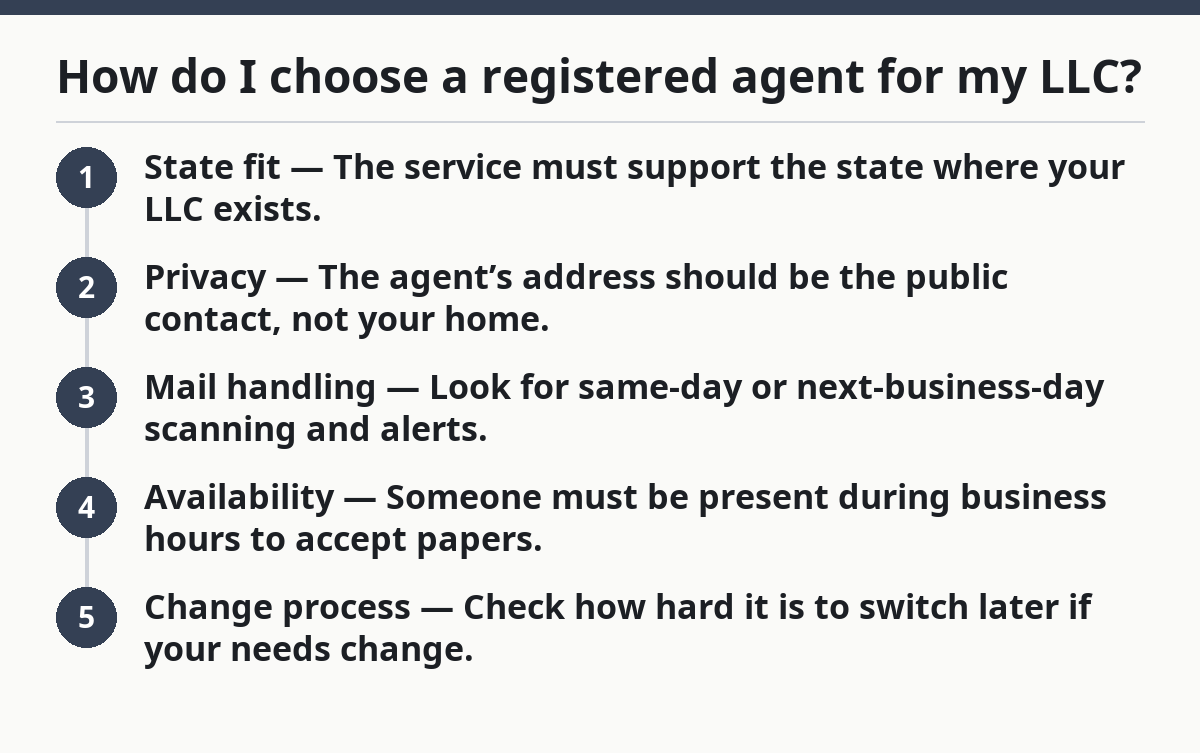
What you should see when this works: the service clearly says which states it covers, what happens when legal mail arrives, and how fast you get a notice. If the website is vague about any of those, keep looking.
1. Check your state’s filing rules before you compare services

Picture this: you’ve found a cheap agent, but your state requires a street address in-state and the service only works through a third-party network. That mismatch costs time and can delay filing. Start with the state filing office rules, because the agent has to fit the state first, not the other way around.
Read the instructions on the state filing office site or the LLC formation page for your state. You’re looking for three facts: whether the agent needs a physical address in the state, whether an individual can serve as their own agent, and whether the state lists any extra requirement for business entities.
Use this quick check:
- Does the state require a street address, not a P.O. box?
- Must the registered agent be available during normal business hours?
- Can you use your own address if you live in-state?
- Does the filing office require a name, address, and signature for the agent consent?
If the answer is unclear, pause before you pay a service. A registered agent that works in one state may not fit another state’s rules. That matters if you expand later and form foreign LLC registrations in more than one state.
For a state-by-state overview, the SBA explains that most states require every LLC to appoint a registered agent, and many require a physical street address rather than a P.O. box. That is why the filing-office rule comes before the price comparison.
Here’s the practical result you want: your chosen service should already say, “We support LLC registered agent service in [your state].” If it doesn’t, the rest of the comparison is wasted.
2. Decide how much privacy you need from public records
Picture this: you freelance from home, and you do not want clients, vendors, or random search results tying your personal address to your LLC filing. Privacy is often the main reason freelancers hire a registered agent, because the agent’s address may show up in state records instead of your own.
The privacy question is simple: do you want your home address on the public filing, or do you want a separate registered agent address used on the record? If the answer is “not my home,” a commercial agent usually makes more sense than listing yourself.
Pay attention to what the service does with your data:
- Does it use its own business address for official filings?
- Does it post your name or contact details anywhere public beyond what the state requires?
- Does it forward mail, or only scan legal notices?
- Does it keep your personal inbox separate from compliance notices?
A real privacy benefit comes from using the agent address for the public filing, not from a nice-looking dashboard. If a service claims privacy but still wants your home address in forms it files on your behalf, that is a warning sign. Not all privacy promises are equal.
According to the FTC, businesses should limit personal information collection and understand how that data is used. For freelancers, that makes the registered agent choice part privacy decision and part filing decision.
The trade-off is plain: privacy usually costs more than doing it yourself, and you still need to keep your own records current. But for a freelancer who works from a spare bedroom or kitchen table, that trade is often worth it.
3. Compare mail handling like it affects deadlines, because it does
Picture this: a notice from the state arrives while you’re on a client call, in a co-working space, or away for a week. A registered agent that only forwards mail slowly can turn a small notice into a bigger problem. The point is not just receiving mail — it’s knowing what came in and how fast.
Ask how the service handles these three things:
- Service of process — what happens if a lawsuit or formal notice is delivered?
- Compliance notices — does it flag annual report reminders or state letters?
- Delivery speed — how quickly do you get scanned copies or alerts?
A good service tells you its process in plain language. You should know whether it scans documents the same day, emails you when mail arrives, and keeps a log you can search later. If the only promise is “we’ll forward your mail,” that is too thin.
Use this simple decision rule:
- If you check email every day and want fast alerts, choose a service with scan-and-upload.
- If you travel a lot, pick one with reliable notice handling and a clean archive.
- If you rarely miss admin tasks, a basic service may be enough as long as it is prompt.
The limitation is worth naming: a registered agent is not a substitute for your own compliance system. It can alert you, but it cannot make you file on time if you ignore the reminder.
4. Pick a service that stays reachable during normal business hours
Picture this: your LLC gets served and the delivery happens at 11 a.m. while you’re editing a proposal. A registered agent must be reachable during business hours, usually a standard weekday window, because that is when service of process can legally be accepted.
This is where freelancers get tripped up. If you try to be your own agent while you’re in client meetings, on-site, or traveling, you may miss the knock. Missing a delivery can create extra fees, missed deadlines, or a scramble to fix records.
A strong service should give you:
- A real street address in the state
- Office coverage on weekdays
- A backup contact path if your email changes
- Document retention you can access later
If you are your own registered agent, ask yourself one blunt question: will you reliably be at that address during business hours all year? If the honest answer is no, a service is the safer fit. That does not make self-service wrong. It just makes it fragile for a freelance schedule.
For context, the IRS requires some business records and tax records to be kept for several years, and state notices can matter long after the original filing date. A reliable agent helps keep the paper trail organized from the start.
5. Watch for hidden costs in the change process, not just the signup pitch
Picture this: you sign up quickly, then six months later you move, switch states, or find a better agent. A registered agent should be easy enough to change, but the switch can still involve a state filing and a fee. That makes the change process part of the original choice.
Before you sign, ask how the switch works:
- Does the service help file the change with the state filing office?
- Is there a form, a signature, or a filing fee?
- How fast does the new agent start receiving mail?
- Will the old agent keep forwarding anything already received?
A service with a clean offboarding path is better than one that makes you dig through support emails for basic instructions. If the change process is buried, assume future headaches.
This is also where cheap can become expensive. A low-cost service that charges for every simple update may look fine at signup and annoying later. A freelancer who expects to grow, move states, or stop using the LLC should treat change support as part of the product, and should consider whether the service’s policy fits the move before acting.
6. Use a short scorecard before you choose
Because service pages can sound similar, use a scorecard before you pick one. A scorecard keeps you from choosing based on the prettiest homepage. Use one page of notes and judge each service on the same criteria.
Score each option on these items:
- State support — Does it clearly cover your LLC state?
- Privacy fit — Does it keep your home address off the public filing?
- Mail handling — Does it scan and alert quickly?
- Reachability — Is it staffed during normal business hours?
- Change support — Can you switch later without drama?
If two services are close, choose the one with clearer mail handling and a cleaner switch process. That is where freelancers usually feel the pain first. A fancy portal means little if state notices sit too long.
For a broader setup path, this choice fits into the larger freelance business formation and setup plan. The registered agent is one piece, but it is one of the pieces that can break quietly.
7. Red flags that mean you should keep looking
Picture this: a service promises privacy, but its site never says whether it uses a real state address or how it handles legal mail. That’s not a detail to skip. It’s a sign you may be buying noise instead of support.
Walk away if you see any of these:
- No clear in-state business address
- Vague language about service of process
- No mention of compliance notices or mail scans
- No weekday coverage or contact method
- A confusing or missing change procedure
A freelancer does not need a giant corporate package. You need reliability, plain terms, and a service that does the boring part right. If a provider hides the boring part, it usually hides the part you’ll care about later.
Can I be my own registered agent?
Yes, if your state allows it and you meet the address and availability rules. That usually means a real street address in the state and someone there during normal business hours to accept service of process.
The downside is simple: your own schedule has to support it. If you travel, work on-site, or do client visits during the day, self-service can be a poor fit. A commercial registered agent is often better for freelancers who want privacy and less risk of missing mail.
What does a registered agent do?
A registered agent receives legal papers and state notices for your LLC and passes them to you. That includes service of process, annual report reminders, and other compliance mail from the state filing office.
The agent’s job is not to run your company or manage clients. It is a contact point with a public address and a reliable workflow for mail that matters. For a freelancer, that can keep your home address off records and help you stay on top of filings.
Do I need a registered agent for my LLC?
Usually yes, because an LLC normally must have a registered agent listed with the state. The exact rule depends on the state filing office, but the filing usually won’t work without one.
If you’re forming an LLC as a freelancer, treat the agent as part of the filing package, not an afterthought. Because rules vary by state, it is smart to confirm the filing-office requirement and, if needed, consult a professional before you file. The right choice protects privacy, handles state mail, and keeps your compliance notices in one place.
Can I change my registered agent later?
Yes, you can change your registered agent later in most states. The change usually involves a state form, a filing fee, and an update to the LLC record.
That flexibility helps if you start with yourself and later want privacy, or if you outgrow a basic service. Just make sure the new agent is active before you switch, so there’s no gap in service of process coverage. If you are changing agents because your business structure is changing too, check the state instructions or consult a professional so the filing stays clean.
Drafted with AI; not yet reviewed by a person.
