

Last updated: November 19, 2026
Quick Answer: a freelance scope of work should include 6 essentials: deliverables, timelines, revision limits, an approval process, out-of-scope work, and assumptions.
What to include in a freelance scope of work depends on the project, but those 6 parts are the core of a clear scope before pricing, payment terms, or contract clauses come into play. This guide shows you what belongs in that document so the project stays clear before pricing, payment terms, or contract clauses come into play.
Key Takeaways
- A scope of work is the project map, not the whole contract.
- List the exact deliverables first, then define when each one is due.
- Put revision limits in writing so feedback does not turn into endless rework.
- Spell out who approves the work and what counts as approval.
- Add a short out-of-scope list so extra requests do not quietly expand the job.
- Write down assumptions when your timeline or output depends on client input.
What belongs in a freelance scope of work?
A freelance scope of work should name the deliverable, the deadline, the revision limit, the approval process, and anything outside the job. That is the minimum that keeps a project from turning fuzzy after the first draft.
For a small project, that may be enough; for a larger one, it may need more detail. The page should answer, in plain language, what you’ll make, when you’ll hand it over, and what happens after the first version.
Here’s the catch: a good scope of work is specific enough to reduce scope creep, but short enough that a client will actually read it. If it reads like a 12-page legal memo, it often fails at the one job it has.
Use this checklist as the core of the scope:
- Project goal: one sentence on what the work is meant to accomplish.
- Deliverables: the exact files, pages, posts, mockups, or edits you will hand over.
- Timeline: key dates, milestone dates, or a final due date.
- Revision limit: how many rounds of changes are included.
- Approval process: who signs off and how approval happens.
- Out-of-scope work: what is not included unless the client adds it later.
- Assumptions: what you are relying on from the client, such as copy, images, access, or feedback by a certain date.
A scope of work does not need to sound polished to be useful. It needs to be clear enough that a client can approve it without guessing.
What should the deliverables say?
Deliverables should describe the exact output, not just the type of work. “Blog post” is weak; “one 1,200-word blog post in Google Docs with two headline options” is usable.
For example, if you’re writing a scope for a design job, and the client says they want a “brand refresh,” that phrase can mean a logo tweak, a color update, or a full identity system. Your scope has to pin down the file type, the count, and the format so the deliverable can’t be stretched later.
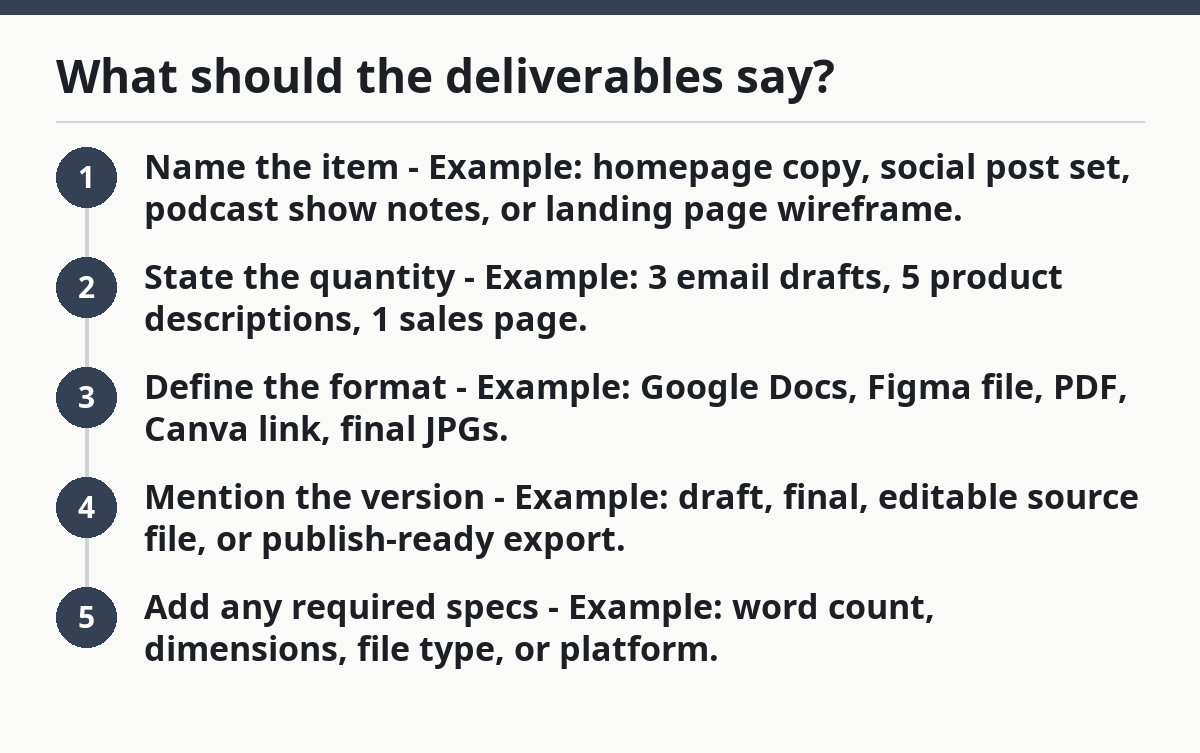
A strong deliverables section usually includes:
- Name the item
– Example: homepage copy, social post set, podcast show notes, or landing page wireframe. - State the quantity
– Example: 3 email drafts, 5 product descriptions, 1 sales page. - Define the format
– Example: Google Docs, Figma file, PDF, Canva link, final JPGs. - Mention the version
– Example: draft, final, editable source file, or publish-ready export. - Add any required specs
– Example: word count, dimensions, file type, or platform.
A vague deliverable invites a vague response. If you leave out the number or format, the client may assume the work includes extra versions, extra channels, or extra polish. That gets expensive fast.
The truth is, deliverables are where many freelancers lose money. They describe the job in a way that sounds friendly, then spend 3 extra hours producing things nobody formally asked for.
How detailed should the timeline be?
The timeline should be detailed enough to show the work sequence, not just the final due date. A single end date is usually too thin, especially when the client has to review drafts or send assets.
For a website copy project, the timeline can also show when the client must send photos or product names. If your scope only says “delivery in two weeks,” you have no clean way to show that the delay came from missing input. A simple timeline avoids that mess.
Use an
- to build the timeline section in a way the client can follow:
- Start date: note the date work begins, so both sides know when the clock starts.
- Milestones: list checkpoints such as outline, first draft, review, and final delivery.
- Client input dates: add due dates for feedback, assets, or approvals if your work depends on them.
- Final date: state the date the completed deliverable is due, not just “after review.”
- Delay rule: say what happens if client input arrives late, such as the schedule shifting by the same number of days.
- Number of revision rounds: 1, 2, or another clear count.
- What counts as a revision: grouped feedback versus a full rewrite.
- What does not count: new pages, new topics, or a change in direction.
- Approver name or role: one person, one team lead, or one designated contact.
- Approval method: email, comment resolution, signed form, or project tool sign-off.
-
New deliverable types
Example: adding email campaigns to a copy project. -
Extra revision rounds
Example: more than the agreed number of feedback cycles. -
Strategic work
Example: brand positioning, market research, or campaign planning if you were hired to execute. -
Source gathering
Example: hunting for images, statistics, or contacts if the client is supposed to supply them. -
Platform changes
Example: converting one approved asset into 4 other formats. - Client will send needed files by a certain date.
- One named contact will provide feedback.
- Existing brand assets are usable.
- Content approvals will happen within the stated timeline.
- Access to tools, accounts, or platforms will be granted before work starts.
- Start with the project goal in one sentence.
- List each deliverable with a count and format.
- Add dates or milestones.
- State the revision limit.
- Name the approver and approval method.
- Add a short out-of-scope line.
- Finish with assumptions tied to client input.
A timeline does two jobs at once. It shows the order of work, and it gives you a record of who was supposed to do what by when. That matters when a project stalls at draft stage and everyone has a different memory of the deadline.
For fast-turn work, a 24-hour review window or a 3-business-day window can keep things from dragging. For longer jobs, a milestone plan works better than one lump date at the end.
What should revision limits and approval process cover?
Revision limits and the approval process should say how many change rounds are included and who can sign off on the work. Without those two pieces, “small edits” can become a full second project.
For a brochure draft, three people from the client side may send notes separately. One wants the tone warmer, one wants new copy, and one wants a different layout. If your scope does not name the approver, you end up chasing opinions instead of finishing work.
Use these points to tighten the section:
A revision limit is not rude. It is a boundary that keeps feedback useful. If you do not set one, every new stakeholder can treat the project as if it is still in draft mode, so it is wise to consult a professional if the approval chain is complex. A clear revision limit also aligns with basic project-management guidance on controlling changes and sign-off, such as the Project Management Institute’s overview of scope management: https://www.pmi.org/learning/library/project-scope-management-baseline-factors-6816.
The approval process matters just as much. A scope that says “client approval required” without naming the approver leaves room for delay. One person says it is done. Another says they never saw it. The result is a stalled handoff.
If a client needs more than the included revision rounds, the scope should say that extra rounds are billed separately or handled under a new scope. That line prevents the quiet creep that can eat margin, so it is wise to consult a professional if pricing or scope control is uncertain. For a related business overview of scope creep, see the U.S. Small Business Administration: https://www.sba.gov/business-guide/plan-your-business/write-your-business-plan.
What counts as out-of-scope work?
Out-of-scope work is anything not listed in the scope, and it should be named before the project starts. If you do not define that boundary, extra asks start looking like part of the original job.
For a copy project, the client may ask for SEO research, meta descriptions, and a homepage rewrite after the first round. None of that is impossible, but none of it should be implied if it was not included. A short out-of-scope list stops the slow expansion.
A useful out-of-scope section often covers:
This section helps because clients often assume related tasks are bundled. A blog post writer may get asked for social captions. A designer may get asked for print setup files. A developer may get asked for browser testing on devices not named in the scope.
The best out-of-scope language is often plain, not defensive. “Any work not listed above is outside this scope” is cleaner than a long warning paragraph. Short lines are easier to enforce than broad complaints after the fact.
Which assumptions need to be written down?
Assumptions should cover anything the project depends on that you do not control. If the work only works when the client sends assets, feedback, or access on time, say so in the scope.
For a newsletter sequence, the client may still have not sent the product names, brand voice guide, or login access after a week. If the scope assumes those items will arrive by a set date, the delay is visible instead of mysterious.
Write down assumptions such as:
Assumptions are not filler. They are the quiet rules that make the timeline possible. If you skip them, the scope can look complete while still depending on things you never received.
This is also where you note any standards or file rules that matter to the job. For example, if the deliverable must be in APA style, WCAG-friendly format, or a specific file type like .docx or .pdf, that belongs here or in deliverables. A client who has to guess the format is a client who will ask later.
The cleanest scopes name the assumption and the result if it fails. If assets arrive late, the schedule shifts. If feedback comes from more than one person, approval pauses until one person is designated. That kind of wording keeps the work moving.
How do you write the scope so a client actually uses it?
The scope gets used when it is short, specific, and easy to scan in under 5 minutes. If a client has to read three dense paragraphs to find the revision limit, the document is too hard to use.
When you are drafting a scope from a client call, the fix is not more formal language. The fix is a clear structure: goal, deliverables, timeline, revisions, approval, exclusions, assumptions. That order mirrors how the project will unfold.
A practical writing order looks like this:
Keep each line tied to one idea. If a sentence tries to cover deliverables, timeline, and revisions at once, it will be hard to enforce later. Short clauses are easier to point back to when questions come up.
A 1-page scope may be enough for a small writing job. A multi-stage campaign may need more detail. The goal is not length; it is clarity. That is why the freelance contracts and client policies hub works best when the scope stays focused on the work itself instead of trying to solve every contract issue in one document.
If you want the client to sign off quickly, write the scope like something a busy person can approve in one pass. The document should answer one question: “What exactly am I buying?”
What is the difference between a scope of work and a contract?
A scope of work defines the job, while a contract covers the legal terms around the job. The scope says what will be done, by when, and with what limits. The contract usually handles payment, rights, liability, and other terms outside the work itself.
How detailed should a freelance scope of work be?
A freelance scope of work should be detailed enough that a stranger can tell what is included and what is not. That usually means naming the deliverables, the timeline, the revision limit, and the approver. If a client could read it and still ask “What do I actually get?”, it needs more detail.
Should a scope of work include revisions?
Yes, a scope of work should include revisions if you want to avoid unlimited edits. State how many rounds are included and what counts as a revision versus a new request. That keeps feedback contained and helps both sides know when the project is finished.
Drafted with AI; not yet reviewed by a person.
