

Last updated: November 19, 2026
Freelancer tax operations and compliance means setting up a repeatable system for invoicing, tracking income and expenses, making estimated payments on time, and filing the right forms in the right country. The answer is a process, not a single form. This guide to Freelancer tax operations and compliance lays out the steps, the records, and the failure points that trip people up.
Information only: this is general tax information, not financial advice. Tax rules vary by country and change often, so a qualified adviser should review your own situation.
Key takeaways
- Freelance tax compliance is mostly recordkeeping, timing, and the right classification of income and expenses.
- The hard part is not filing once a year; it’s building monthly habits that keep your numbers clean.
- A separate bank account, invoice log, receipt system, and payment calendar cut most avoidable problems.
- Estimated tax payments, sales tax or VAT/GST, and self-employment tax can all apply, but the rules depend on where you live and where clients are based.
- If your work crosses borders, the paperwork gets more complicated fast. That should be treated as an early warning, and a qualified professional should review it. See the IRS self-employment tax guidance and UK self assessment guidance for country-specific examples.
What freelancer tax compliance actually covers
Freelancer tax compliance covers the full chain from the day you get paid to the day you file, and it starts before your first invoice. If you earn from contract work, consulting, design, writing, coding, or similar self-employed work, you usually need to track income, classify business expenses, and keep proof for each item. The exact forms and deadlines depend on your country, and in some places on your turnover, client location, and business structure.
Picture this: you’re juggling three clients, two payment apps, and a stack of receipts in your email inbox. The work is fine, but your tax trail is scattered, and that is where compliance breaks down. This section tells you what the system has to cover so you can see the moving parts before they become a filing problem.
- Income tracking: every invoice, deposit, refund, and chargeback.
- Expense records: receipts, bank statements, mileage logs, and subscription bills.
- Tax timing: monthly, quarterly, or annual payment deadlines.
- Filing duties: income tax, self-employment tax, VAT/GST, payroll if you hire help.
- Proof: records that show the business purpose of each deduction.
A good starting point is the tax authority in your country and, if relevant, the revenue agency in each country where you do business. For example, the UK government’s guidance on self assessment and the IRS page on self-employment tax explain core concepts for their systems. Those pages are country-specific, which is the point: there is no universal freelancer tax rulebook. The right standard is the one that applies where you pay tax.
How do you set up freelancer tax operations?
You set up freelancer tax operations by turning tax work into a monthly process with four parts: account separation, transaction capture, categorization, and deadline control. The goal is not perfection on day one; it is a system that can survive a busy month without losing records or missing a due date.
Picture this: it’s the first week of the month, and money has already moved through cards, transfer apps, and a client portal. If you wait until year-end, you’ll spend hours rebuilding what should have been captured in minutes. The steps below show the clean version of the process.
- Open a separate business account: route all client income and business spending through one bank account, and keep personal spending out of it. Verify that every client deposit lands in that account, and that personal groceries or rent do not. A mix of personal and business transactions is a problem because it breaks the paper trail and can make deductions harder to support.
- Create an invoice numbering system: use one sequence for all invoices, such as 2025-001, 2025-002, and so on. Verify that each invoice has a date, client name, service description, amount, currency, and payment terms. Gaps or duplicates make it harder to match income to bank deposits.
- Record income the day it arrives: log each payment within 24 hours of receipt, even if it sits in a payment platform before transfer. Verify the gross amount, fees, and net deposit. If you only track net deposits, you can understate revenue and miss fee deductions.
- Save receipts at the point of purchase: keep a digital copy the same day for software, equipment, internet, travel, and subcontractors. Verify the vendor name, date, amount, and what the item was for. A receipt with no business purpose is weak support if a tax authority asks for proof.
- Categorize expenses using fixed buckets: create categories such as software, supplies, home office, travel, insurance, professional fees, and marketing. Verify that each category is used consistently every month. If the same cost moves between categories, your reports stop being reliable.
- Track tax set-asides before spending: move a chosen share of each client payment into a separate tax savings account right away. Verify that the reserved cash matches your expected tax bill range, not the amount left over after spending. If the tax account stays empty, your filing date will become a cash crunch.
- Build a deadline calendar: list all filing and payment dates for income tax, estimated tax, VAT/GST, and local business tax if applicable. Verify each date against the official tax authority site, since deadlines can change when weekends or public holidays intervene. A missed date can mean interest, penalties, or both.
- Reconcile monthly: compare your invoice log, bank statement, and bookkeeping file once a month, ideally within 7 days of month-end. Verify that every deposit and withdrawal has a matching record. Unexplained differences are your signal to stop and fix the books before they grow.
That process scales. A solo freelancer and a small agency both need the same basic controls; only the volume changes. If you want the cleanest books, make the process boring and repeatable.
Which taxes can apply to freelancers?
Freelancers can face income tax, self-employment tax, VAT or GST, sales tax in some places, and local business taxes, but the mix depends on where you live and where you work. The hard part is not the names; it is knowing which tax applies to which transaction and when payment is due.
Picture this: one client is local, one is abroad, and one pays through a platform that deducts fees before money reaches you. That sounds simple until tax rules split the income into different buckets. This is where the generic advice gets people into trouble, because one country’s rules do not transfer cleanly to another.
- Income tax: tax on your profit or taxable income after allowed deductions.
- Self-employment tax or social contributions: separate charges in some countries for independent work.
- VAT/GST/sales tax: indirect tax that may apply to taxable supplies, depending on registration rules and client type.
- Withholding tax: tax taken off at source in some cross-border contracts.
- Local business tax or license fees: city or region-level charges that can sit on top of national tax.
The exact thresholds and rates vary by country and change over time, so the right move is to check the official tax authority for your jurisdiction before you assume anything. If you work across borders, also check the client’s country rules, because the place where the customer sits can change the paperwork. The EU, UK, Canada, Australia, India, and the US all have different structures, and none of them should be guessed from memory.
A useful habit is to label each income stream by tax type as soon as the contract is signed. That way, a one-off consulting job and a recurring retainer do not blur together. Labeling them early saves hours.
What records do you need to keep?
You need records that show what you earned, what you spent, when money moved, and why each business expense belongs to the work. Good records are not just for filing; they are the evidence behind your numbers if a return is reviewed later.
Picture this: your tax return is done, but six months later you cannot explain three expense lines or prove a client payment came from a business contract. That is when clean records matter most. The rule is simple: if a tax authority asked for support tomorrow, could you find it fast?
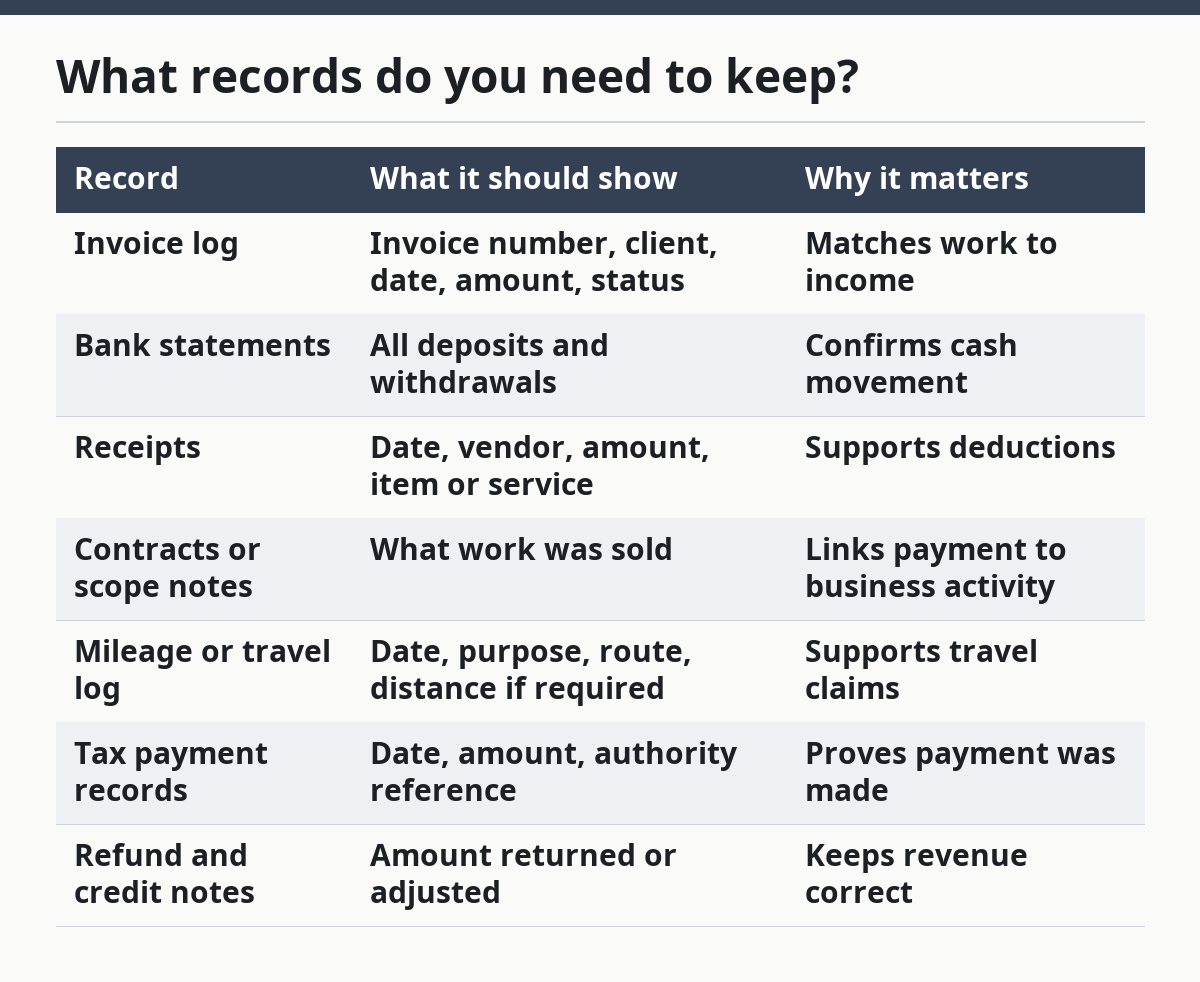
Use this checklist as a minimum record set:
| Record | What it should show | Why it matters |
|---|---|---|
| Invoice log | Invoice number, client, date, amount, status | Matches work to income |
| Bank statements | All deposits and withdrawals | Confirms cash movement |
| Receipts | Date, vendor, amount, item or service | Supports deductions |
| Contracts or scope notes | What work was sold | Links payment to business activity |
| Mileage or travel log | Date, purpose, route, distance if required | Supports travel claims |
| Tax payment records | Date, amount, authority reference | Proves payment was made |
| Refund and credit notes | Amount returned or adjusted | Keeps revenue correct |
If you use accounting software, make sure it can export a CSV or similar file, because a locked-in system creates headaches later. If you keep paper receipts, scan them at 300 dpi or better so the text remains readable. Blur, torn paper, and missing dates are all warning signs. The record may exist, but it may not hold up.
One more point: keep records for the period required in your country, which can differ by tax type. Do not guess on retention. The rule can be 3 years in one place, 5 or 6 in another, and longer if there is a loss carryforward or audit issue. Check the official source.
How do estimated taxes work for freelancers?
Estimated taxes work by making you pay part of your annual tax before the year ends, usually in installments, instead of waiting for one large bill. If no one withholds tax from your freelance income, the tax authority may expect payments during the year based on current or prior earnings.
Picture this: your work is steady, but no tax is being withheld by an employer. Your bank balance looks fine until the return is due and the bill lands all at once. Estimated payments are the system that prevents that surprise, but you should confirm the rules with a qualified professional or official tax authority guidance.
The practical method is straightforward:
- Estimate your taxable profit from the year so far.
- Separate income tax from self-employment or social charges, if both apply.
- Check the official payment schedule for your country.
- Pay on time and keep proof of payment.
- Revisit the estimate after a strong month, a weak month, or a big contract change.
The catch is that estimated tax is based on changing income, and freelancers rarely earn a flat amount every month. A contract ends. A late payment arrives. A new client starts. That is why the estimate should be reviewed more than once a year, not filed and forgotten.
A common mistake is to set aside tax only on the money that remains after expenses. That feels comfortable, but tax is due on rules, not on leftovers. Another mistake is to ignore platform fees or payment processor charges when estimating cash flow. Fees reduce cash in hand, but they do not erase the underlying income.
If your country uses a pay-as-you-earn system or requires advances on tax, the same principle applies: keep the due dates on a calendar, keep proof of each payment, and revise the estimate when income changes. The number itself is country-specific. The habit is not.
What mistakes do freelancers make with tax compliance?
Freelancers usually make the same six mistakes, and each one creates a very specific mess later. None of them are glamorous, and none of them are hard to avoid once you know the pattern.
Picture this: the year starts tidy, then receipts scatter, payments drift into personal accounts, and the return becomes a rescue job. That is the normal failure mode. The fix is discipline, not genius.
-
Mixing personal and business money. This makes it hard to show what was business income or a business expense. The better alternative is one business account and one personal account, with transfers clearly labeled.
-
Ignoring small expenses. Software, postage, bank fees, domain renewals, and subscription tools add up over 12 months. The consequence is an overstated profit figure. The better alternative is to log every business cost, even when the receipt is small.
-
Waiting until year-end to sort receipts. That turns a 15-minute task into a cleanup project with missing details. The result is lost deductions and more stress. The better alternative is weekly or monthly filing of receipts.
-
Guessing at cross-border tax rules. A foreign client can trigger withholding, VAT/GST, or registration duties you did not expect. The consequence can be underpayment or extra filings. The better alternative is to check the tax authority guidance for both countries before invoicing.
-
Treating all deposits as income. Some transfers are reimbursements, loan proceeds, or refunds. If you book them wrong, your revenue number becomes inflated. The better alternative is to label each deposit by source and keep the backup document.
-
Missing payment deadlines because cash flow was tight. Interest and penalties often start running once a due date passes. The better alternative is to ring-fence tax money as soon as income lands and use a calendar with reminders set 7 days early.
The truth is, most compliance errors are not about bad intent. They are about weak systems. A clean monthly routine beats a heroic year-end scramble every time.
When does the standard approach not apply?
The standard freelancer tax setup does not fit every case, especially when the work crosses borders, uses employees or contractors, or runs through multiple entities. That is where the simple “track income and file once a year” model stops being enough.
Picture this: you work through an agency, sell to overseas clients, and hire a subcontractor for part of the job. Now your tax picture has withholding, contractor payments, and maybe registration issues layered on top of basic income tracking. The standard approach still helps, but it needs extra rules.
You invoice through a platform that pays you net of fees: the platform statement may not match your gross income. — Record the gross amount, the fee, and the net deposit separately so revenue stays correct.
You sell to clients in another country: VAT, GST, withholding, or permanent-establishment issues may appear. — Check the client-country rules before billing, and keep the contract terms in writing.
You work with subcontractors: you may need vendor records, payment proofs, and possibly reporting forms. — Keep W-9, W-8, or local equivalent forms where relevant, plus invoices from the contractor.
You have mixed personal and business use items: home internet, phone, car, or office space may need apportionment. — Use a reasonable method and keep the calculation notes, not just the final number.
You change legal structure: moving from sole trader to LLC, limited company, or similar entity changes filings and sometimes tax treatment. A qualified adviser should review the change, and you should check the official rules before filing. — Separate the old and new business records from the date of change and do not blend them.
The moment your work stops looking like simple self-employment, the bookkeeping should get more formal, not less. That is the point where country-specific rules matter most, and a qualified adviser can help interpret them correctly.
How long does freelancer tax prep take, and what does good look like?
Freelancer tax prep takes far less time when it is done monthly, and the result is a set of books that can be filed without a rescue mission. A good system does not mean zero errors; it means small issues are easy to spot and fix.
Picture this: your records are complete, your categories are consistent, and your bank reconciliation takes less than an hour because the numbers line up. That is the sign of a healthy process. Bad records do the opposite: they hide problems until filing season, then turn every task into detective work.
A practical benchmark is this:
- Weekly: capture receipts and log new income.
- Monthly: reconcile bank activity and classify expenses.
- Quarterly: review tax estimates and payment deadlines.
- Year-end: prepare the return with all support in one place.
Good looks like this:
- each invoice has a matching payment or a clear open balance;
- each bank line has a business label or a personal label;
- receipts are stored in one folder or accounting app;
- tax payments are dated and confirmed;
- you can explain your revenue and expense totals without guessing.
This structure exists so scaling up from one client to ten is annoying, not chaotic. If you skip the structure, even one busy month can create a backlog. That is the trade-off. Speed now usually means cleanup later.
What should you check before filing?
You should check that your income, expenses, payment proofs, and deadline dates all match before you file anything. Filing is not just typing numbers into a form; it is confirming that the numbers came from a complete record set.
Picture this: the return is almost ready, but one client payment is missing, one expense is duplicated, and one tax installment was never recorded. Those are small errors with real consequences. The checklist below catches the ones that matter most.
- Did every invoice get recorded at gross value?
- Do bank deposits match the invoice log?
- Are refunds, chargebacks, and reversals handled correctly?
- Did you classify expenses using the same rules all year?
- Are personal purchases excluded from business deductions?
- Are estimated or installment tax payments logged?
- Are foreign-source payments checked for special reporting?
- Do your totals match your accounting software export?
If the answer to any of these is “not sure,” stop and reconcile before filing. A return built on uncertain numbers is not a return you should send yet. The fix is usually a missing receipt, a bank mismatch, or an unrecorded payment—not a full rewrite.
FAQ
Do freelancers always need to pay estimated tax?
No, but many do when no tax is withheld from their income. The rule depends on your country, your income level, and whether you already have tax withheld elsewhere. Check the official tax authority guidance for your location so you know whether installments apply.
Can I deduct home office costs?
Sometimes, yes, but the rules differ a lot by country. The space usually has to be used regularly and mainly for business, and the calculation method may be fixed or based on actual costs. Keep a simple floor-plan note or area calculation and save the bills that support the claim.
What if I get paid by PayPal, Stripe, or another platform?
Record the gross income, the platform fee, and the net deposit separately. The payment platform is a tool, not your tax rulebook, and its statements may not match the taxable amount in your country. Keep the monthly reports, because they often show transaction IDs that help during reconciliation.
Do I need an accountant to handle freelance taxes?
Not always, but complex cases often benefit from qualified help. Cross-border work, VAT/GST registration, multiple income streams, or entity changes are the points where mistakes get expensive. A good adviser can review the rules for your country and tell you where the edge cases are.
What is the biggest compliance mistake freelancers make?
The biggest mistake is waiting until filing season to clean up a year’s worth of records. That usually leads to missing receipts, bad estimates, and rushed decisions. A monthly routine is far easier to maintain and far safer than a year-end scramble.
Drafted with AI; not yet reviewed by a person.
