
Last updated: November 19, 2026
Key Takeaways
- Freelancers estimate annual tax liability by forecasting profit and applying the tax layers that apply to them.
- The estimate is only useful when it includes income, deductions, tax rates, and filing status.
- Set aside a percentage from your projected annual tax bill; don’t copy someone else’s rate.
- Most forecast errors come from routine bookkeeping mistakes and missed tax layers.
Freelancers estimate annual tax liability by projecting all taxable income, subtracting likely deductions, then applying the income tax, self-employment tax, and state tax rules that fit their situation.
The right number is a forecast, not a guess.
The steps below show how to build an annual tax liability estimate, spot weak assumptions, and decide how much to set aside.
What this estimate is for, and what it is not
This estimate is for freelancers who already have a rough idea of their yearly income and expenses and need a saving target for tax time. It assumes you can gather 12 months of income records, a list of business expenses, and the tax year rules that apply where you live. This is information, not financial advice; because tax rules differ by country and change often, a qualified adviser should review your own situation.
Picture this: you’re trying to decide how much of each client payment to set aside, and you don’t want to wait until April or year-end to find out you’re short. The estimate you build here is the annual tax liability estimate, which means the tax bill you expect for the full year before you start parking cash. It is the number that drives your set-aside plan.
This page covers the forecast itself, not quarterly payment timing or a worksheet for filing. It belongs beside the hub on freelancer taxes and deductions, but it stands on its own as the planning piece.
- You need income projection.
- You need deduction assumptions.
- You need to account for self-employment tax, estimated taxes, and state tax where relevant.
How do freelancers estimate taxes for the year?
Freelancers estimate taxes for the year by projecting net profit, then applying each tax layer that their tax system uses. The cleanest method is to work from gross income, subtract business deductions, and estimate federal or national income tax, self-employment tax, and state tax from that profit.
Start with the simple version first. If the business is too messy to model in one pass, the estimate will be too low.
- Add up expected freelance income for 12 months. Use invoiced work, recurring retainers, and likely repeat clients. Verify that you are counting only money tied to the business, not personal transfers. A problem shows up when bank deposits are used as income without checking refunds, platform fees, or money held for a future payout.
- Separate business income from non-business income. Use one ledger or spreadsheet with two columns: business and personal. Verify that side income, gifts, or reimbursements are not sneaking into the tax base. If you mix them, the forecast inflates and your set-aside becomes too large.
- Estimate deductible business expenses. List rent, software, supplies, contractor payments, travel, and any home office item that your local rules allow. Verify that each expense is ordinary for the business and backed by a record. If you include personal spending, the tax estimate drops too far.
- Calculate projected net profit. Subtract deductions from gross income to get net profit for the year. Verify that the result is positive before you move on, because a loss changes the tax picture. If the number looks wildly high or low, one of the prior inputs is wrong.
- Apply self-employment tax where it exists. Self-employment tax is the payroll-style tax many freelancers owe on business profit in some systems. Verify the rate and base in your country, because the rules are not universal. If you use a flat guess with no source, the estimate may miss a major part of the bill.
- Apply income tax to the remaining taxable income. Income tax usually sits on top of profit after deductions and any allowed adjustments. Verify which brackets or bands apply to your filing status and jurisdiction. A problem shows up when you use the wrong year’s tables or forget that tax bands change.
- Add state tax or local tax if your area charges it. Some places tax freelance income at the state, provincial, or local level. Verify the rate, filing threshold, and whether your residency or business location controls the rule. If you skip this step in a taxed state, the estimate is incomplete.
- Compare the total to cash already reserved. Set aside the difference between the forecasted tax bill and the money already in your tax account. Verify that the reserve is separate from operating cash. If the reserve is being used for rent or ads, the estimate is not the problem — the cash control is.
That method works even before your books are perfect. You can start with rough numbers, then tighten them as invoices and expenses come in.
What numbers are needed to estimate tax liability?
You need four inputs before the estimate has much value: income, deductions, tax rates, and filing status. If one of those is missing, the result is just a rough guess with a spreadsheet look.
Picture this: you’re opening your books on a Sunday afternoon and trying to build the year from scratch. The job gets easier if you collect the same records every time — invoices, bank statements, expense receipts, and the tax year tables for your country or state. The IRS explains the self-employment tax rules in Publication 334, and HMRC publishes business records guidance for self-employed taxpayers. IRS Publication 334 · HMRC record keeping guidance No mystery math.
Use this checklist:
- Gross freelance income for the year. Include client payments, platform payouts, retainers, and any other business receipts.
- Business deductions. Include deductible expenses only, not personal spending.
- Self-employment tax inputs. Know whether your jurisdiction taxes business profit this way and what rules apply.
- State tax or local tax rules. Some places add another layer on top of federal or national tax.
- Filing status and household facts. These can affect brackets, allowances, or credits.
- Any credits or adjustments you already expect. Child-related credits, retirement contributions, or similar items can change the bill, but only if your local rules allow them.
This is where generic articles often go wrong: they say “track income and expenses” and stop there. That misses the tax structure. A freelancer with $50,000 of gross income and a freelancer with the same profit but different state rules can face very different bills.
How much should you set aside from each payment?
You should set aside a percentage based on your projected annual tax bill, not a fixed rule copied from someone else’s business. The right reserve depends on profit margin, tax residence, credits, and whether self-employment tax applies.
Picture this: a client pays you today, and you need to know how much stays in checking. The answer comes from your forecast, not from a magic percentage. If your tax system is complex, a conservative reserve is safer than a thin one; if your business has many deductible costs, the reserve may be lower than you expect.
A practical way to do it:
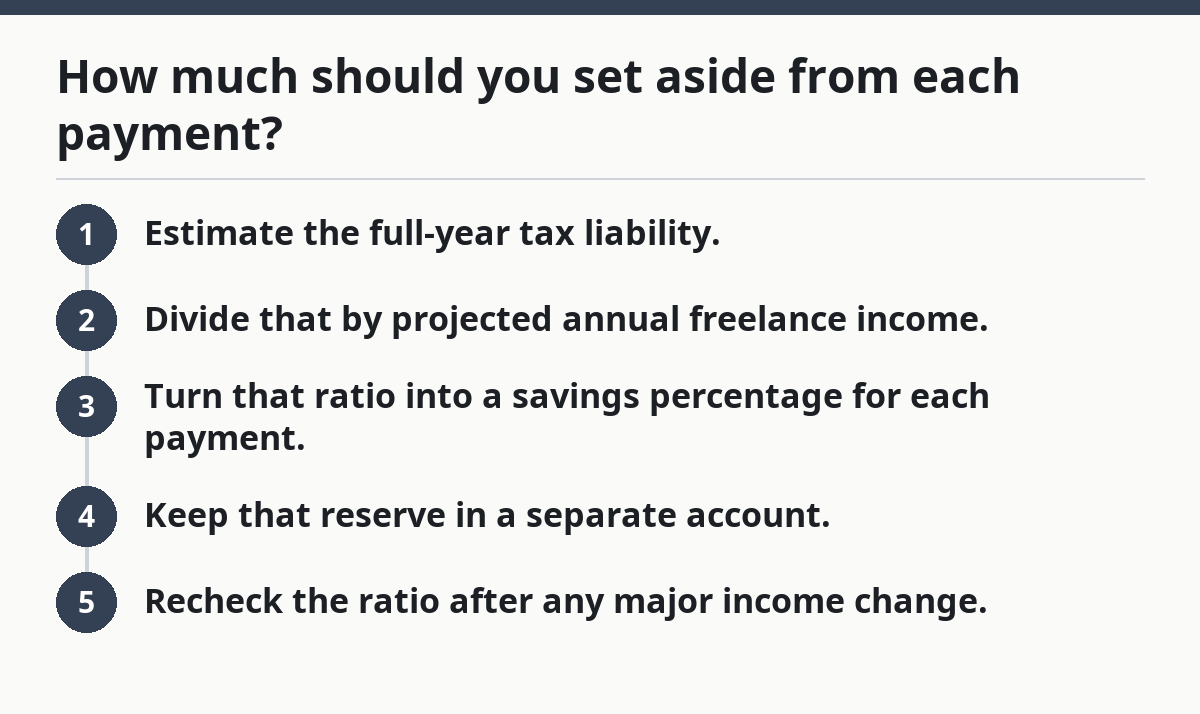
- Estimate the full-year tax liability.
- Divide that by projected annual freelance income.
- Turn that ratio into a savings percentage for each payment.
- Keep that reserve in a separate account.
- Recheck the ratio after any major income change.
So, if income jumps midyear, your reserve rate may need a reset.
If a big deductible expense lands late in the year, your estimate may be too high.
If you have wage income from a job plus freelance income, the total tax picture changes.
If your state tax is based on year-end profit, not monthly income, timing matters.
The truth is, freelancers get into trouble when they set aside too little in the first half of the year and hope the second half will cover it. That is not a plan.
Common mistakes that distort the forecast
The forecast goes wrong for a few predictable reasons, and most of them are boring bookkeeping errors. That is also why they are so common.
Picture this: your estimate looked fine in March, then December arrives and the reserve is short. Usually the mistake was not the tax rate — it was the input. One number was too optimistic, or a whole tax layer never got included.
Here are the ones I see most often:
- Using gross deposits as income. Platform fees, refunds, and client reversals can make deposits larger than true income. The fix is to use recorded revenue, not raw bank inflows.
- Ignoring self-employment tax. This can leave a large hole in the reserve if you only model income tax. The fix is to add the self-employment layer before you decide what to set aside.
- Treating every expense as deductible. Personal purchases, mixed-use items, and unsupported receipts can shrink taxable profit on paper. The fix is to count only legitimate business deductions under your local rules, and consult a tax professional if you have mixed or unclear expenses. See IRS Publication 535 for business expense guidance. IRS Publication 535
- Using last year’s tax table without checking the current year. Tax brackets, allowances, and thresholds can change. The fix is to use the tax year that matches the income year.
- Forgetting state or local tax. That creates a reserve that looks healthy until the extra bill appears. The fix is to model that layer from the start if it applies where you live.
- Not revisiting the estimate after a big contract change. A 3-month retainer, a cancelled project, or a sudden jump in rate changes the annual picture. The fix is to update the projection whenever income shifts materially.
If the tax system in your area has credits, pension deductions, or special business rules, a simple worksheet may not be enough. Use it as a planning tool, not as a final filing answer, and consult a professional if you have complex deductions such as home office, equipment, travel, or mixed personal-business costs.
When this approach stops being enough
This method stops being enough when the income pattern or tax rules are too irregular for a plain forecast. At that point, the right move is to slow down and get a more precise estimate from a qualified tax preparer or adviser who knows your jurisdiction.
Picture this: your freelance work is no longer a side stream, but a mix of retainers, foreign clients, business mileage, and home-office claims. The simple percentage method starts to wobble. That does not mean the method is useless; it means the tax picture is too layered for a quick reserve rule.
Stop and get help if any of these apply:
- You earn income in more than one country: cross-border tax rules can change which income is taxed where, and the reserve can be off in either direction.
- You have complex deductions: home office, equipment, travel, or mixed personal-business costs may need more careful treatment, so consult a professional before relying on a simple estimate.
- You also have wage income: employer withholding changes the total tax picture and can make a freelance-only forecast misleading.
- Your state or local rules are unusual: a flat estimate may miss filing thresholds, surtaxes, or residency rules.
- Your income swings hard month to month: a 12-month average may hide a large end-of-year tax bill.
Not every freelancer needs a high-detail model. But when the result will control how much cash you set aside, complexity matters. A rough number in a complex case can be worse than no number at all.
What a good annual tax estimate looks like
A good estimate is specific, repeatable, and easy to update when facts change. It does not need to be perfect on day one, but it should be built from records, not optimism.
Picture this: you open your spreadsheet in October and can explain every line in under a minute. That is a good sign. You know the income total, the deduction assumptions, the self-employment layer, the state tax piece, and the reserve still sitting in the tax account.
A solid forecast usually has these traits:
- It uses current-year tax rules, not old habits.
- It separates business income from personal money.
- It shows how deductions changed the taxable profit.
- It includes every tax layer that applies to you.
- It gets updated at least once after any major income shift.
The estimate does one job: it tells you how much cash to keep out of reach so tax season does not become a scramble. If you want a fuller picture of deductions and recordkeeping, the hub on freelancer taxes and deductions is the better next stop.
How do freelancers estimate taxes for the year?
Freelancers estimate taxes for the year by projecting gross income, subtracting deductible business expenses, and then applying the tax layers that fit their location and filing setup. That usually includes income tax, self-employment tax, and sometimes state tax. The estimate gets better when you update it after big income or expense changes.
What numbers are needed to estimate tax liability?
You need projected income, deductible expenses, applicable tax rates, and filing details that affect the result. If your area uses credits, pension deductions, or a state-level tax, those also belong in the estimate. A forecast built without those pieces can be far off.
Should freelancers estimate taxes monthly or quarterly?
Monthly estimates are better for cash control, while quarterly updates are usually enough for a broader tax forecast. The right choice depends on how fast income changes and how tight your cash flow is. If your income swings a lot, monthly reviews keep surprises smaller.
Drafted with AI; not yet reviewed by a person.
