
Last updated: November 20, 2026
Quick Answer: use 4 checks. If you are working on How Freelancers Choose a Business Name That Is Available and Easy to Register, the fastest path is to check state rules, DBA records, domain availability, and trademark risk before you print a card or file a form. If the name clears those 4 checks, it is much easier to register and use without a clash later.
Key takeaways
- Start with your jurisdiction, because naming rules vary by state, province, or country.
- A name can look free in one place and still collide with a DBA, a trademark, or a web domain.
- A good name is usually short, easy to spell, and different from close competitors.
- Personal names are simpler; brand names give more room to grow.
- If a name is already tied up in a trademark class or a state filing, pick another one rather than hoping the risk will disappear.
Who this applies to
This applies to freelancers who want a business name they can actually use, register, and keep. It assumes you already know your rough service area, such as design, writing, bookkeeping, or consulting, and that you are checking a name before filing forms or ordering branding.
Rules vary by jurisdiction, so the same name can be fine in one place and blocked in another. The safest path is to check your local secretary of state records, your DBA records, your domain registrar, and a trademark database before you commit, and to consult a qualified lawyer or filing professional if the result is unclear.
A practical way to think about How Freelancers Choose a Business Name That Is Available and Easy to Register is simple: one name, 4 screens. If the name passes the state naming rules, DBA search, domain check, and trademark screen, it has a much better chance of being usable. If it fails any one of those checks, the problem is usually easier to fix before filing than after.
How do I choose a business name that is available?
Choose a business name that passes 4 checks in the same day: state naming rules, DBA records, domain availability, and trademark search. The name should also be easy to say, easy to spell, and different from names already in your field. For example, the USPTO trademark search page and WIPO’s Global Brand Database are useful screens for obvious conflicts.
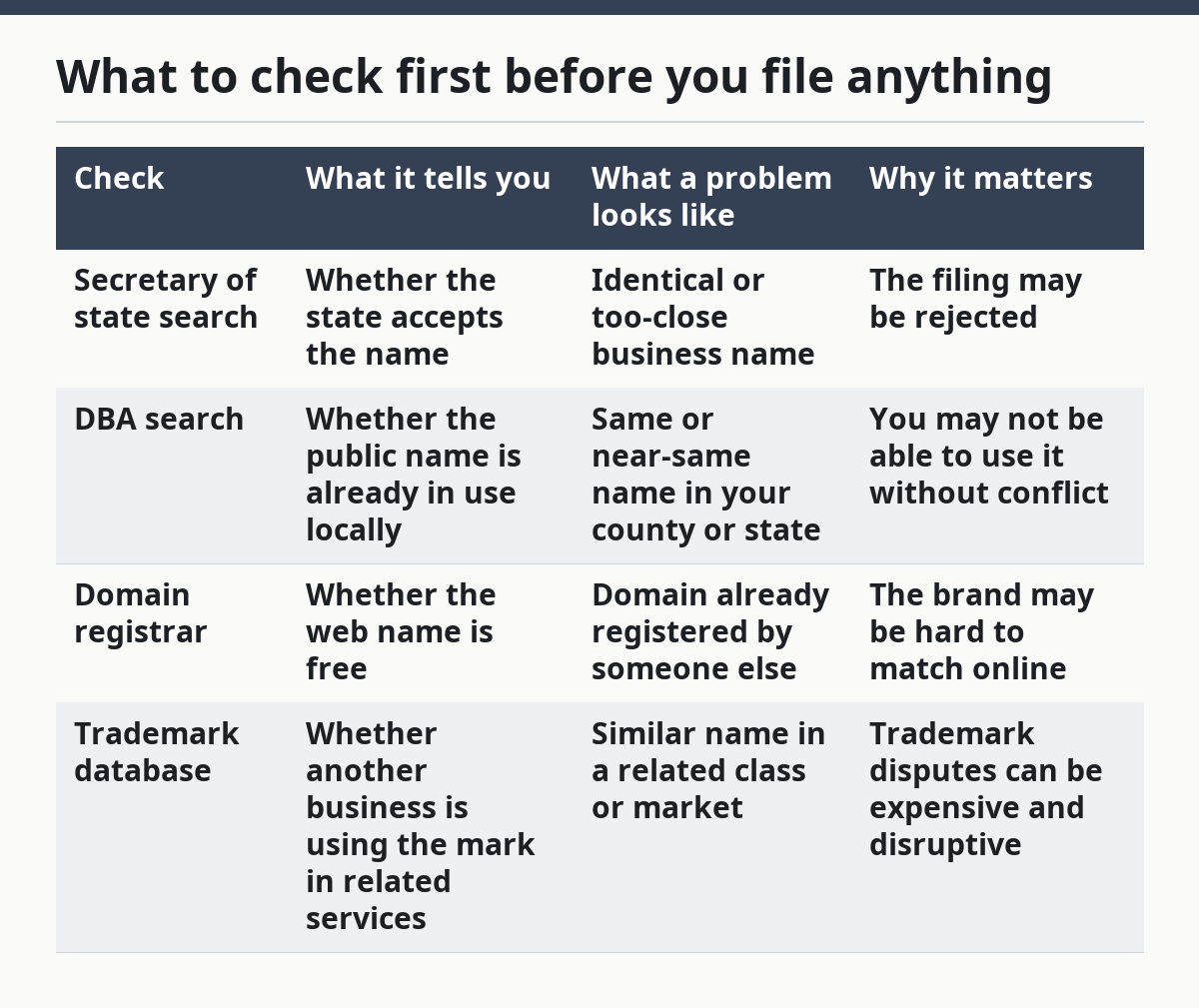
What to check first before you file anything
Before you file anything, start with the secretary of state name search, because that is the fastest way to catch obvious conflicts in many jurisdictions. Many states may treat names that are too close as unavailable even if they are not identical, so “Blue Ridge Writing” and “Blue Ridge Writers” may still cause trouble; if you are unsure, check the state’s naming rules or ask a filing professional.
Then check the DBA, which stands for “doing business as.” A DBA is the public name a freelancer may use when operating under a name other than a personal legal name, and the filing rules differ by place. If the DBA already exists in your area, that is a warning sign even if the exact wording is slightly different.
Next, check a domain registrar for the web address. A .com is often the cleanest choice, but the main point is consistency: if the domain is already taken, the name may still work legally, but the mismatch can make the brand harder to remember. The better move is to check state records first and treat the domain as a second screen, while also confirming the result with a source such as the USPTO trademark search page or WIPO’s database.
Finish with a trademark database such as the USPTO trademark search page or WIPO’s Global Brand Database to look for names already used in related services. If you are not sure whether a result is a real conflict, consult a trademark attorney before you file.
| Check | What it tells you | What a problem looks like | Why it matters |
|---|---|---|---|
| Secretary of state search | Whether the state accepts the name | Identical or too-close business name | The filing may be rejected |
| DBA search | Whether the public name is already in use locally | Same or near-same name in your county or state | You may not be able to use it without conflict |
| Domain registrar | Whether the web name is free | Domain already registered by someone else | The brand may be hard to match online |
| Trademark database | Whether another business is using the mark in related services | Similar name in a related class or market | Trademark disputes can be expensive and disruptive |
How do you check a freelance business name step by step?
Check the name in 7 passes, and change it as soon as one pass fails. Keep each pass short and write down the exact spelling you are testing, because punctuation, plurals, and spacing can change what shows up in a search. Use the same spelling in every screen so you do not miss a conflict.
- Secretary of state search: Type the exact name into your state business database and verify whether it is available for registration. A problem is a close match, not just an exact match, because many offices reject names that sound too similar.
- DBA search: Search the DBA records for the same wording and for likely variations of the name. A problem is a match in your county, city, or filing area, because a public-use name can already be claimed there.
- Domain registrar check: Search the exact name as a domain, especially the .com version. A problem is that the main domain is taken, because that can force a clumsy URL and reduce trust.
- Trademark database check: Search the trademark database for exact and similar names in related services. A problem is a match in a service class that overlaps yours, because the risk comes from related use, not just identical spelling.
- Social handle check: Search the same name on the major social platforms you plan to use. A problem is that the handles are missing or inconsistent, because customers may not find the same name across channels.
- Spelling test: Read the name out loud once and write it from memory. A problem is that it needs explanation, because names that are hard to spell are harder to search and harder to refer someone to.
- Comparison test: Put the name beside 2 or 3 local competitors and compare the wording. A problem is that your name looks too much like a nearby business, because confusion is bad for both branding and registration.
Two source pages are worth keeping open while you do this: the USPTO trademark search page and WIPO’s Global Brand Database. They do not replace local filing rules, but they are a solid screen for obvious conflicts. If either search turns up something close in your service area, pause and try a different name instead of forcing the issue, and consider legal advice if the result is unclear.
What makes a name easy to register?
A name is easy to register when it is short, distinct, and not built on common filler words. “Jane Smith Copywriting” is usually simpler than a vague brand like “Next Level Solutions,” because the first is specific and the second is likely to run into crowded search results.
Keep the structure simple: one main word, one modifier, and no extra punctuation if you can avoid it. Hyphens, extra apostrophes, and unusual spellings can make a name look clever, but they also make filing, typing, and remembering harder. A name that a person can spell after hearing it once is usually a better register-and-go choice than one that needs a correction.
This is also where personal names and brand names differ. A personal name is often easier to clear because it is naturally tied to one person, but it can be harder to scale if the business grows beyond the founder. A brand name can be broader, but it needs more checking because more people have already tried to claim something similar.
When should you stop and pick another name?
Stop and pick another name when the risk is clear enough that the next step would only waste time.
The secretary of state database rejects the name: the name is not available where you want to file — choose a new one before you build anything around it.
The DBA search shows a close local match: the public-use name is already in circulation — try a different name, because confusion can follow the filing.
The trademark database shows a related service using the same or similar name: the name may create a conflict in the market — get qualified legal help if you still want to use a close variation.
The domain registrar shows the exact domain is taken and the alternative looks awkward: the online brand will be hard to match — select a cleaner name instead of settling for a long or confusing URL.
The name only works if you add extra words you will not actually use: the name is too weak on its own — simplify it until the core version stands up by itself.
The name looks too much like a competitor’s name in the same field: customers may confuse the two businesses — change it, even if the filing office might allow it.
These are not small style issues. They affect whether the name is easy to protect, easy to remember, and easy to file. A name that creates doubt at the first check usually creates friction later too.
What mistakes do freelancers make most often?
Freelancers usually make 5 avoidable mistakes when choosing a name, and each one causes a different kind of pain later. The common thread is that the name is judged only by how it looks on a logo, not by how it behaves in a filing system.
One mistake is checking only the domain and skipping the state search. That can lead to a name that looks available online but is blocked at filing time. The better move is to check state records first and treat the domain as a second screen.
Another mistake is using a name that is almost the same as a local competitor. That may seem harmless, but it can create confusion for clients and may be hard to defend if a dispute comes up. A cleaner alternative is to change one core word, not just the ending.
A third mistake is choosing a name that is difficult to spell after hearing it once. That hurts referrals, search, and email use. A better choice is a name with ordinary spelling and one clear pronunciation.
A fourth mistake is ignoring the DBA. A freelancer may assume the personal name is enough, then discover the public business name still needs a separate filing in the local system. The correct alternative is to check the DBA requirement early, before branding work starts.
A fifth mistake is picking a name that only makes sense in one short trend cycle. That can age fast and force a rebrand in 12 months or less. A more durable name is broader, clearer, and not tied to one passing phrase.
What should you do if the standard process does not fit?
Adjust the process if your name is personal, multi-state, or likely to grow into a larger brand. A single-city freelancer has a simpler search than someone serving clients across several jurisdictions, because every jurisdiction can have its own naming rule and DBA filing path.
If you want to use your own legal name, the search is usually simpler, but it is not automatic everywhere. Some places still have rules about public names, and some business forms still require a DBA if you use a trade name. If you plan to expand later, check whether the personal name leaves room for services beyond your own name.
If your first choice is taken, do not force a near-copy by adding a generic word like “pro,” “group,” or “solutions.” That often leaves the name just different enough to feel safe and just similar enough to create confusion. A better fix is to change the core noun, not just decorate it.
If you are trying to match a handle, a domain, and a filing name exactly, accept that one of the three may need to move. The cleanest brand is useful, but the cleanest legal path matters more. When the same name does not work in all 3 places, the naming decision is usually the part that needs revision.
How should a freelancer decide between a personal name and a brand name?
Use a personal name when simplicity matters most and a brand name when the business needs room to grow. A personal name is often easier to clear in a 1-person business, while a brand name can look more formal and can outlast a single freelancer’s name.
The trade-off is real. A personal name can make registration and recognition easier, but it may be less flexible if you later add services, partners, or a team. A brand name can be more scalable, but it usually takes more searching because more names are already in use.
Think in terms of the next 2 years, not just the next 2 months. If the business is likely to stay a solo operation, a personal name may be enough. If the goal is to build a broader practice, a brand name may be worth the extra search time and the added risk of finding a conflict.
FAQ
How do I know if a freelance business name is available?
You know only after you check the secretary of state database, the DBA records, the domain registrar, and a trademark database. One search is not enough, because a name can be free in one place and blocked in another. If any of those checks shows a close match, treat that as a warning, consult a professional if needed, and test a new option.
Should I use my personal name or a brand name?
Use your personal name if you want the simplest path and your work is likely to stay tied to you alone. Use a brand name if you want more room to grow or want a name that is not tied to one person. The better choice depends on how long you expect the business to stay a solo practice.
What should I check before registering a business name?
Check the state naming rules, the DBA record, the domain, the trademark database, and the social handles you plan to use. That 5-part check catches the most common conflicts before you spend time on forms or branding. If the name fails any one of those screens, choose a cleaner option first.
Drafted with AI; not yet reviewed by a person.
