

Last updated: November 20, 2026
Key Takeaways
- A payment plan agreement should list the total fee, payment count, due dates, and late-payment terms.
- Freelancers offer payment plans without confusing the client by tying each payment to one simple event and one simple date.
- Date-based installments suit recurring work, while milestone releases fit projects with clear stages.
- The payment plan agreement wording should be brief enough to scan and specific enough to invoice from.
Freelancers offer payment plans clearly when they state the total fee, the number of payments, and the trigger for each one. In How Freelancers Offer Payment Plans Without Confusing the Client, the goal is to make the schedule easy to read, easy to invoice, and easy to approve. A clear payment plan agreement removes guesswork before the work starts.
Freelancers confuse payment plans when the dates, amounts, and trigger for each payment stay vague. A clear payment plan agreement fixes that by naming each installment, each due date, and what gets delivered when. The sections below show how to set one up without turning it into contract soup.
A payment plan is easiest to understand when it reads like a schedule, not a sales pitch. That means the client can see the total, the cadence, and the consequence if a payment is late.
What a payment plan agreement needs to say
A payment plan agreement needs to say the total fee, the number of installments, the due dates, and what happens if a payment is late. If those four pieces are clear, the rest of the client agreement is easier to follow.
Picture this: you’re sending a proposal for a $3,000 project, and the client wants to pay over time. The problem is not the split itself — it’s the fog around it. Three parts have to be plain: how much is due, when it is due, and what payment opens next.
Here is the cleanest structure to use:
- Total project fee
- Installment count or milestone count
- Exact due dates or trigger dates
- Invoice timing
- Late fee or pause rule, if you use one
- What deliverable or work stage each payment covers
A good payment plan agreement also uses one label for the payment type and keeps it there. If you call them “installments” in one line and “milestones” in the next, a busy reader may assume they mean different things. They usually do not.
Use plain nouns. “First installment due on signing” is better than “initial consideration remitted upon commencement.” One is clear. The other reads like a legal dare.
How do freelancers offer payment plans without confusing the client?
Freelancers offer payment plans without confusing the client by tying each payment to one simple event and one simple date. The client should not have to guess whether the next invoice depends on a calendar day, a draft approval, or a deposit being received.
Picture this: you’re breaking a $4,500 web project into installments. If the schedule says “50% before launch” and “50% after completion,” the client still has to infer what “launch” means. A cleaner setup names the exact date, phase, or deliverable. Clarity beats clever wording.
Use this order:
-
State the full fee first.
Put the total amount at the top of the payment section so the client sees the whole deal before the split. That keeps the plan from feeling like hidden pricing. -
Choose one payment structure.
Use either installments by date or milestone releases by stage. Mixing both in the same line usually causes confusion, especially on longer projects. -
Label each payment with a number.
“Payment 1,” “Payment 2,” and “Payment 3” are easy to scan. That matters more than fancy labels. -
Add the due date or trigger.
Use a calendar date, such as “May 15,” or a clear event, such as “within 3 business days of draft approval.” Avoid open-ended phrases like “soon after.” -
Connect each payment to a deliverable or block of work.
If the payment covers research, draft, revisions, or final files, say so in one short clause. -
Tell the client what happens if a payment is late.
If work pauses after a missed due date, say that in one sentence. If you charge a late fee, name the fee or point to the invoice terms.
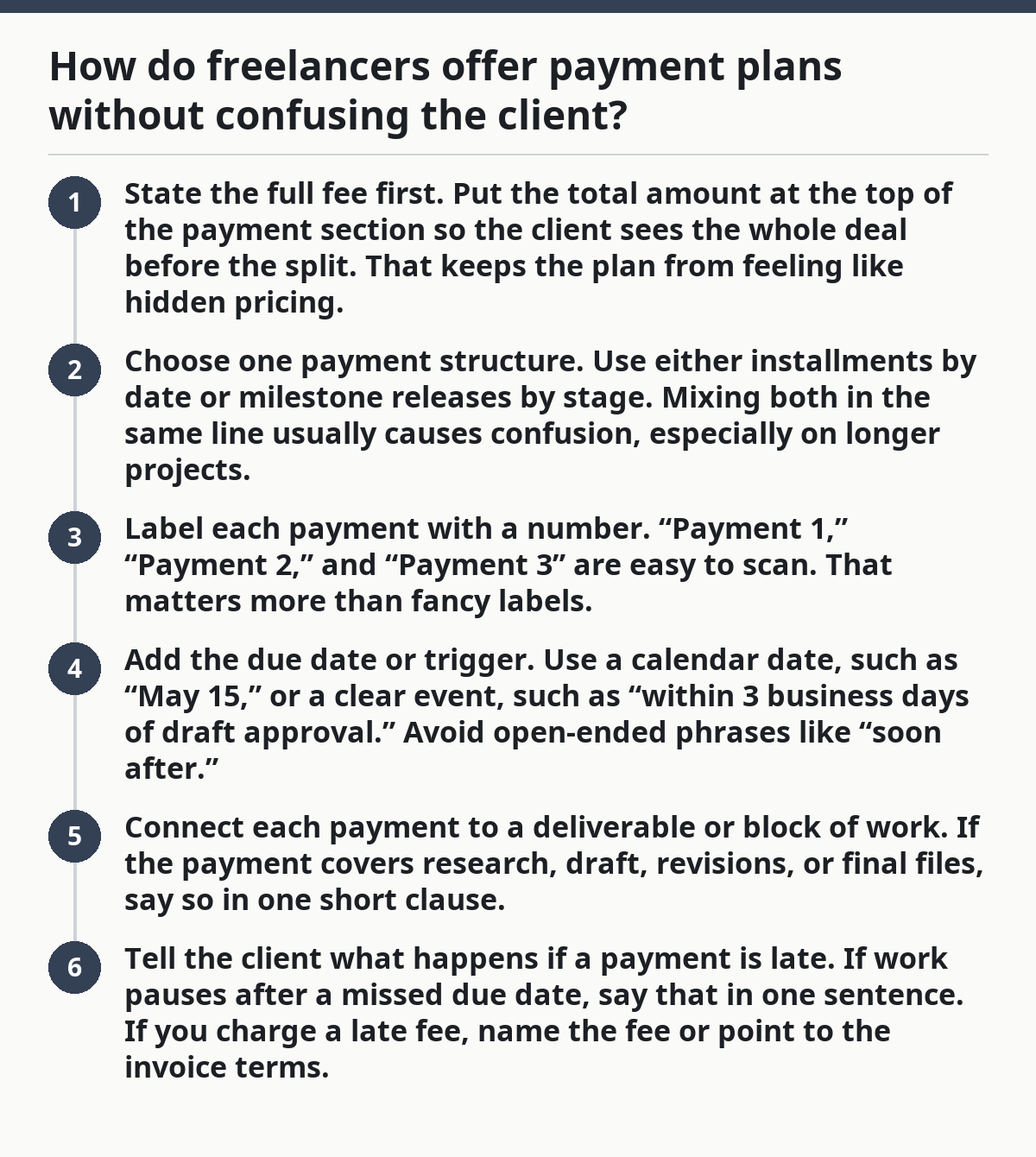
This structure fits on one page. A payment plan agreement does not need to be long to be clear.
Installments vs. milestone releases: pick one lane
Installments are easier for recurring timelines, while milestone releases work better when the project has visible stages. The wrong choice is not illegal or broken; it just makes the plan harder to follow.
Picture this: you’re handling a 6-week brand package. If the work is split into research, concept, revision, and final delivery, milestone releases match the flow. If the work is a steady monthly retainer, installments by date are simpler. Match the schedule to the work.
Here is the difference in plain language:
- Installments are date-based. The client pays on set calendar dates, such as the 1st and 15th of the month.
- Milestone releases are stage-based. The client pays when a draft, mockup, or final version is approved.
- Hybrid plans can work, but they are the easiest to misread. Use them only when the project really needs both a date and a trigger.
A simple rule helps: if the work is mostly time-based, use installments. If the work changes in clear phases, use milestones. A payment plan agreement gets muddy when the money schedule and the work schedule fight each other.
One caution: do not make a milestone so vague that it turns into a debate. “Design phase complete” is better than “when the work feels ready.” The first can be checked. The second invites arguments and delays.
The payment plan agreement wording that keeps everyone aligned
The payment plan agreement wording should be short enough to scan and specific enough to invoice from. If an invoice can’t be drafted from the sentence, the sentence is too soft.
Picture this: you’re writing the payment section of a client agreement and trying to sound professional. A lot of freelancers overdo it here. They add thick language, but the client only needs a few facts. Short lines beat long clauses.
Use wording like this:
- “Total project fee: $2,400.”
- “Payment 1: $800 due on June 1.”
- “Payment 2: $800 due on July 1.”
- “Payment 3: $800 due on August 1.”
- “Work pauses if an invoice remains unpaid for 7 days after the due date.”
If you use milestone releases, swap in the trigger:
- “Payment 1 due when the outline is approved.”
- “Payment 2 due when the first draft is delivered.”
- “Payment 3 due when final files are sent.”
Keep the same nouns across the whole document. If the body says “project fee,” do not switch to “balance” and “rate” and “retainer” unless those terms truly apply. Mixed labels make the math feel uncertain.
This is also where the payment plan agreement should say whether the first invoice is due before work starts or on a specific date. That line removes the “Do you need the first invoice now?” back-and-forth that eats time on every project.
How to schedule invoices so the plan is easy to pay
Invoice scheduling should follow the payment plan, not sit next to it as a second, different system. If the invoice dates and the agreement dates drift apart, the client will ask which one matters.
Picture this: you’re setting up a three-part project and want to avoid billing confusion. The clean move is to send each invoice a little before the due date, not after work has already started on the next stage. One schedule, one source of truth.
Use a simple invoice rhythm:
- Send the first invoice with the agreement or immediately after signing.
- Send later invoices 3 to 7 days before the due date.
- Keep the invoice due date identical to the agreement due date.
- Use the same reference line on every invoice, such as the project name and installment number.
That last point matters more than most freelancers think. “Invoice 2” is clearer than “Second payment request.” It saves time when someone on the client side forwards it to finance.
If your accounting tool allows reminders, set them for 1 day before and 3 days after the due date. You do not need a dramatic system. You need one that keeps the schedule visible. A payment plan agreement fails when the invoice arrives with no memory of why it exists.
The truth is, this is where many plans fall apart. The agreement says one thing, the invoice says another, and the client starts asking basic questions before the money moves.
Common mistakes that make a payment plan hard to understand
A payment plan becomes confusing when it hides timing, mixes labels, or leaves the last payment vague. Those mistakes cost time, delay cash flow, and create awkward follow-up messages.
Picture this: you’re almost done with a project, but the final invoice reads “remaining balance due upon completion.” Completion of what, exactly? The work? The revisions? The final files? Vague endings cause the most trouble.
Here are the mistakes that show up most often:
-
No due date on one installment.
Cost: the client assumes payment can wait. Fix: put a date or event on every line. -
Two names for the same payment.
Cost: people think there are extra charges or hidden stages. Fix: use one label, such as installment or milestone, and stick with it. -
A last payment with no trigger.
Cost: the final money stalls while both sides wait for the other. Fix: say what “completion” means in one sentence. -
Invoices sent too late.
Cost: the due date arrives before the invoice does. Fix: send each invoice ahead of the deadline by a few days. -
A plan that sounds flexible but acts strict.
Cost: the client feels ambushed if a date is missed. Fix: describe the pause rule and any late fee before signing.
One more trap: do not bury the payment plan inside a long proposal and hope the client finds it. Put it in its own section, with short lines and clear spacing. A well-written payment plan agreement is easy to skim on a phone. If it takes effort to decode, it is not done yet.
What should a simple payment plan include before signing?
A simple payment plan should include the total fee, the number of payments, the due dates or milestone triggers, the invoice timing, and the rule for missed payments. If those five pieces are visible before signing, the plan is usually easy to manage.
Picture this: you’re about to send a client agreement and want to avoid the usual back-and-forth. A clean payment plan does not need legal drama or fancy formatting. Five lines can do the job.
Use this pre-sign checklist:
- Is the total fee written once and clearly?
- Does each installment have a due date or trigger?
- Does each payment connect to a stage of work?
- Does the invoice schedule match the agreement?
- Is the late-payment rule written in plain language?
That checklist also helps you spot the places where a plan gets fuzzy. If you cannot explain one line out loud in 10 seconds, it probably needs a rewrite.
For a broader look at billing systems, the guide to freelance billing and client payment systems can sit alongside this one. This page handles the structure of the payment plan agreement; that larger guide covers the wider billing setup around it.
Payment plan agreement examples that stay clear
A payment plan agreement stays clear when the example can be read in one pass without side notes. If someone has to interpret the plan, it is already too complicated.
Picture this: you’re choosing between a monthly split and a stage-based split. The right one depends on how the work moves, not on what sounds polished. Simple examples beat clever ones.
Here are two clean models:
Date-based installment plan
- Total fee: $1,200
- Payment 1: $400 due March 1
- Payment 2: $400 due April 1
- Payment 3: $400 due May 1
Milestone release plan
- Total fee: $2,700
- Payment 1: $900 due when the outline is approved
- Payment 2: $900 due when the first draft is delivered
- Payment 3: $900 due when final files are sent
Both examples keep the math obvious. Both also let the client see what each payment covers. The difference is the trigger: one uses dates, the other uses progress.
The wrong move is to make the schedule so customized that no one can trace it later. If the client, the freelancer, and the invoice all tell the same story, the payment plan agreement is doing its job.
Can freelancers split project fees into installments?
Yes, freelancers can split project fees into installments as long as the schedule is easy to follow and tied to clear due dates or milestones. The cleanest split uses a total fee, a set number of payments, and one trigger for each payment. If the work is complex, a milestone-based plan is often easier to understand than a date-only plan.
How do I write a payment plan for a client?
Write a payment plan for a client by listing the total fee, each installment amount, the due date or milestone trigger, and the invoice timing. Keep the wording short and use the same terms throughout the client agreement and invoice. If a payment is late, say exactly when work pauses or when a fee applies.
What should be included in a freelance installment schedule?
A freelance installment schedule should include the total project fee, the number of installments, each payment amount, each due date or milestone, and the invoice schedule. It should also show what each payment covers so the client can match money to work. If the plan is unclear on timing, it will cause delays later.
Drafted with AI; not yet reviewed by a person.
