
Last updated: November 20, 2026
Quick Answer: 1 clear invoice workflow, firm payment terms, and a follow-up system that starts before a bill goes overdue are usually enough to keep freelance cash moving. Freelancer Billing and Payment Operations: Complete Guide breaks down when invoices, due dates, and payment methods are handled casually. The right setup is a clear invoice workflow, firm payment terms, and a follow-up system that starts before a bill goes overdue. The steps below settle what to charge, when to bill, how to get paid, and what to do when money stalls.
What freelancer billing and payment operations actually cover
Freelancer billing and payment operations cover the full path from signed work to cleared cash, and they should be built around one invoice format, one payment policy, and one follow-up routine. If those three pieces are messy, the rest of the business gets messy too.
Picture this: you’re done with a project, the handoff email is sent, and now you need money in the bank without awkward chasing. That means you need a system for scope, billing triggers, payment methods, reminders, and recordkeeping before the work starts. This is not about being “organized”; it’s about avoiding a 30-day delay that turns into 60.
A clean billing setup usually includes:
- A written scope or statement of work
- A billing schedule tied to milestones, dates, or hours
- Invoice numbers and due dates
- A payment method such as ACH, card, PayPal, Stripe, Wise, or bank transfer
- A late-payment process with reminders and escalation
For example, a clean billing setup is easier to build when you review the scope with a contract or billing professional and anchor the process to published guidance from the U.S. Small Business Administration and the IRS on cash flow and recordkeeping. The common mistake is treating invoicing as admin at the end. It isn’t. It starts when the job is sold. If the agreement says “Net 15,” then the invoice should show that exact term, not a vague “due soon.” If the project has milestones, each milestone should trigger a specific billable event.
The best part is that you do not need fancy software to do this well. A spreadsheet, a template invoice, and a consistent reminder cadence can work if the terms are solid.
Key Takeaways:
- Billing ops are the money path, not just the invoice file.
- The job starts before delivery, with scope and terms.
- Payment speed depends on friction, clarity, and follow-up.
- A simple process beats a clever one that nobody uses.
- Late payment handling should be planned before the first bill goes out.
What actually determines the right billing setup
The right billing setup depends on project type, cash-flow risk, and how predictable the work is. If the work is fixed-scope, milestone billing is usually cleaner. If the work changes week to week, hourly billing or a retainer often fits better.
Picture this: you’re deciding whether to bill upfront, after delivery, or every month. The answer changes if the project runs for 3 days, 3 months, or 12 months. A logo job and a monthly content retainer do not need the same payment structure.
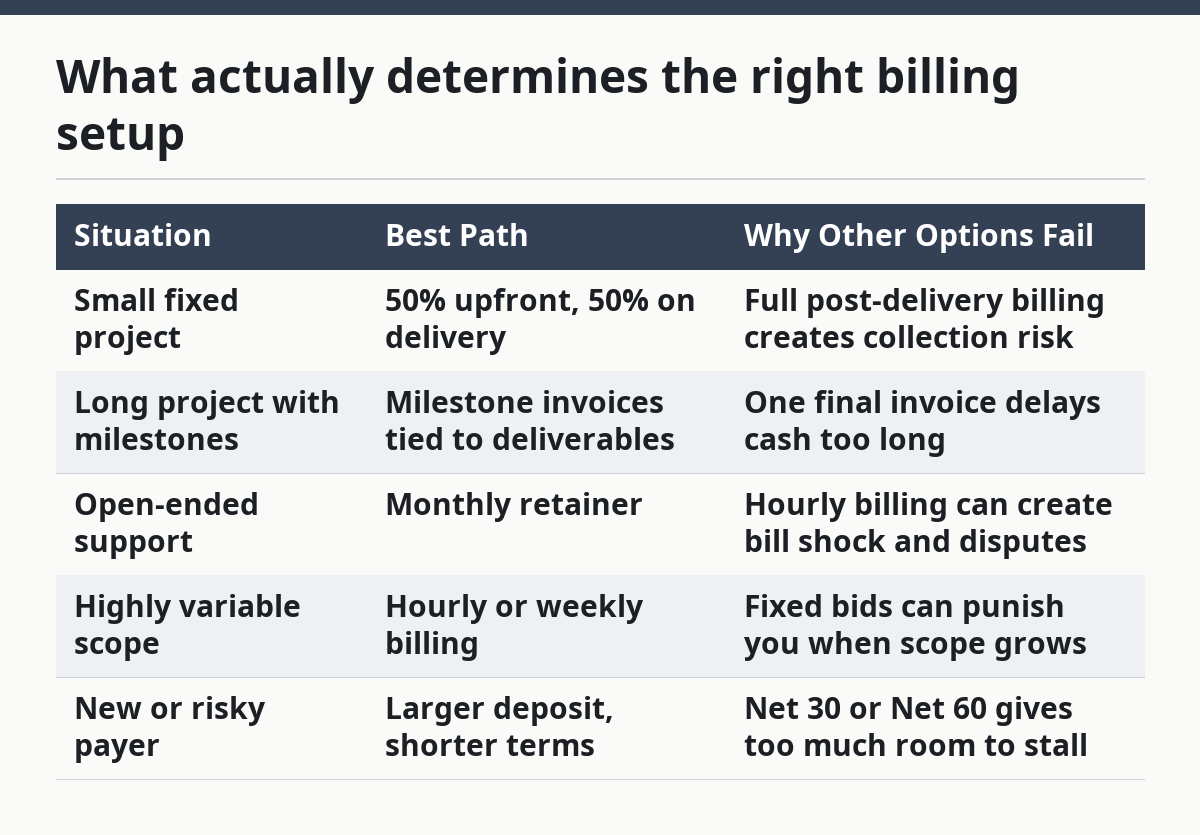
Use this table to match the setup to the situation:
| Situation | Best Path | Why Other Options Fail |
|---|---|---|
| Small fixed project | 50% upfront, 50% on delivery | Full post-delivery billing creates collection risk |
| Long project with milestones | Milestone invoices tied to deliverables | One final invoice delays cash too long |
| Open-ended support | Monthly retainer | Hourly billing can create bill shock and disputes |
| Highly variable scope | Hourly or weekly billing | Fixed bids can punish you when scope grows |
| New or risky payer | Larger deposit, shorter terms | Net 30 or Net 60 gives too much room to stall |
If you’re working with a new payer, then reduce risk early. Ask for a deposit, keep the first invoice short, and make the due date unmistakable. If the relationship is stable and the work repeats, you can relax the structure a little, but not the paper trail.
Here’s the catch: the right model is not the one that sounds nicest. It’s the one that keeps cash moving and cuts dispute risk. A $5,000 project with a clear 50/50 split is often safer than a $4,800 job billed only at the end.
A practical setup path:
- Write the scope in plain language.
- Pick one billing trigger: deposit, milestone, hourly cycle, or monthly retainer.
- Set payment terms in days, not vague words.
- Choose one default payment method.
- Prepare an invoice template before the work begins.
- Decide when reminders go out: for example, 3 days before due, on due date, and 7 days after.
Quick check: if you’re still changing invoice terms after the job starts, your billing setup is not finished yet.
How should a freelancer invoice clients?
A freelancer should invoice on a schedule that matches the work, with a clean line item list, a due date, and a payment method that makes it easy to pay. If the invoice can’t be read in under 30 seconds, it’s too complicated.
Picture this: you’re sending a bill and hoping nobody asks for “more detail.” That usually means the invoice is doing too much or too little. The invoice should confirm what was done, what it costs, when it’s due, and how to pay—nothing more.
A useful invoice usually includes:
- Your business name and contact info
- The payer’s name and billing address
- Invoice number
- Issue date
- Due date
- Itemized description of work
- Rates, quantities, or milestone amounts
- Total due
- Accepted payment methods
- Late fee policy, if used
- Tax details, if applicable
The format matters because it shapes payment speed. A vague line like “creative services” invites questions. A line like “March newsletter copywriting, 4 drafts, 2 revision rounds” is easier to approve. If you bill hourly, show the hours and rate. If you bill by milestone, name the milestone and its deliverable.
If you use accounting software, common tools include QuickBooks, Xero, FreshBooks, Wave, and Stripe Invoicing. If you use a spreadsheet, keep the structure consistent. The software matters less than the habit.
A solid invoice workflow:
- Send the invoice within 24 hours of the trigger event.
- Attach supporting proof if needed, such as a milestone sign-off.
- Use one subject line format, like “Invoice #104 — March Design Work.”
- State the amount due, due date, and payment link in the first screen of the email.
- Store a copy in a folder by year and payer name.
- Mark the invoice as sent in your tracker the same day.
The truth is, many late payments start with a weak invoice. If the payer has to ask what the bill is for, you’ve already lost time.
Quick check: if your invoice does not show the due date, payment method, and exact amount without scrolling, fix the template first.
Payment terms, deposits, and retainers: which one fits?
Payment terms, deposits, and retainers each solve a different problem, and the wrong one creates friction fast. If you need protection from nonpayment, a deposit helps. If you need steady cash, a retainer helps. If you need a simple one-off closeout, net terms may be enough.
Picture this: you’re choosing between “pay half now,” “pay every month,” and “pay in 15 days after the invoice.” Each option changes risk, cash flow, and how much chasing you’ll do later. The right choice depends on whether the work is custom, recurring, or easy to resell.
Here’s how the common choices behave:
- Deposit: Good for custom work and new relationships. It reduces cancellation risk and gives you working capital.
- Net 15 / Net 30: Good when the payer has a normal accounts-payable process. It’s simple, but slower.
- Retainer: Good for ongoing access, support, or creative work that repeats each month.
- Prepayment: Good for small projects, urgent work, or low-trust situations. It gives you the cleanest cash position.
- Split billing: Good for milestones. It spreads risk and makes progress easier to track.
One common mistake is using a retainer when the scope is unclear. A retainer buys availability or capacity, not unlimited work. If the agreement doesn’t define what’s included, the month turns into a dispute.
Another mistake is giving Net 30 to everyone by default. That can be fine for established business payers with a real AP department. It’s a bad fit for individuals, tiny agencies, or new accounts with no payment history.
A simple decision path:
- If the work is custom and the payer is new, ask for a deposit.
- If the work happens every month, use a retainer with a clear scope cap.
- If the work has clear milestones, bill at each milestone.
- If the payer has formal AP, use Net 15 or Net 30 only if you can wait.
- If the project is small and urgent, request prepayment.
- If cash flow is tight, shorten terms before you discount your rate.
On the flip side, a lower price with worse terms can be a worse deal than a higher price with a deposit. Cash timing has value.
Quick check: if you’re saying “I just want to be fair,” but you’re also carrying the whole risk, your terms need work.
How do freelancers get paid faster?
Freelancers get paid faster by reducing friction, asking for payment at the right time, and making it hard to ignore the bill. If the payer can approve, route, and pay in one pass, money moves sooner.
Picture this: you’re waiting on a payment that should have taken a week, but it’s been sitting in someone’s inbox for 18 days. That usually means the invoice got stuck in approval, the method was awkward, or nobody knew who owned the payment. The fix is process, not pleading.
Speed depends on four things:
- Timing — Send the invoice immediately after the trigger.
- Clarity — Use a short description, a due date, and a total.
- Method — Offer the payment rail the payer already uses.
- Follow-up — Send reminders before the due date and after it.
Payment methods matter. ACH or bank transfer is often cheaper for larger invoices. Card payments can be faster, but fees are higher. PayPal is familiar to many small payers, though disputes and fees can be annoying. Wise can work well for cross-border work, depending on the route. Stripe and similar processors are useful when you want a hosted payment link.
A payment process that tends to work:
- Confirm the billing contact before the project starts.
- Ask how that payer prefers to receive invoices.
- Send the invoice the same day the work is approved.
- Include the payment link or wire instructions in the body, not hidden in an attachment.
- Send a reminder 3 days before due.
- Send a polite nudge on the due date.
- Escalate after 7 to 14 days with a clear next step.
One thing that trips people up: “payment received” is not the same as “invoice approved.” If the payer needs internal approval, build that into the schedule. A monthly retainer can still be slow if the approval chain is broken.
Useful outside references exist here: the U.S. Small Business Administration has general guidance on cash flow, and the IRS has recordkeeping guidance for business income and expenses. Those pages won’t solve every billing issue, but they help anchor the admin side.
Quick check: if your money arrives late even when the work is done, your payment method or approval path is probably the bottleneck.
What should happen when a bill is late?
A late bill should trigger a fixed reminder sequence, a clear escalation point, and a stop-work decision if the delay continues. If you improvise every time, the process gets emotional fast.
Picture this: you’re staring at an invoice that passed due 10 days ago and wondering whether to sound firm or friendly. The answer is to sound clear. Not rude. Clear. The goal is to get paid without turning the relationship into a fight.
A late-payment sequence can look like this:
- Send a polite reminder 3 days before the due date.
- Send a short notice on the due date.
- Send a firmer follow-up 5 to 7 days after the due date.
- Reference the invoice number, amount, and payment method again.
- Offer help if the payer needs a new invoice copy or remittance details.
- Pause new work after a defined threshold, such as 14 or 30 days late.
- Move to formal collection steps if the amount and relationship justify it.
The best follow-up emails are short, but they still need the invoice number, the amount, the due date, and one sentence asking for an update. Long explanations slow the point down. You are not writing a memo.
If the payer says they “sent it to finance,” ask for the finance contact. If they say “we’re waiting on approval,” ask when approval is expected. If they say “the check is in the mail,” ask for a payment date and method. Each answer gives you a next step.
Here’s the catch: stopping work is a business decision, not a mood. If you keep working while old invoices sit unpaid, you train the relationship to treat your time as flexible and your cash as optional. When approval has already been received internally, you can reference that status in your next message and ask for the exact release date.
Tools can help here. A CRM, invoicing app, or even a spreadsheet can track reminder dates, contact names, and status. The tool matters less than the rule: no invoice should live in “maybe” forever.
Quick check: if you have no written rule for when to follow up or stop work, your late-payment process is too soft.
Edge cases where the normal advice breaks down
The normal advice breaks down when the payer, project, or country changes the rules, and you need a different path. If one of these situations fits, copy the standard playbook less and the specific playbook more.
Picture this: you’re trying to use the same invoice system for a local one-person business, a U.S. corporation, and a payer in another country. That’s three different payment realities. One template will not fit all three without trouble.
| Situation | What Changes | What to Do Instead |
|---|---|---|
| Cross-border work | Currency, transfer fees, and bank delays | Quote the billing currency, state who pays transfer fees, and confirm the payment rail before work starts |
| Enterprise payer | Long approval chains and procurement steps | Get the billing contact, purchase order if needed, and internal due date upfront |
| Small one-person payer | No formal AP process | Use a deposit or card link and keep terms short |
| Ongoing scope creep | Billable work expands without a new agreement | Freeze the old scope and issue a written change order or new milestone |
| Rush work | Delivery speed matters more than admin elegance | Require prepayment or a larger deposit before starting |
| Disputed invoice | The issue is scope, not payment method | Break down the work, show the signed scope, and pause until the dispute is resolved |
Cross-border billing needs special care because bank fees can eat into small invoices. A $300 payment can get ugly if the transfer costs are unclear. The same is true if you quote one currency but receive another. Put the currency in the agreement and invoice.
Enterprise payers often have standard 30-day or 45-day cycles, but the internal delay can be longer if you miss a PO, vendor setup, or tax form. Ask for that paperwork before the work begins. If you wait until the invoice is sent, you may already be stuck.
On the flip side, small payers often pay fastest when you make it easy. A card link, a plain invoice, and a short due date may beat a formal Net 30 process that nobody follows.
Quick check: if the payer has procurement, another currency, or a messy scope, don’t use a generic invoice flow.
What tools and records should a freelancer keep?
A freelancer should keep invoices, contracts, payment confirmations, and a simple aging log, because those four records settle most billing disputes fast. If the records are missing, the conversation turns into memory versus memory.
Picture this: you’re asked six months later why a charge was made, or whether a revision was included, or if payment already cleared. That is when records save time. The document trail matters more than polished wording.
Minimum records worth keeping:
- Signed contract or statement of work
- Invoice copy
- Payment confirmation or bank record
- Email thread about scope changes
- Reminder log
- Tax records, if applicable
Aging logs are simple but useful. Even a spreadsheet can track invoice number, amount, issue date, due date, status, and last contact date. That gives you a fast view of what is current, due, late, or disputed.
Software can help if the volume grows. QuickBooks and Xero are common for bookkeeping. FreshBooks is often used by solo workers for invoicing and time tracking. Wave can suit simpler setups. Stripe helps when you want payment links or recurring billing. The exact stack matters less than the rule that every invoice has a home.
A simple recordkeeping routine:
- Save the signed agreement in a dated folder.
- Issue one invoice number sequence for the year.
- Store the sent invoice PDF.
- Save payment proof once it lands.
- Log any change in scope in writing.
- Archive closed jobs by year.
The truth is, recordkeeping is not about tax season alone. It is the fastest way to answer “what happened here?” without digging through 200 emails.
Quick check: if you can’t find the signed scope and the last invoice in under 2 minutes, your records are too loose.
The standard advice that is wrong for some freelancers
The standard advice is wrong when it tells every freelancer to use Net 30, bill only after delivery, and keep chasing politely forever. If your work is custom, time-sensitive, or high risk, that advice can cost you cash.
Picture this: you’re told to “be flexible” because that sounds client-friendly. Then the project stretches, the bill gets delayed, and you’ve financed someone else’s timeline. Flexibility is useful only when it is priced and bounded.
A few bad assumptions to reject:
- “Net 30 is normal, so it’s always fine.” Not if your cash flow is tight or the payer has a history of delay.
- “One invoice at the end keeps things simple.” Not if the project lasts weeks or months and you need cash sooner.
- “I should avoid deposits because they sound pushy.” Not if the work is custom and cancellation would hurt.
- “A nice reminder is enough.” Not if the payer needs a clear escalation rule.
For freelancers doing design, writing, development, consulting, or video work, the better answer is often a smaller job with stronger terms, not a bigger job with looser ones. That is especially true when the work cannot be resold if the payer disappears.
If the payer pushes back on terms, ask which part is the problem: deposit size, due date, or payment method. Then adjust the smallest thing that lowers risk. Do not throw out the whole structure to save one deal.
Quick check: if your current terms depend on hope, the standard advice is not built for your business.
Freelancer billing and payment operations FAQ
What is the safest payment structure for a new client?
A deposit plus a short final invoice is usually the safest structure for a new client. It reduces nonpayment risk and gives both sides a clear checkpoint. If the project is small, full prepayment can be even cleaner.
How often should I send payment reminders?
Payment reminders should usually go out before the due date, on the due date, and again about 7 days after if nothing has arrived. After that, the tone can get firmer. The exact rhythm should match the size of the invoice and the payer’s process.
Is hourly billing better than fixed pricing?
Hourly billing is better when the scope changes often or the task is open-ended. Fixed pricing is better when the deliverable is clear and revisions are bounded. If scope is likely to move, fixed pricing without a change-order rule usually causes disputes.
What should I do if a payer keeps missing deadlines?
If a payer keeps missing deadlines, stop treating it as a one-off and start treating it as a process problem. Shorten terms, require a deposit, or pause work until the account is current. If the pattern repeats, the relationship may not fit your billing model.
Do I need accounting software to handle billing well?
No, you do not need accounting software to handle billing well, especially at low volume. A good template, a spreadsheet, and a reliable reminder system can be enough. Software becomes more useful when invoice volume, tax tracking, or recurring billing gets too hard to manage by hand.
Drafted with AI; not yet reviewed by a person.
