
Last updated: November 19, 2026
Quick Answer: A freelancer’s best late-payment follow-up is usually a 3-step email: name the invoice, restate the due date, and ask for a payment date. How Freelancers Write a Late-Payment Follow-Up That Gets a Response depends on keeping the message short, specific, and easy to forward. The steps below show what to say, when to say it, and when to escalate.
Key Takeaways
- Lead with the invoice number, amount, and due date.
- Keep the first reminder polite and easy to answer.
- Each next message should add one clear next step, not more emotion.
- A client contract and payment terms make the late-fee line easier to use.
- If the client goes quiet, shift from reminders to a firmer collections tone.
This page fits the larger guide to freelance billing and client payment systems, but here I’m staying on the wording, timing, and escalation of the late payment follow-up itself.
What should a late-payment follow-up actually do?
A late-payment follow-up should get one reply that names a payment date, asks for a reason if needed, or confirms that the invoice is already in motion. It should not sound like a speech, a threat, or a sales email.
Picture this: you’ve already sent the invoice, the due date passed, and you need the client to act without turning the message into a fight. How Freelancers Write a Late-Payment Follow-Up That Gets a Response starts with one job, and that job is payment or a reply with a date.
That means your note needs four parts:
- the invoice number
- the amount due
- the payment terms the client already agreed to
- a specific next step, such as “Please pay by Friday” or “Tell me if you need the invoice resent”
A clean late-payment follow-up also makes it easy for the client to forward it to accounting. That is why short lines beat a long explanation. If the person reading it has to hunt for the invoice details, you’ve made the job harder.
A short note is usually easier to act on than a vague “just checking in.” A simple line like “Invoice #204 is past due under our 14-day payment terms” is stronger than a paragraph of softening.
Use this structure:
- Open with the invoice and due date.
- Say it is overdue.
- Ask for payment or a dated update.
- Close with a short, polite deadline.
That last piece matters. Without a deadline, the follow-up becomes a nudge with no edge.
When should you send the first reminder?
The first reminder should go out the day after the due date or within a few business days, based on the payment terms in the client contract. If the contract says net 15 or net 30, do not wait a week just because you feel awkward.
Picture this: your invoice was due on Tuesday, and by Wednesday morning there’s still no payment. You want to act before the delay becomes “normal” in the client’s head. A quick reminder at that point feels routine, not hostile.
Here’s the catch: the first email should still assume the delay might be clerical. If the client missed it because it landed in the wrong inbox, your tone should give them an easy save.
A good first reminder usually includes:
- the invoice file or a resend of the invoice
- the due date
- a simple ask, such as “Can you confirm when payment will go out?”
- a short closing line that leaves room for an easy answer
Avoid a cold opener like “You are overdue.” That can make the client defensive before they even see the amount. Instead, write a line that sounds like a person who expects payment but still wants the conversation to stay professional.
If the invoice is now 7 days late, your second message can be firmer. If the delay is only 1 day, keep it light and factual. Timing should match the size of the miss.
A simple escalation timeline
| Time past due | Tone | What to include |
|---|---|---|
| 1 day | Polite | Invoice, due date, quick reminder |
| 7 days | Firm | Invoice again, request for payment date |
| 14 days | Direct | Mention overdue status and next step |
| 30 days | Escalated | Reference contract terms and late fee if allowed |
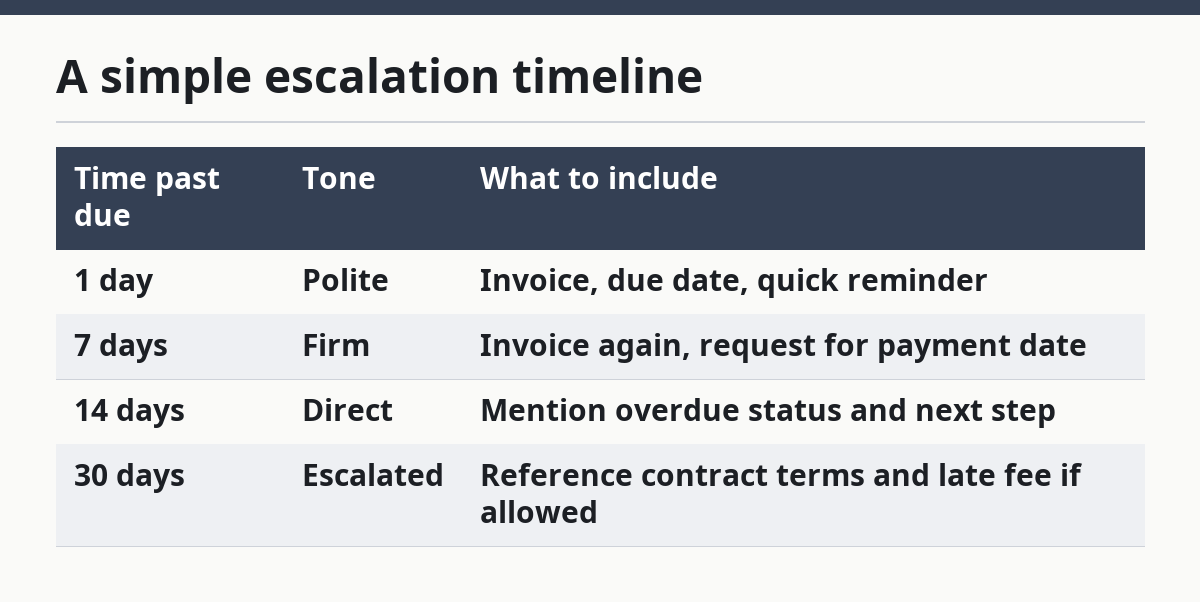
That timeline is not magic. It’s a usable pattern. If your client usually pays late but always pays, stay calm and keep records.
How do you write the email so it gets a response?
You write it so the client can answer in one sentence. A late-payment email gets more replies when it asks for a date, names the invoice clearly, and keeps the body under 150 words.
Picture this: you open your inbox and see a message that starts with apology language, then circles around the point for five paragraphs. You probably put it off. Your client will do the same if you write like that.
Use this core sequence:
- Subject line: “Invoice #204 past due” or “Reminder: Invoice #204”
- Opening line: state the invoice number, amount, and due date.
- Middle line: say the invoice is unpaid and ask for a payment date.
- Closing line: thank them and invite a quick reply.
A subject line does a lot of work. “Following up” is vague. “Invoice #204 past due” gives the reader the whole point before they open the email. If the client uses an accounts payable team, the number in the subject line helps the right person route it fast.
The tone should be polite, not pleading. “I’m checking in” is softer than “Please send payment by Friday,” but it also creates less pressure. Use the softer line only on the first reminder. After that, be direct.
A useful sample looks like this:
Hi [Client Name],
I’m following up on invoice #204 for $1,250, which was due on March 8 under our 14-day payment terms. Please let me know when payment will be sent, or if I should resend the invoice to a different contact. Thanks.
That message is short, plain, and hard to misread. It also gives the client two ways to respond: pay now or route it correctly.
A weak version sounds like this:
- “Just wanted to see if you had a chance to look at my invoice.”
- “Hope you’re doing well and wanted to circle back.”
- “Let me know when you get a chance.”
Those lines are polite, but they bury the ask. The client can ignore them without feeling a need to act.
What should the escalation sequence look like?
The escalation sequence should move from polite reminder to firm demand to contract-based collections language. If you jump straight to anger, you lose the chance to collect without a fight.
Picture this: the invoice is now 14 days late, the first email got no reply, and you need the next message to sound like a process, not a personal complaint. The client should feel that the missed payment has a clear path forward.
Use the same structure each time, but change the pressure:
- First email: reminder and easy reply
- Second email: overdue notice and request for a payment date
- Third email: reference the client contract, payment terms, and any late fee
- Final email: state that work pauses or collections steps may follow, if your contract allows it
A late-fee line belongs only when your contract already covers it. If your contract says a late fee applies after 10 days, say so plainly: “Per our agreement, a late fee now applies to overdue invoices.” Do not invent a fee after the fact.
The strongest escalation messages do two things at once. They remind the client of the agreement, and they tell them what happens next. That next step might be:
- payment by a certain date
- a reply with proof of payment
- a request to resend the invoice to accounting
- a notice that future work is paused until the balance clears
Do not send three reminders in one day. That looks reactive and weak. A better pattern is to give each message time to land, then make the next one more direct.
This is also where your records matter. Keep the invoice, the due date, each reminder, and any replies in one thread or one folder. If the client claims they never saw the first note, you can resend it without rebuilding the story from scratch.
What polite collections language sounds like
Polite collections language sounds firm, factual, and boring in the best way. It removes extra emotion and leaves only the debt, the date, and the next step.
Picture this: you are no longer nudging a busy client. You are telling a slow payer that the balance is still open and that the agreement now matters more than their silence. That shift has to show up in the wording.
Useful phrases include:
- “This invoice is now overdue.”
- “Per our payment terms, the balance was due on [date].”
- “Please confirm the date payment will be sent.”
- “If you need the invoice resent, I’m happy to do that.”
- “Per the client contract, a late fee now applies.”
Those lines work because they do not insult the client. They also do not hide the point. The goal is to make the message easy to answer and hard to dismiss.
Avoid these habits:
- apologizing for asking to be paid
- writing three paragraphs about your own cash flow
- threatening legal action in the first overdue email
- using sarcasm, all caps, or exclamation marks
A polite collections email is not weak. It is controlled. The reader should feel that you expect payment and that you know the paperwork well enough to stand behind the ask.
If the client is a company, route the message to the person who handles vendor payments as well as the person who hired you. If the client is an individual, keep the tone even simpler. In both cases, one clean message beats a long back-and-forth.
The tone also protects the relationship if the client later pays and hires you again. A freelancer does not need to be soft, but there is no prize for sounding angry.
What should you not say in a late-payment follow-up?
You should not write anything that gives the client an easy excuse to ignore the invoice or a reason to read the email as a personal attack. A late-payment follow-up fails fast when it turns vague, emotional, or cluttered.
Picture this: you’re angry, the money is late, and the first draft in your head sounds like a rant. That’s normal. It’s also the version most likely to stall the reply.
Bad phrases usually fall into a few groups:
- vague: “Just checking in”
- passive: “Whenever you get a chance”
- accusatory: “You’ve been ignoring me”
- rambling: too much backstory, not enough ask
A polite email still needs a deadline. Without one, you’ve only made contact. You haven’t created motion.
Also avoid stacking too many questions in one message. “Did you get the invoice, can you confirm receipt, and when will it be paid?” can feel like a pop quiz. One direct question is easier to answer: “Can you confirm when payment will be sent?”
Another mistake is changing the numbers or terms from one message to the next. If the invoice says net 15, don’t casually mention net 30 in a later email. If the late fee starts after 10 days, do not threaten it on day 1. Consistency is part of credibility.
The clearest version of this email is plain enough that the client can forward it to finance without editing it. If your message sounds like it was written in a rush, it gives the reader room to treat it the same way.
For freelancers who want a broader system behind this, the hub on freelance billing and client payment systems is the right place for the setup side. This page stays with the follow-up itself: the wording, the timing, and the escalation chain.
FAQ
When should a freelancer send a late payment reminder?
A freelancer should send the first late payment reminder as soon as the invoice is overdue, often the next day or within a few business days. The right timing depends on the payment terms in the client contract. If the agreement says net 14 or net 30, use that date as the trigger, not your mood.
What should a late payment email say?
A late payment email should say which invoice is overdue, how much is due, when it was due, and what you want next. The first sentence should be direct. A good email asks for a payment date, offers to resend the invoice if needed, and stays short enough that the client can reply quickly.
Can freelancers charge late fees?
Freelancers can charge late fees if the client contract or invoice terms already allow them. The late fee should be stated before the invoice goes overdue, not added after the fact. If your agreement is unclear, keep the follow-up focused on payment and avoid making new demands in the email.
Drafted with AI; not yet reviewed by a person.
