
Last updated: November 19, 2026
Quick Answer: How Freelancers Form an LLC in Their State usually takes 7 steps: choose a name, confirm state rules, file articles of organization, pay the state fee, name a registered agent, create an operating agreement, and wait for approval.
In short: if you want to form an LLC as a freelancer, you choose a business name, check that your state allows it, file articles of organization with the state secretary of state, pay the state filing fee, and keep an operating agreement and registered agent in place.
Key Takeaways
- The filing is usually called articles of organization, and many states let you submit it online.
- One missing field can send the form back and add another round of waiting.
- A single-member LLC should still have an operating agreement, even if the state does not file it.
This page walks through the filing sequence, step by step, so you can see what to do first and what the state expects next.
What you need before you file

How Freelancers Form an LLC in Their State starts with preparation, because the filing itself is short and the setup is where most mistakes happen. You need a name, a registered agent, and the basic information the state asks for before you open the form.
You need four things before you start the online filing: a business name, a registered agent, the address or contact details for that agent, and the basic information the state asks for on the articles of organization. Some states also ask for the LLC’s purpose, effective date, or organizer details. The exact form varies, but the pattern does not.
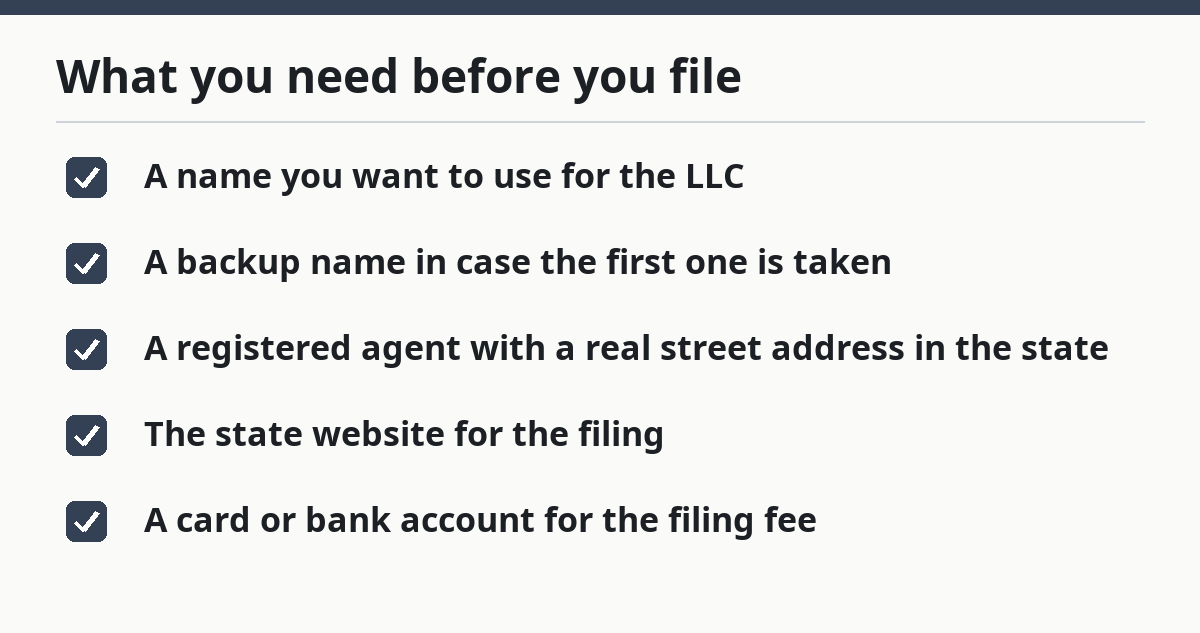
Use this quick checklist first:
- A name you want to use for the LLC
- A backup name in case the first one is taken
- A registered agent with a real street address in the state
- The state website for the filing
- A card or bank account for the filing fee
If the state charges a fee, expect to pay it during filing rather than after. In many states, the fee is due the same day you submit the form. No payment, no filing.
Here’s the catch: some freelancers try to skip the name search and just “see what happens.” That can waste an hour and still leave you with a rejected filing. Check the name first.
How do freelancers form an LLC in their state?
How Freelancers Form an LLC in Their State is usually a state filing, then a records step after approval. Freelancers form an LLC in their state by filing formation paperwork with the state secretary of state or the office that handles business formations, then keeping the LLC’s records straight after approval. The exact form is usually called articles of organization, and the filing is often done on the state website.
The process is usually simple on paper and annoying in practice because each state asks for the same core facts in a slightly different layout. The trick is to follow the state’s order, not some generic checklist from the internet.
-
Search the business name. Use the state’s online name search to see whether your name is available. You should see no exact match, and in many states you should also avoid names that are too close to existing ones. If the name is taken, pick the backup and search again.
-
Choose a registered agent. This is the person or service that accepts legal and state notices for the LLC. You should have a name and a street address ready before you start the form. A P.O. box usually won’t work.
-
Open the state filing page. Find the official state website that handles LLC formation. You want the page for new LLC filings, not a tax page or a generic business portal. When you land on the right page, you should see the articles of organization or equivalent filing form.
-
Enter the LLC details. Fill in the name, registered agent, principal address, and any organizer or management fields the state requests. Some states ask whether the LLC is member-managed or manager-managed. If that option appears, choose the one that matches how you plan to run it.
-
Pay the filing fee. Submit the payment by card or other accepted method on the state site. The fee amount changes by state, so you’ll see the number before you confirm. Once payment goes through, the state should show a submission confirmation or filing receipt.
-
Save the confirmation and wait for approval. Keep the confirmation page, receipt, or filing number. After that, the state reviews the filing and either approves it or sends it back for correction. If the form is clean, you should get stamped articles, a certificate, or another approval notice.
-
Create the operating agreement. Even if the state does not file it, the operating agreement should exist in your records. It sets the basic rules for the LLC, which matters even for a one-person shop.
That’s the filing sequence in plain order. It’s not glamorous, but it is the path.
Why the business name search comes first

How Freelancers Form an LLC in Their State begins with the name search because the LLC name has to be available before filing. Picture this: you’ve built a brand around a name you like, printed it on invoices, and then the state rejects the filing because another LLC already owns a confusingly similar name. That mistake can cost you days and force a rebrand before you even start.
The name search belongs at the top because the LLC name has to be available in your state before filing. Most state search tools are free and take only a few minutes. You type the name into the state database, and if it appears as taken or too close to another entity, you move on.
Look for these name rules while you search:
- The name may need to include “LLC,” “L.L.C.,” or a similar ending
- It can’t imply a license you don’t have, like “bank” or “insurance”
- It often must be distinguishable from existing state records
- Some states block words that suggest a government office
The best move is to search one exact name, then one or two close backups. That keeps you from building the rest of the filing around a name that won’t pass. You can also check the availability of a web domain at the same time, but that’s separate from the state filing.
The truth is, a good freelancer name is the one the state will accept and your clients can remember. Available is not.
What the articles of organization actually ask for
How Freelancers Form an LLC in Their State also depends on the articles of organization, because that form creates the entity. Picture this: you’re on the filing form and it looks shorter than you expected, but every blank matters. One missed field can send the form back, and that means another round of waiting. The form is simple, but it’s not casual.
The articles of organization usually ask for the LLC name, the registered agent’s name and address, and the LLC’s principal office address. Some states also ask for the organizer’s name, the effective date, the duration of the LLC, or whether the company will be member-managed or manager-managed.
A basic filing often includes these fields:
- LLC business name
- Registered agent
- Principal office address
- Organizer information
- Management structure
- Effective date, if the state allows one
You do not need a 20-page packet for this stage. In many states, the form is one page or a short online entry screen. What matters is that the data matches what you intend to use later. If your registered agent is a service, use the exact service name the company gives you, not a nickname.
If the state lets you choose an effective date, that can matter when you want the LLC to start on a specific day. Some states allow immediate filing; others let you delay the start. If you don’t need that, use the default.
One more point: the state filing creates the LLC, but it does not by itself teach you how to run it. That’s where the operating agreement comes in next.
Do you need an operating agreement for a single-member LLC?
Yes, a single-member LLC should still have an operating agreement, even if your state does not file it. The document gives your LLC a written rulebook, and that matters when a bank, vendor, or state office wants proof that the entity is real and organized.
A lot of freelancers skip this because they think a one-person company needs no internal rules. That’s the mistake. The LLC may have one owner, but it still needs a clear record of ownership, management, and how money moves in and out.
A useful operating agreement usually covers:
- The owner’s name and ownership share
- How the LLC is managed
- How profits and losses are handled
- What happens if the owner adds another member later
- How records are kept
- How the LLC can be dissolved
For a single-member LLC, the agreement can be short and practical. It does not need to read like a merger contract. It should simply say who owns the LLC, who runs it, and how decisions are made.
Here’s the catch: some freelancers treat the operating agreement as a formality they’ll “do later.” Later often becomes never, so it is wise to consult a lawyer or tax professional and check your state rules before you put it off. That can make the LLC look unfinished when someone asks for paperwork during onboarding or banking setup.
Keep the signed agreement with your LLC records, not buried in a random folder. If a state requires an operating agreement by law, follow that rule. Even when it is not filed with the state, it belongs in your file. The IRS guidance on LLC classification also shows why records matter: IRS LLC guidance.
How the state filing fee and approval work
How Freelancers Form an LLC in Their State also includes the filing fee and the review step. Picture this: you’ve filled out every blank, clicked submit, and now the state wants payment before it will even look at the form. That part is normal. The filing fee is the gate, and approval comes after the state processes your submission.
The state filing fee is paid when you submit the articles of organization or shortly after, depending on the state’s system. The amount varies by state, so the exact number is best checked on the state filing page before you start. You should expect a receipt, confirmation number, or saved PDF right away.
A clean filing usually moves through these stages:
- You submit the form on the state website
- You pay the fee
- You get a confirmation screen or email
- The state reviews the filing
- You receive approval or a correction request
Processing time also varies by state. Some filings come back fast through the online portal; others take longer if the office is backlogged or if you mail the form instead of filing online. If the state offers both options, online filing is usually the faster path.
Save every file the moment you get it. Keep the confirmation, stamped articles, and any state notice in one folder. That folder is the paper trail for your LLC.
The best part is not excitement; it is that once the state approves the filing, you have a real LLC in that state. From there, the remaining setup is mostly record-keeping and keeping the entity in good standing, which is the kind of task a freelancer can handle without drama.
What freelancers often get wrong during formation
How Freelancers Form an LLC in Their State gets easier when you avoid the usual mistakes. Picture this: you think the filing is done, then you learn the name was wrong, the agent address was unusable, or the form was sent to the wrong state page. Those errors are common, and each one creates delay you didn’t need.
The most common mistakes are boring but costly:
- Using a taken name can force a new filing and a rebrand.
- Choosing the wrong registered agent can leave the LLC without a valid notice contact.
- Missing a required state field can trigger rejection.
- Skipping the operating agreement can leave the LLC’s rules vague.
- Filing on a third-party page instead of the state site can send you to the wrong form or fee schedule.
The fix is simple: use the official state website, read the form line by line, and match the legal names exactly. If a field says “principal office,” don’t paste a mailing address unless the state allows it. If the form asks for the organizer, enter the person submitting the filing, not a brand name.
This is not the place for guesswork. A 10-minute review before submission can save a week of back-and-forth with the state office.
For a broader setup path after formation, the hub page on freelance business formation and setup can help you see where this filing fits in the bigger sequence.
When filing an LLC is the wrong first move
How Freelancers Form an LLC in Their State is not the right first step for every solo business. Picture this: you want the LLC because it sounds official, but the state filing fee, annual reports, and paperwork are going to sit on your desk unused. That’s a bad fit for some freelancers. Not every solo operator needs the same structure on day one.
This filing is wrong for you if you are not ready to keep separate records, maintain a registered agent, and follow your state’s annual filing rules. It can also be the wrong move if you want to stay as simple as possible and have not thought through the admin that comes with a new entity.
The practical question is not “Is an LLC good?” It’s “Am I ready to maintain one?” Formation is the easy part. The harder part is keeping the records clean for the rest of the year.
If you do move ahead, keep your formation folder tidy:
- State filing receipt
- Articles of organization
- Operating agreement
- Registered agent details
- Any state approval notice
That folder turns a one-time filing into an organized entity. Without it, the LLC exists on paper and nowhere else.
What documents do I need to form an LLC?
You usually need the articles of organization, a business name, a registered agent’s name and address, and the information the state asks for on its filing form. Some states also want an organizer name and an effective date. Keep a payment method ready for the filing fee, since many states require it at submission.
Do freelancers need a registered agent?
Yes, an LLC normally needs a registered agent in the state where it is formed. The agent receives legal and state notices at a real street address, not a P.O. box. If you hire a service, use the exact service name and address it gives you on the filing form.
Do I need an operating agreement for a single-member LLC?
Yes, it is smart to have one even if the state does not file it. A single-member LLC still needs written rules for ownership, management, and records. Banks and vendors may ask for it, and it helps keep the company’s paperwork clean.
How long does LLC filing take?
It depends on the state and the filing method. Online filings are often faster than paper filings, but the review time still varies by state office workload. You should expect an immediate confirmation after submission, then a separate approval notice later if the filing is accepted.
Drafted with AI; not yet reviewed by a person.
