

Last updated: November 19, 2026
Freelancer banking and cash management — The Complete Guide means keeping business money separate, timing tax money before you spend it, and building a cash buffer that stops a slow month from wrecking your rent. Quick Answer: the simplest effective setup is one business checking account, one tax savings account, and one reserve account, plus a weekly money routine. The sections below show what to open, how to move money, and what changes when your income is uneven.
Key Takeaways
- A freelancer needs two things fast: a clean place for business money and a habit for moving tax money out before it gets spent.
- The right bank setup is usually boring on purpose: one operating account, one tax account, and one savings bucket for irregular bills.
- Cash management is less about spreadsheets than timing—getting paid faster, paying yourself on a schedule, and holding enough buffer for dry weeks.
- If your income is lumpy, the standard “just watch your balance” advice fails. You need a rule for every deposit.
- The best system for most freelancers is the one you can run in under 15 minutes a week.
What freelancer banking actually has to do
Freelancer banking has to separate business cash from personal cash, because mixed money turns tax season into guesswork. If you do one thing right, make it this: keep business income in its own account and move money out on a schedule, not by memory. That keeps your records cleaner and makes every other decision easier.
Picture this: you get a $2,400 payment on Monday, three invoices are still open, and a quarterly tax bill is coming in six weeks. If the money sits in your checking account with no rule attached, it will get eaten by rent, food, software, and “small” expenses. That is the whole problem.
A clean setup usually has three jobs:
- receive income
- hold tax money
- hold operating cash for bills and owner pay
A simple structure works better than a fancy one for most solo workers:
- Open a business checking account for all freelance income.
- Open a second account for taxes.
- Open a savings account for irregular bills, like annual software, insurance, or a new laptop.
- Send each incoming payment through the same split rule every time.
- Pay yourself from the business account on a set day, like Friday or the 1st and 15th.
If you are in the U.S., the IRS page on estimated taxes is worth reading before you set your split rule: https://www.irs.gov/businesses/small-businesses-self-employed/estimated-taxes
If you are outside the U.S., use your tax authority’s guidance on self-employment payments and keep the same habit.
The truth is, the bank matters less than the system. A free account with weak bookkeeping support can still work fine if you track transfers. A premium account with no cash rule can still leave you short. Quick check: if you cannot tell how much of today’s balance is already spoken for, this section applies to you.
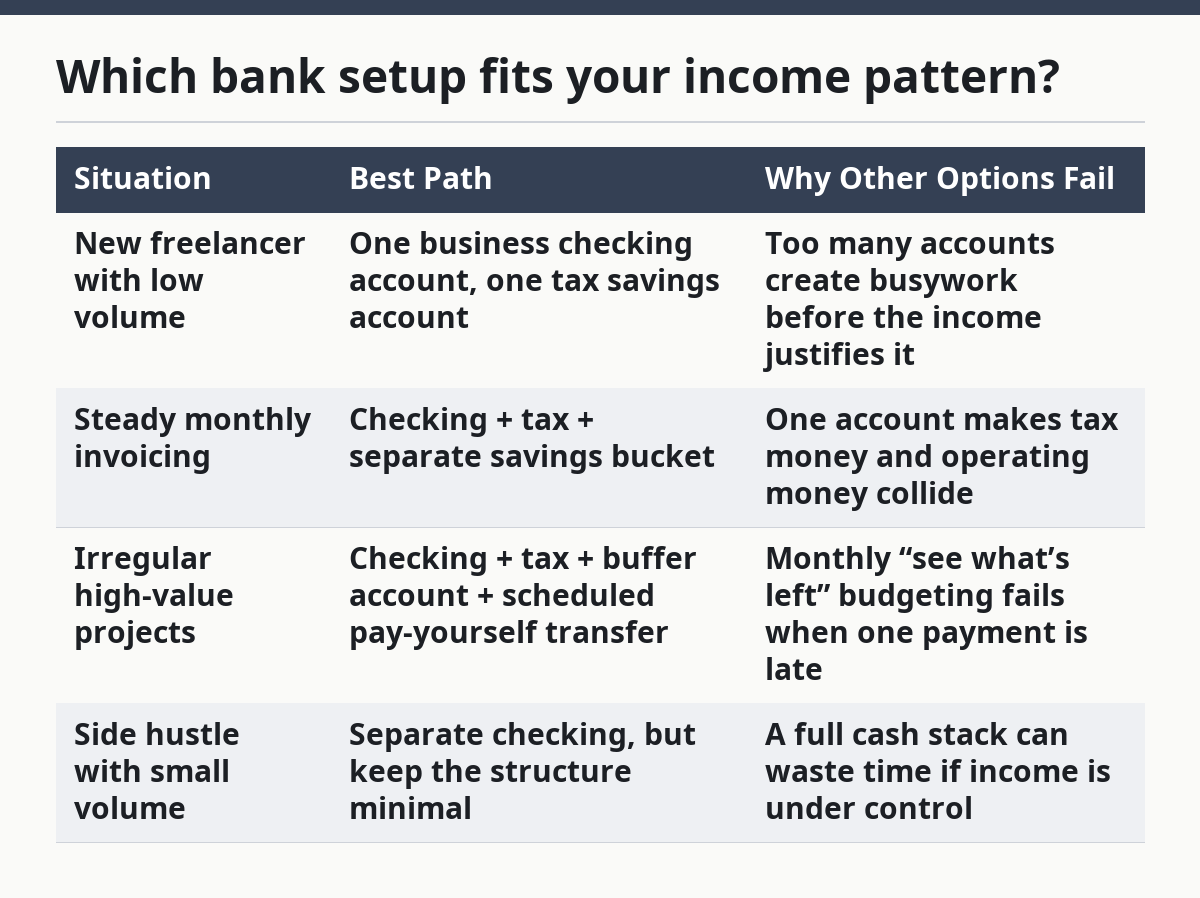
Which bank setup fits your income pattern?
The right setup depends on how often money lands in your account and how predictable your bills are. If payments arrive on a clock, you can run a lighter system. If you invoice unevenly or wait 30 to 60 days for payment, you need a buffer and a stricter split. The wrong setup is the one that assumes every month looks the same.
Picture this: you freelance part-time and bring in one or two payments a month, each from a different platform or client. A single checking account might feel easier, but it usually blurs the line between money you can spend and money you still owe the tax office. That’s a bad fit.
| Situation | Best Path | Why Other Options Fail |
|---|---|---|
| New freelancer with low volume | One business checking account, one tax savings account | Too many accounts create busywork before the income justifies it |
| Steady monthly invoicing | Checking + tax + separate savings bucket | One account makes tax money and operating money collide |
| Irregular high-value projects | Checking + tax + buffer account + scheduled pay-yourself transfer | Monthly “see what’s left” budgeting fails when one payment is late |
| Side hustle with small volume | Separate checking, but keep the structure minimal | A full cash stack can waste time if income is under control |
A good setup for most freelancers follows this path:
- Open a checking account used only for freelance income and business spending.
- Link a tax savings account at the same bank or a bank that transfers quickly.
- If you have annual or quarterly expenses, open a second savings bucket for them.
- Set up transaction alerts for deposits, debits, and low balance warnings.
- Name each account by purpose so you do not guess later.
- Move money on the same day every week.
- Reconcile against your bookkeeping app or spreadsheet every 7 days.
Real tools help, but they are not magic. A business checking account from a major bank, a credit union, or an online bank can all work if it offers clear transfers and downloadable statements. If you use bookkeeping software such as QuickBooks, Xero, Wave, or FreshBooks, connect the account so you do not hand-key everything at tax time.
The catch is that account fees and transfer delays matter more when your cash cushion is thin. If your bank holds ACH transfers for several business days or charges for overdrafts after a timing mistake, a cheaper-looking setup can cost you more than it saves. Quick check: if one late invoice could push you below zero, you need the buffer version, not the minimalist one.
How much cash should a freelancer keep on hand?
A freelancer should keep enough cash to cover a real dry spell, not just the current week. The exact amount depends on how stable your income is, but the rule is simple: if your income is uneven, your cash buffer needs to be bigger than your monthly bill surprise.
Picture this: you have rent, utilities, software, and insurance due in the same 30-day window, and two clients pay late by 10 days. If your checking account is also your spending account, the shortfall shows up fast. Cash flow, not profit, is the problem here.
The buffer usually serves three jobs:
- cover fixed monthly bills
- absorb late payments
- keep tax money untouched
A practical cash routine looks like this:
- List your fixed monthly bills.
- Add irregular bills that arrive quarterly or yearly.
- Keep a separate tax reserve for self-employment tax or income tax.
- Set a minimum operating floor in checking so small timing gaps do not cause overdrafts.
- Sweep extra money into savings only after the floor and tax reserve are funded.
- Review the floor every 3 months if your income changes.
If you are a freelancer with steady recurring retainers, your floor can be tighter because deposits are easier to predict. If you are project-based, use a larger floor and keep more cash in savings that can move quickly. A 1-week buffer is thin. A 1-month buffer is safer. For highly irregular income, 2 to 3 months of basic expenses is the more cautious target.
On the flip side, holding too much idle cash in the wrong place can make you lazy about billing and pricing. Cash in a checking account is not a business plan. It is a delay. Put the money where it has a job.
A good comparison for this decision is:
- Checking for bills you need to pay now
- Savings for taxes and irregular expenses
- A short-term reserve for late invoices and slow months
If you want a neutral source on interest-bearing business accounts and cash safety, the FDIC explains deposit insurance here: https://www.fdic.gov/resources/deposit-insurance/
That does not solve cash flow, but it does matter if you keep a larger reserve.
Quick check: if you can name your fixed expenses but not your cash floor, this section is for you.
What is the most practical way to handle tax money?
A practical way to handle tax money is to move it out of sight the same day income lands. If you wait until the end of the quarter, the tax reserve turns into spendable money by accident. That is the most common mistake, and it causes the most pain.
Picture this: a payment clears, you tell yourself you will set aside tax later, and by Friday the balance has already gone toward groceries, a software renewal, or a dinner that felt justified at the time. Tax money needs a rule, not a mood.
A clean tax routine usually follows this order:
- Estimate your effective tax rate using last year’s return or a current professional estimate.
- Set a transfer percentage for every deposit.
- Move that percentage to a tax savings account the day the payment arrives.
- Never borrow from that account for regular spending.
- If your income is uneven, review the transfer rate monthly.
- Pay estimated taxes on the actual filing schedule that applies to you.
For many freelancers, the tax reserve is the difference between a calm April and a panic scramble. The exact percentage depends on location, entity type, deductions, and whether you owe self-employment tax, income tax, or both. I am not going to guess a number that could be wrong for your case. That would be sloppy.
A useful rule is to keep the tax account boring:
- no card attached
- no casual transfers out
- no business spending from that account
- no “I’ll pay it back later” behavior
If your business structure has changed this year, or if you are not sure how estimated payments apply to you, check the IRS estimated tax page or your country’s tax authority before setting the percentage. A CPA or enrolled agent can help if your income is from multiple countries, platforms, or business entities.
The truth is, most freelancers do not fail because they cannot make money. They fail because they spend tax money first and deal with the bill second. Quick check: if you ever cover taxes with next month’s income, you need this system now.
How do you get paid faster without creating new problems?
You get paid faster by removing friction from the invoice, the payment method, and the follow-up. But faster payment is only good if the deposit lands in an account with a clear split rule. Speed without structure just makes the chaos arrive sooner.
Picture this: a project ends on Friday, the invoice goes out on Monday, and the client waits until the due date because the payment terms were vague. If your cash plan assumes prompt payment without backup, you get squeezed. The invoice is part of cash management.
A payment flow that helps cash look like this:
- Use clear invoice terms, such as due on receipt or net 7, if your market supports it.
- Send the invoice the same day the work is accepted.
- Put payment links in the invoice so there is no extra step.
- Follow up once before the due date and once after, using the same wording every time.
- Record the expected deposit date in your bookkeeping system.
- When the payment lands, split it immediately into operating, tax, and reserve buckets.
A few tools can make this easier:
- Wave for simple invoicing and basic bookkeeping
- QuickBooks Online for a fuller accounting stack
- Xero if you want cleaner bank reconciliation and are comfortable with setup
- Stripe Invoicing or a comparable payment processor if your work model uses card payments or links
Here’s the catch: payment processors can add fees, payout delays, or reserve holds. That matters if your cash cushion is thin. A faster invoice paid through a processor is still not the same thing as money in your bank account. The gap between “paid” and “available” is where freelancers get caught.
A better workflow for project-based freelancers:
- invoice at milestone completion
- keep a late-fee policy if your market allows it
- never depend on one giant month-end payout
- reconcile deposits against invoices every Friday
If your work is retainers or subscriptions, the focus shifts. Auto-pay, recurring invoices, and a known deposit date matter more than chasing each payment. Quick check: if your biggest problem is not finding work but getting paid on time, this is your lane.
What should you do in a slow month?
In a slow month, you cut spending first, protect tax money second, and preserve enough operating cash to keep working. Do not raid the tax account to feel better about the checking balance. That move creates a future problem to solve a present one.
Picture this: two invoices slip into next month, a software renewal hits, and you are staring at a smaller balance than planned. The temptation is to “borrow” from savings without changing anything else. That is how a short month becomes a long one.
Use a fast triage order:
- Freeze nonessential spend for 2 weeks.
- Check which bills are fixed and which can wait.
- Protect tax transfers unless a tax pro tells you otherwise.
- Chase the oldest open invoices first.
- Ask for partial payment or milestone payment if the work is still active.
- Move any excess personal draw to the end of the month, not the start.
- Review what caused the shortfall so next month is not a repeat.
A slow month also exposes bad pricing. If every quiet period forces you to cancel subscriptions, skip savings, or delay bills, your rates are too low or your buffer is too thin. The fix is not one heroic month. It is a better baseline.
The best thing is that a cash buffer gives you choices. Without one, every bill becomes urgent. With one, you can make measured cuts:
- pause tools you rarely use
- renegotiate deadlines
- shift personal spending down for 30 days
- keep marketing and delivery costs that actually produce revenue
If the slow month is caused by seasonality, build that into your annual plan. If it is caused by one big late payer, your process needs tighter follow-up. Quick check: if you are deciding which bill to skip this month, you need a cash rule, not more optimism.
The edge cases where normal advice breaks down
Normal advice breaks down when your income source, tax setup, or payment timing is unusual. If any of these apply, a standard “open a bank account and budget better” answer is not enough. You need a different cash rule.
Picture this: you are paid in multiple currencies, work through a platform that holds funds, or split time between freelance work and a day job. Those cases change the math. Different setup, different fix.
| Situation | What changes | What to do instead |
|---|---|---|
| Multiple currencies | FX fees and conversion timing affect true cash flow | Keep the operating account in your main spending currency and convert on a schedule, not ad hoc; consult a tax or banking professional if cross-border transfers are material, and review bank fee disclosures and conversion guidance from your provider or tax authority |
| Platform holds funds | Money is earned before it is available | Treat held funds as pending, not spendable, until payout clears |
| Mixed W-2 and freelance income | Tax estimates get more complex | Separate freelance tax money from paycheck withholding and review the total with a tax pro |
| High refund or chargeback risk | Cash can reverse after deposit | Keep a larger reserve and avoid spending payments before the reversal window passes |
| Large annual expenses | Cash looks healthy until a yearly bill lands | Build a monthly sinking fund for insurance, software, and equipment |
| Irregular project milestones | Revenue arrives in bursts | Budget from average monthly income, not the biggest month |
If you are paid through a marketplace or processor with holds, read the payout rules before planning bills around the gross invoice total. If you handle cross-border income, watch for bank fees, transfer delays, and exchange-rate spread. If you have both freelance income and a salary, your tax reserve may be smaller or larger than you expect because withholding already covers part of the bill.
One more edge case: if your freelance work is seasonal, your cash plan should be annual, not monthly. A wedding photographer, tax preparer, or holiday consultant can have a very different cash curve from January to December. Monthly budgeting alone misses that pattern. Quick check: if your income is lumpy, delayed, or split across systems, you are in edge-case territory.
The 7-step setup I’d use first
The right first setup is simple: one business checking account, one tax savings account, one reserve account, and a weekly money routine that you can repeat in under 15 minutes. Anything more complicated usually fails before the quarter ends.
Picture this: you are starting from zero, and you want the least messy path that still protects your taxes and bills. The goal is not perfection. The goal is a system that does not collapse when work gets busy.
- Open a business checking account and use it for every freelance deposit.
- Open a tax savings account and label it clearly.
- Open a reserve savings account for irregular business expenses.
- Choose one weekly transfer day.
- Set a split rule for every deposit, even small ones.
- Review open invoices and expected cash every week.
- Reconcile bank activity against your bookkeeping system once a week.
That setup works because it gives each dollar a job before you can spend it. It also keeps your records clean enough to handle tax time without sorting through personal purchases and business expenses on the same statement.
You do not need a complicated cash dashboard on day one. You need a repeatable habit, a tax reserve, and enough buffer to survive a late payer. A good account structure beats a clever spreadsheet that nobody updates.
The truth is, freelancers often want the perfect tool before they build the routine. That order is backward. Get the banking flow working first, then add software, automation, or more accounts if the volume actually demands it. Quick check: if you are still mixing business and personal money, start here.
FAQ
Do I really need a separate bank account for freelance income?
Yes, if you want clean records and less tax-season confusion. A separate account makes it easier to see what belongs to the business, what belongs to taxes, and what you can actually spend. If your freelance work is tiny and temporary, you can still separate the money with minimal setup, but mixing it is the fast route to mistakes.
How much of each payment should I set aside for taxes?
Use your actual tax situation, not a random percentage. The right amount depends on your country, business structure, deductions, and whether you already have withholding from another job. If you are unsure, start with a conservative transfer and have a tax professional or official tax calculator help you set the rate.
Should I keep freelance cash in checking or savings?
Keep day-to-day operating money in checking and tax or reserve money in savings. Checking is for bills that are due soon and payments you need to send fast. Savings is for money you do not want to spend by accident, especially tax money and your buffer for slow months.
What if my clients pay late all the time?
Then your cash plan has to assume delay, not punctuality. Shorten your billing terms where possible, send invoices immediately, and keep a larger cash buffer so one late payer does not hit your rent. If the pattern is severe, consult a tax or legal professional about tightening your contract language and stop treating late payment as rare.
What is the biggest mistake freelancers make with cash?
They treat revenue as spendable income the day it lands. That ignores taxes, upcoming bills, and late payments. The better habit is to split each deposit immediately and pay yourself only from the amount left after the tax reserve and operating needs are covered.
Drafted with AI; not yet reviewed by a person.
