
Last updated: November 19, 2026
Quick Answer: most freelancers need 2 accounts — one business bank account and one payment account. This guide to Freelance banking and payment accounts — The Complete Guide shows when 1 account is enough, when 2 accounts are better, and what to check before you open anything.
Freelancers need one place to receive client money, pay tax, and keep business cash separate from personal spending. The right setup is usually a business bank account plus a payment account that matches how clients pay you. The steps below show what to open, what to avoid, and when a simple personal account is enough.
A bank account specialist in this field knows the difference between client receipts, card payouts, FX fees, and tax pots — and that difference is where freelancers usually lose money.
Key Takeaways
- A freelance setup usually has two jobs: hold business money safely and get paid without friction.
- A business bank account is for clean records, while a payment account is for fast collections from cards, bank transfers, and invoices.
- The best choice often depends on how clients pay you, which countries you invoice, and how often you move money.
- If you only take one-off local payments, a simple account may be enough.
- If you invoice across borders or take card payments, a dedicated payment provider usually saves time and confusion.
- The wrong setup creates mixed records, awkward tax prep, and avoidable transfer fees.
What a freelance banking and payment setup actually needs to do
A freelance account setup should do three things well: receive money, keep it separated from personal cash, and make bookkeeping bearable. If it can’t do those three, it fails the test, even if the app looks polished.
Picture this: you’ve just finished a project, the client wants to pay by bank transfer, and you also need to set aside money for tax before the next bill lands. A decent setup lets you split that cash without mental gymnastics.
That means you’re usually choosing between a bank account, a payment account, or both. A bank account holds funds and handles the day-to-day plumbing. A payment account is the layer that sits between you and the payer — cards, links, invoices, wallets, and sometimes foreign currencies.
A few terms matter here:
- Business bank account: an account used for freelance income and expenses.
- Payment processor / payment account: a service that takes card or bank payments and routes them to you.
- Merchant account: the older card-payment structure, often bundled into modern payment services.
- Multi-currency account: an account that can hold or convert money in more than one currency.
The main mistake is treating every account like a bank account. A payment account can be excellent for collecting money and still be a poor place to store it long term, so it is wise to check the account rules and, if needed, ask an accountant or financial professional before leaving cash there. According to the U.S. Small Business Administration, separate records make it easier to track business income and expenses; see also HMRC’s guidance on business records and bookkeeping.
Do freelancers really need a separate business bank account?
A separate business bank account is the cleanest setup for most freelancers, and it becomes close to mandatory the moment your income stops being occasional. If you take regular client work, mixing business and personal spending is a bookkeeping headache waiting to happen.
Here’s the catch: some freelancers can start with a personal account if their local bank allows it and the volume is tiny. But that’s a temporary convenience, not a stable system. The more invoices, refunds, reimbursements, and tax reserves you have, the more separation matters.
The practical benefits are simple:
- Client payments are easier to identify.
- Business expenses are easier to prove.
- Tax prep gets faster.
- Cash flow becomes visible at a glance.
- Refunds, chargebacks, and bank references are easier to trace.
What a generic article often misses is the non-obvious cost of mixing money. A personal account might work until you need proof of business income for a mortgage, a lender, or a tax authority. Then the neat shortcut becomes a pile of screenshots and explanations.
You should skip a separate business account only if you’re doing extremely light freelance work, your bank explicitly allows business use on a personal account, and you have no payroll, VAT, or foreign invoices to manage.
Separate account checklist
Use a separate account if any of these are true:
- You invoice more than a few clients a year.
- You want one place for tax set-asides.
- You pay contractors, software, or ad spend from the same pot.
- You need a clean audit trail.
- You want to see true profit, not blended personal cash.
What’s the difference between a bank account and a payment account?
A bank account stores money; a payment account moves money, and those are not the same job. Freelancers need both functions to work together, but they solve different problems.
A bank account is where cash sits after it lands. It’s also where direct transfers, standing orders, and basic spending usually happen. A payment account is built for acceptance: payment links, card checkout, invoice payment pages, subscriptions, and sometimes instant payouts.
Picture this: one client pays by bank transfer in your home currency, another pays by card from abroad, and a third wants to split a payment into monthly chunks. A bank alone won’t make that easy. A payment account may handle the collection side well, but it may not be the best long-term place to park the funds.
The difference shows up in four places:
- Speed: payment accounts often collect faster.
- Fees: banks may be cheaper for direct transfers, while payment platforms charge for convenience.
- Controls: banks are better for holding and moving settled money.
- Tools: payment providers often add invoicing, checkout links, and payout routing.
The trap is opening the wrong thing first. If your clients mainly pay by bank transfer, a payment platform may add cost without enough benefit. If your clients want cards or a checkout page, a plain bank account may feel too bare.
Quick decision rule
- Choose a bank account first if clients already know how to pay you.
- Choose a payment account first if you need a way to accept cards or online payments.
- Choose both if you work across countries, currencies, or payment methods.
Which account setup fits your freelance work?
The best setup depends on your payment mix, your invoicing countries, and how often you move money. A copywriter with two local retainer clients does not need the same structure as a designer invoicing three countries.
Picture this: you’re comparing accounts while trying to keep admin under an hour a week. The right setup should reduce work, not create a new finance hobby.
1) Local freelancer paid by bank transfer
This is the simplest case, and a basic business bank account often wins. If clients pay by domestic transfer and you don’t need card checkout, you can keep the setup lean.
What matters most:
- low transfer friction
- easy reference numbers
- clear monthly statements
- simple expense tracking
The weakness is obvious: if a client later asks to pay by card or in another currency, you may need a second tool. That’s not a failure; it’s a sign the business outgrew the starter setup.
2) Freelancer taking card payments or payment links
A payment account fits well here because it gives clients a fast way to pay online. That can mean card checkout, invoice buttons, or mobile-friendly links.
Why it helps:
- less back-and-forth over how to pay
- faster payment for small invoices
- useful for one-off clients who won’t do bank transfers
The downside is that fees can stack up, and payout timing may be less predictable than a normal bank transfer. Some platforms also hold reserves or run extra checks if your volume changes suddenly.
3) Freelancer working across borders
A multi-currency payment account or bank account is usually the better fit. Cross-border work brings exchange rates, local payment rails, and transfer fees into the picture.
What changes:
- incoming currency can matter as much as the invoice total
- conversion fees can eat thin margins
- clients may prefer local methods you don’t use at home
The problem is complexity. A provider may advertise global payments, but what matters is whether it supports the currencies and payout routes you actually need.
4) Freelancer with irregular income
A setup with a strong cash-split routine matters more than a flashy account. When money arrives in bursts, the main risk is spending tax cash by accident.
The best structure for this situation usually includes:
- one account for operating money
- one holding area for tax
- one payment layer for collection
If your account setup can’t support that split, you’ll keep moving money by hand and hoping the numbers line up. That’s a bad system.
The honest side-by-side: bank account vs payment account
A bank account wins for storage and bookkeeping. A payment account wins for collection and client convenience. The right answer depends on where the money starts and where it needs to end up.
| Criteria | Bank Account | Payment Account | Winner for this condition |
|---|---|---|---|
| Holding settled funds | Built for storage and normal cash management | Often a pass-through after payment collection | Usually bank account |
| Accepting card payments | Usually not the main tool for this | Designed for it | Usually payment account |
| Bank transfer receipts | Strong fit for domestic transfers | Can support payouts, but not always the best first stop | Usually bank account |
| Multi-currency work | Depends on the bank’s FX and account features | Often stronger for collection in different currencies | Often payment account |
| Tax and bookkeeping clarity | Very good if kept separate from personal spending | Good for receipts, weaker if money sits there too long | Usually bank account |
| Client checkout experience | Manual payment instructions | Checkout links, invoice buttons, card entry | Usually payment account |
| Fee control | Often simpler and lower for basic transfers | Can add processing, payout, and FX fees | Usually bank account |
| Risk of account holds | Usually lower for normal banking use | Higher when volume, disputes, or risk flags change | Usually bank account |
| Best for beginners | Good if clients already pay by transfer | Good if the only problem is collecting payment easily | Depends on payment method |
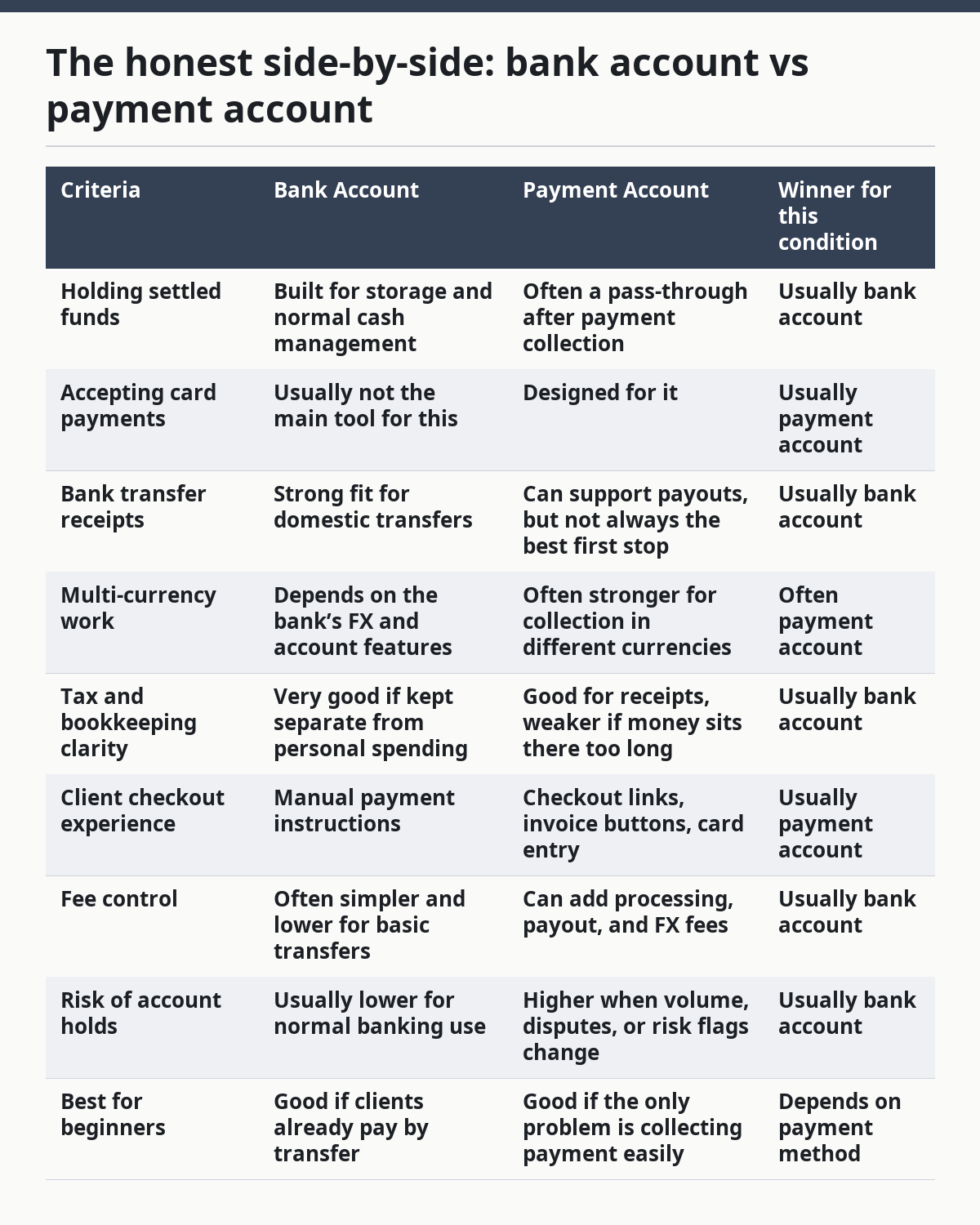
The clear pattern is this: the bank account is the home base, and the payment account is the front door. That division saves confusion.
When does a payment platform beat a bank account for freelancers?
A payment platform beats a bank account when collection speed matters more than storage simplicity. If clients need a link, a button, or a card form, the payment platform becomes the better first touchpoint.
Picture this: you send an invoice and want the client to pay in two clicks instead of copying bank details into a transfer form. That small convenience can change how fast a small business gets paid.
It’s strongest in these situations:
- small invoices where convenience matters
- international clients who prefer cards
- new clients who don’t want to handle bank transfer details
- recurring online services or retainers
- freelance work sold through a checkout page
The downside is not cosmetic. Payment platforms may charge per transaction, hold funds for review, or ask for extra verification when your pattern changes. They can also become messy if you leave all your cash there instead of sweeping it into a bank account.
A lot of generic advice misses this: payment tools are not just “more modern.” They are better at payment acceptance, not necessarily better at financial control.
Choose a payment platform if your biggest problem is getting paid at all. Skip it if your problem is too many fees on already thin-margin invoices.
Good fit signals
A payment account is usually right if:
- clients pay late because paying is awkward
- you invoice across multiple currencies
- your work is sold online
- you need fast payment confirmation
- your clients expect card payment as standard
What features matter most in a freelance account?
The best feature list is the one that matches the way you work, not the one with the longest brochure. A freelancer usually needs fewer features than a small company, but the right few matter a lot.
Picture this: you open an account because the marketing page looks polished, then discover the transfers are awkward, the statements are clunky, or the tax export is a headache. That’s finance admin in a nicer font.
Must-have features
- Separate business identity: your freelance income should not blur into personal spending.
- Clear statements: the records should be readable for bookkeeping or a tax preparer.
- Easy payouts: money should land in a place you can actually use.
- Multiple payment methods: especially if clients differ in how they pay.
- FX visibility: if you invoice abroad, you need to see conversion costs clearly.
Nice-to-have features
- invoice creation
- payment links
- sub-accounts or pots
- recurring billing
- accountant access
- card and bank transfer support in one place
The catch is that some features are decorative. A slick dashboard does not help if the platform freezes payouts or buries fees in the conversion step. Read the actual account rules, not just the homepage.
What can go wrong with freelance payment accounts?
The biggest risks are not dramatic; they’re administrative. A freelancer usually gets tripped up by bad separation, hidden fees, and account limits that only appear after the money starts flowing.
Picture this: one month is quiet, then three invoices land at once, the platform flags the activity, and payout timing shifts. That’s when a nice-looking system becomes a real-world bottleneck.
Common problems
-
Money gets mixed together
You stop knowing what belongs to tax, what belongs to spending, and what belongs to profit. -
Fees stack up quietly
A small fee per payment, a conversion fee, and a payout fee can turn into a real margin cut. -
Funds get held or delayed
Payment platforms may review unusual activity, especially with new accounts or higher volumes. -
Bookkeeping becomes messy
A payment account is not always the best place to store old revenue. -
The setup outgrows the business
What worked for three clients may fail for thirty.
The honest limitation is that no account solves bad cash flow. A better account can make collections smoother, but it won’t fix underpricing, late-paying clients, or weak tax habits.
Which setup should you choose?
Choose a business bank account if your clients pay by transfer and you want the cleanest place to hold money. Choose a payment account if your biggest problem is collecting payment quickly and easily. Neither is enough alone if you invoice across borders, take cards, and need tax clarity.
Picture this: you want one answer you can act on this week, not a theory. The best freelance setup is usually a bank account as the base and a payment account as the front end when clients need it.
Straight verdict
- Choose a business bank account first if you are paid mainly by bank transfer, want simple records, and don’t need a checkout page.
- Choose a payment account first if you sell online, accept card payments, or work with clients who expect a fast payment link.
- Choose both if you handle international clients, multiple currencies, or mixed payment methods.
- Choose neither yet if your freelance work is too irregular to justify setup costs and admin.
The one setup I would not recommend is “everything goes into my personal account and I’ll sort it out later.” That usually becomes later, later, later.
What should you check before opening one?
You should check payment methods, payout timing, fees, and account rules before opening anything. Those four items decide whether the account helps you or adds work.
Picture this: two accounts look similar on the surface, but one supports the currencies you need and the other doesn’t. That difference only shows up after you’ve already moved your business over.
Pre-open checklist
- Does it support the way your clients already pay?
- Can it hold the currencies you invoice in?
- Are payouts fast enough for your cash flow?
- Are there fees for transfers, FX, refunds, or card payments?
- Does it allow freelance or sole trader use in your country?
- Can your accountant or bookkeeper read the statements easily?
If you can’t answer those six questions in five minutes, the account is not simple enough for freelance life.
Can one account do everything?
One account can do a lot, but it rarely does everything well. The cheapest setup is not always the best setup, and the most convenient setup is not always the safest place to store money.
Picture this: you want one login, one balance, and one dashboard. That sounds tidy. It also means you may be forcing collection, storage, foreign exchange, and bookkeeping into a single tool.
The truth is, one-account systems work best only when the business is simple:
- one country
- one currency
- one or two payment methods
- low invoice volume
- no need for specialist checkout tools
As soon as one of those changes, a second account often makes life easier, not harder. The split between a payment account and a bank account is not clutter. It’s structure.
FAQ
Can I use a personal bank account for freelance work?
Sometimes, but it’s a weak long-term setup. If your bank allows it and your freelance income is tiny, a personal account may work for a while. Once you have regular invoices, tax set-asides, or business expenses, a separate account is cleaner and easier to defend on paper.
Do I need both a bank account and a payment account?
You usually do if you take different kinds of payments. A bank account is better for holding money and managing expenses, while a payment account is better for collecting card payments or online invoices. If all your clients pay by domestic transfer, you may not need both on day one.
What matters more: fees or features?
Fees matter more if your margins are thin, and features matter more if your clients need a specific way to pay. A low-fee account that doesn’t support the payment method your clients use is still the wrong account. Start with payment fit, then compare the cost.
Is a multi-currency account worth it for freelancers?
Yes, if you invoice in more than one currency or pay foreign suppliers. It helps you see exchange costs clearly and can reduce the friction of cross-border work. If every client pays in your home currency, you probably don’t need it yet.
What’s the biggest mistake freelancers make with payment accounts?
The biggest mistake is treating a payment account like a savings account. Those platforms are built for collection and payout, not for long-term storage. Once the money lands, it’s usually better to move it into the account you use for bookkeeping and tax planning.
Drafted with AI; not yet reviewed by a person.
