

Last updated: November 19, 2026
Key Takeaways
- A project cancellation clause can give both sides a clean exit by naming notice, payment, and handoff rules.
- Freelancers write a project cancellation clause by stating who can cancel, how much notice is required, what is paid for unfinished work, and what happens to created files.
- A cancellation clause should state the required notice days and when the clock starts.
- Kill fees and refunds work best when earned money and unused money are separated.
A freelance project cancellation clause tells the client what happens if the work stops early. How Freelancers Write a Project Cancellation Clause is to spell out notice, payment for work in progress, any kill fee, and what each side must hand over. The sections below show exactly what to include and what to leave out.
What a cancellation clause has to do
Picture this: you’re halfway through a website draft, the client changes direction, and the project stalls. A project cancellation clause gives both sides a clean exit by naming the notice period, any refund rule, and the handoff for work already done.
The clause does one job: it turns a messy stop into a clear contract clause.
A good version usually covers these pieces:
- Notice period — how much warning either side must give, often 7 or 14 days
- Kill fee — a cancellation payment for reserved time or lost booking space
- Work in progress — what gets billed or delivered if the job stops midstream
- Refund terms — whether any unused money comes back, and when
- Handoff obligations — what files, drafts, or source material the freelancer must send
Here’s the catch: the clause is not a penalty trap. It should match the size of the job and the amount of work already done. A 2-hour logo tweak does not need the same language as a 3-month retainer.
If you want the clause to sit well inside the rest of the agreement, tie it to the same language used in the broader contract. The hub on freelance contracts and client policies can handle that structure; this page stays focused on the cancellation piece.
How do freelancers write a project cancellation clause?
Freelancers write a project cancellation clause by naming who can cancel, how much notice is required, what gets paid for unfinished work, and what happens to the files already created. The best clauses are short, plain, and specific enough to hold up in a real project.
Start with the right shape. A clause that says “either party may cancel with written notice” sounds tidy, but it means little unless it also says what written notice looks like, how many days count as notice, and whether the client owes a kill fee.
Use this order:
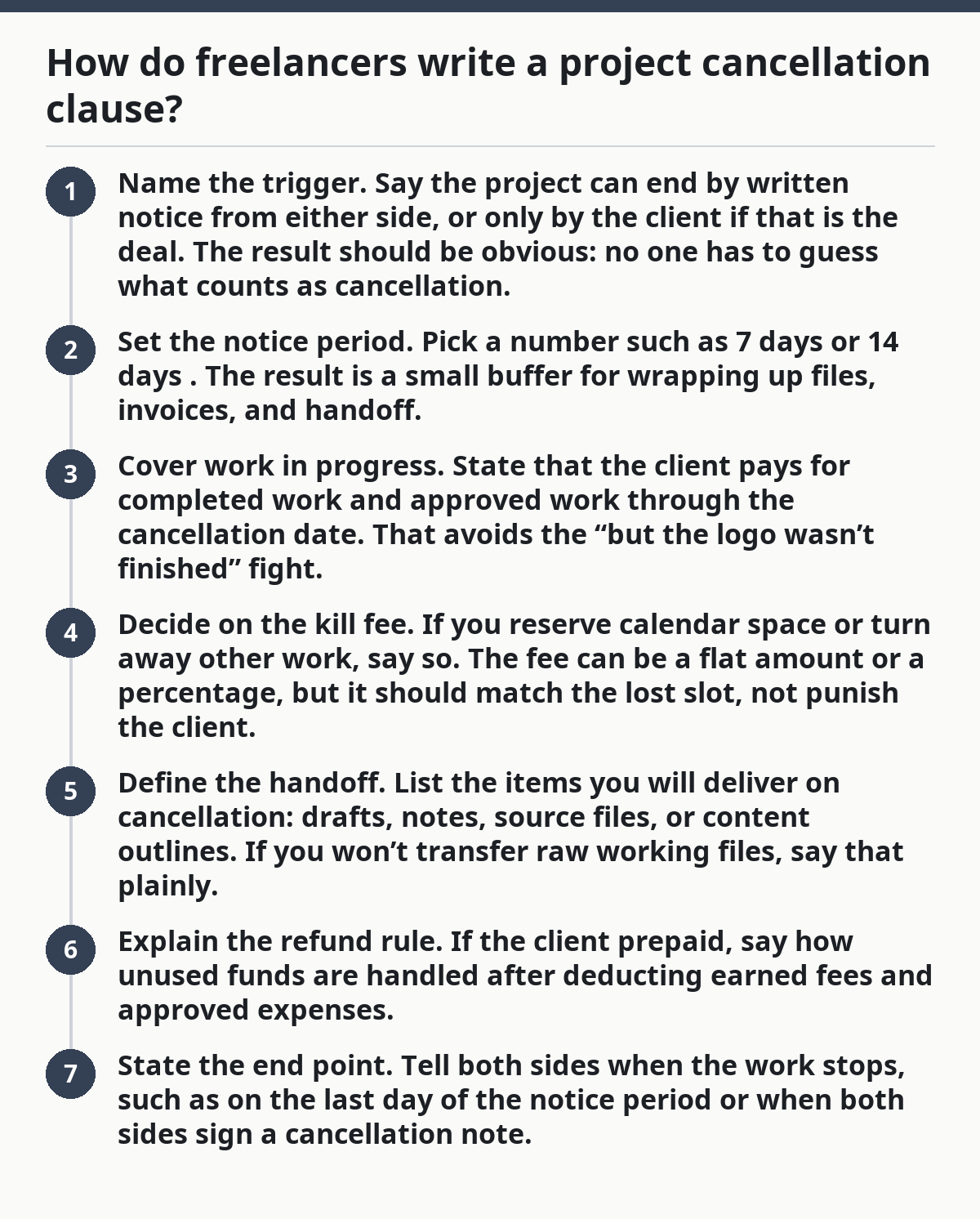
- Name the trigger. Say the project can end by written notice from either side, or only by the client if that is the deal. The result should be obvious: no one has to guess what counts as cancellation.
- Set the notice period. Pick a number such as 7 days or 14 days. The result is a small buffer for wrapping up files, invoices, and handoff.
- Cover work in progress. State that the client pays for completed work and approved work through the cancellation date. That avoids the “but the logo wasn’t finished” fight.
- Decide on the kill fee. If you reserve calendar space or turn away other work, say so. The fee can be a flat amount or a percentage, but it should match the lost slot, not punish the client.
- Define the handoff. List the items you will deliver on cancellation: drafts, notes, source files, or content outlines. If you won’t transfer raw working files, say that plainly.
- Explain the refund rule. If the client prepaid, say how unused funds are handled after deducting earned fees and approved expenses.
- State the end point. Tell both sides when the work stops, such as on the last day of the notice period or when both sides sign a cancellation note.
A clean clause is short enough to read in one breath and specific enough to survive a bad week. That is the standard.
What should a cancellation clause say about notice and timing?
A cancellation clause should say exactly how many days of notice are required and when the clock starts. If the clause is vague, the fight usually starts around timing, not money.
The best notice period depends on the job size. A one-off blog post might use 48 hours or 3 days. A web build or brand project often needs 7 to 14 days so the freelancer can close out the current phase and stop booking new work into that slot.
Use a clear trigger:
- Written notice by email
- Notice sent to the addresses named in the contract
- The cancellation date set by the notice period, not the date of the argument
That wording matters because “immediate cancellation” and “cancellation on written notice” are not the same thing. One ends the project right away. The other gives time for closeout.
The truth is, notice also protects the client. If a freelancer disappears midproject, the client needs a clean date to stop waiting and start planning the handoff. If the client pulls the plug, the freelancer needs a cutoff date for final billing.
A simple clause can say:
- Either party may cancel the project with 7 days’ written notice
- The project ends at 5:00 p.m. on the last day of that notice
- The freelancer will complete work already started up to that date
- The client remains responsible for fees earned before the cancellation date
One bad habit is writing a notice rule that only works one way. If the client can cancel anytime but the freelancer can’t, the clause turns into a one-sided escape hatch. That usually creates resentment before it creates safety.
How do kill fees and refunds fit into the clause?
Kill fees and refunds fit by separating earned money from unused money. A kill fee pays for lost time and reserved capacity; a refund returns money for work that never got done.
This part needs careful wording because people mix up deposits, advances, and prepayments. If a client paid up front for a 4-week project and cancels in week 2, the clause should say how much of that money is earned, how much covers completed work, and whether any part is nonrefundable as a kill fee.
A useful structure looks like this:
- Earned fees first — payment for tasks already completed
- Approved expenses second — any out-of-pocket costs the client agreed to
- Kill fee third — a fixed amount or agreed share for reserved time
- Refund last — only the unused balance, if any, after the above items
That order keeps the clause from becoming a penalty clause dressed up as a refund rule.
Be specific about the trigger too. For example, if the client cancels after the kickoff call and after the freelancer has blocked out 2 weeks of capacity, the clause can say the kill fee applies. If the freelancer cancels because the client stops responding for 14 days, the clause can say the same thing or a different thing. Either way, the contract should not force the reader to infer the answer.
A plain sentence can do the job here. “Client will pay for all work completed through the cancellation date, plus any agreed kill fee, and any remaining prepaid balance will be refunded within 14 days” is clearer than legal fog.
What happens to unfinished work if a client cancels?
Unfinished work stays with the clause until you say who owns it, who gets it, and what gets handed over. Without that language, the dispute usually lands on drafts, source files, and half-finished assets.
A cancellation clause should cover work in progress in plain terms. That means the client should know what they will receive on the way out, and the freelancer should know what they are not required to finish after cancellation.
A practical handoff list may include:
- Drafts completed to date
- Editable files, if the contract says those are included
- Research notes or outlines tied to paid work
- Login credentials or admin access the freelancer set up for the client
- A final invoice or cancellation statement
You should also say what is not included. Raw working files, design layers, or unfinished source material may stay with the freelancer unless the contract says otherwise. That is not mean; it is clarity.
One common mistake is promising to “transfer all work” without saying what that means. Another is promising a full package of deliverables after cancellation even when only half the fee has been paid. Both versions create a gap between the price and the labor.
If the client wants a clean handoff, make the clause tie delivery to payment. For example, “The freelancer will release completed deliverables once earned fees are paid through the cancellation date.” That protects both sides from the awkward pause where the client wants files and the freelancer wants the invoice cleared.
Common mistakes that make cancellation clauses fail
A cancellation clause fails when it sounds fair but says nothing useful. The biggest mistakes are vague timing, vague payment terms, and vague handoff language.
The most common traps are easy to spot:
- No notice period — leads to surprise cancellations and rushed billing
- No kill fee language — makes reserved time look free, even when it blocked other work
- No rule for unfinished work — leaves drafts and source files in limbo
- No refund formula — forces the freelancer to improvise under pressure
- Only one-way rights — gives one side the power to walk away while the other side carries all the cost
Each mistake has a cost. A vague notice rule costs time. A missing fee rule costs money. A missing handoff rule costs trust and, sometimes, the client’s ability to reuse the work already paid for.
The fix is not more pages. It is sharper wording. Short sentences beat noble-sounding language every time. Say who can cancel, how much warning is needed, what gets billed, what gets returned, and what gets handed over.
A clause can also be too broad. If it says the freelancer can keep “all payments” after any cancellation, that may feel harsh and may not fit the work actually completed. If it says the client can cancel “for any reason” without paying for completed work, that is just as lopsided. The clause should survive a real project, not just a friendly draft.
For general contract structure, the Freelancers Union and the American Bar Association both have plain-language contract guidance worth reading before you finalize terms. That keeps the cancellation language from drifting away from the rest of the agreement.
A simple way to draft the clause without overcomplicating it
A simple clause works better when it matches the size of the project. If the job is small, keep it to a few sentences. If the job runs for months, add a separate paragraph for handoff and payment timing.
Use this drafting order:
-
Start with the right of cancellation.
Say either party may cancel by written notice. The result is a clean starting point. -
Add the notice period.
Use a clear number, like 7 days or 14 days. That gives both sides a known cutoff. -
State what gets paid.
Include completed work, approved work in progress, and any agreed expenses. The result is no debate over earned fees. -
Add the kill fee if needed.
Say when it applies and how it is calculated. That protects reserved time. -
Cover refund terms.
Explain what happens to any balance after earned fees and the kill fee are subtracted. If no refund is due, say why. -
Close with handoff obligations.
List the files or materials the freelancer will deliver after cancellation and tie delivery to payment if needed.
A useful test is to read the clause out loud. If you have to pause and explain three terms, it is too dense. If the client can read it and know what happens on day 1 and day 7 after notice, it is doing its job.
A final note on fit: this clause is for the project that can stop midstream. It is not the place for late payment rules, deposit math, or milestone billing mechanics. Those deserve their own contract sections so each rule stays clean.
Should freelancers charge a cancellation fee?
Yes, when the freelancer has reserved time or already started work, a cancellation fee can be fair. The fee should match the actual cost of the lost slot or the work already done, not act like a punishment. If the project is tiny and no time was blocked, a fee may not be needed.
What happens to unfinished work if a client cancels?
Unfinished work should be handled by the clause, not by guesswork. The agreement should say what the client receives, what stays with the freelancer, and whether release depends on payment for work already completed. Drafts, notes, and source files are the usual flash points.
Can a freelancer keep a deposit after cancellation?
Sometimes, yes, if the contract says the deposit is nonrefundable or earned at a certain stage. A deposit is not the same thing as a refund balance, so the clause should spell out whether it covers reservation of time, startup work, or both. If that language is missing, the dispute gets much harder.
Drafted with AI; not yet reviewed by a person.
