
Last updated: November 19, 2026
Key Takeaways
- The answer is a complete invoice with clear currency, IBAN, SWIFT/BIC, and tax identification fields.
- Format the payment block so accounts payable can copy it into a transfer screen.
- Invoice in the client’s expected payment currency unless the contract says otherwise.
- Include the tax ID your client’s country or your own tax system expects on the invoice.
Freelancers miss payments on international work when the invoice leaves out the bank details, currency, or tax fields the client needs to process it. For How Freelancers Send Invoices to International Clients Without Payment Delays, the fix is a clean international invoice with the right payment data, in the right language, and in the currency the client can actually pay. The steps below explain what to include and what to skip.
The fields an international invoice needs

Picture this: you’ve finished the work, the client is ready to pay, and your invoice is missing one line that their finance team needs before they can release the transfer. The answer is a complete invoice with clear currency, iban, swift/bic, and tax identification number fields.
A cross-border invoice is not a design contest. It is a document that gives accounting staff enough exact data to move money without emailing you back for basics. If you’re billing a company overseas, every field should answer a question: who billed, who owes, what was delivered, how much is due, and where the money should go.
Use this as your core checklist:
- Your full legal name or business name
- Client legal name and billing address
- Invoice number and invoice date
- Description of work or project period
- Amount due and currency
- Payment due date or terms
- Bank transfer details
- iban and swift/bic for international wires
- Tax fields your client or country requires
- Any reference number the client asked you to quote
The most common delay is not fraud or a failed transfer. It is a missing field that forces a 2-day email loop. That delay hurts cash flow fast.
How do you format the payment details so a bank can use them in international invoices?
You format the payment section so a bank clerk or AP system can copy it straight into a transfer screen. That means separate lines for the account holder, account number, iban, swift/bic, bank name, and bank address if your bank provides it.
Here’s the catch: a domestic-looking invoice often fails in cross-border billing because the client can’t tell which country format to use. A bank transfer in the EU may use an iban alone in some cases, while many global transfers still ask for both iban and swift/bic. If your bank gives you a correspondent bank or intermediary bank field, include it exactly as written on your banking details sheet.
Use this order on the invoice:
- Account holder name
- Bank name
- iban
- swift/bic
- Account number, if your bank still lists one separately
- Bank address, if available and required
- Payment reference or invoice number
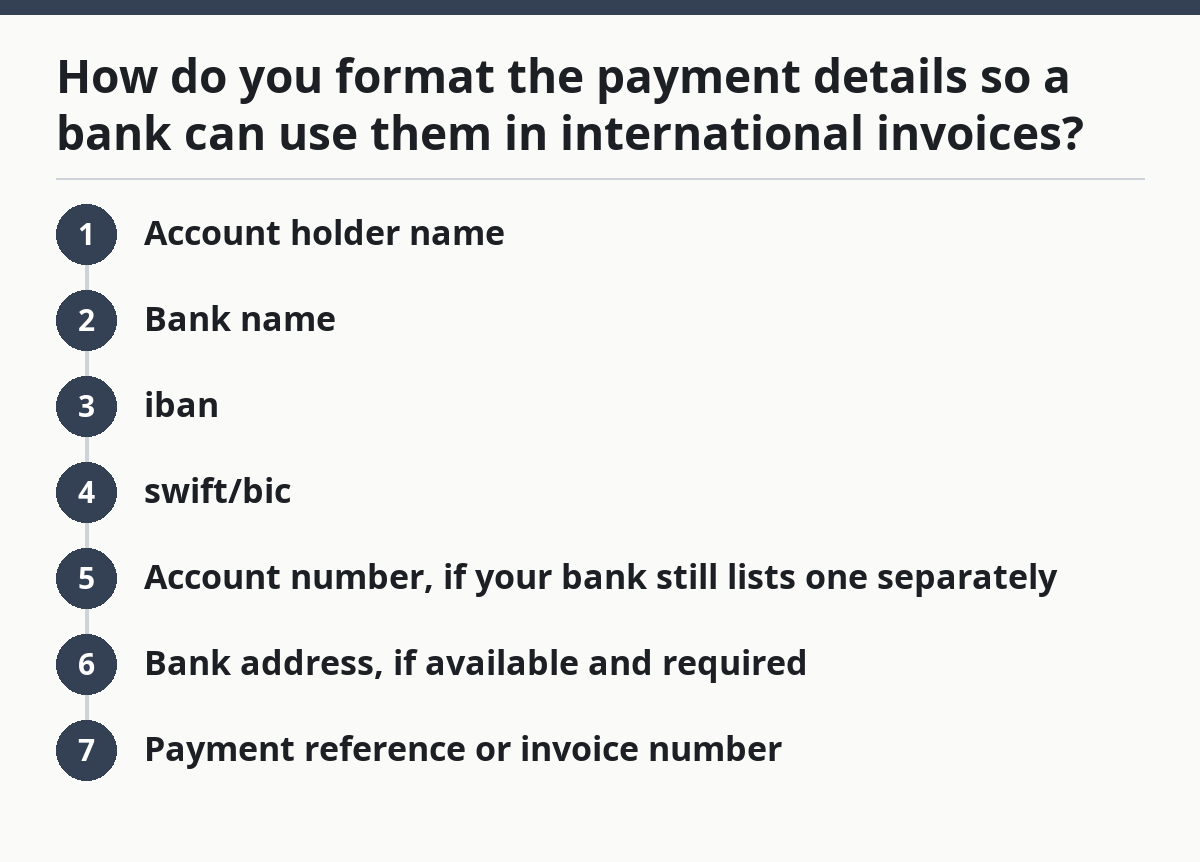
That order makes the payment block easier to scan. It also reduces typing mistakes when the client copies the details into a transfer form.
A clean payment block beats a pretty one. It is precision.
Should freelancers invoice in local currency or USD?

Freelancers should invoice in the currency the client expects to pay, unless the contract says otherwise. If the client’s finance team books expenses in EUR, GBP, or another local currency, billing in that currency can reduce back-and-forth and short questions about exchange rates.
The wrong currency choice creates friction in two places. First, the client may need approval for a foreign currency invoice. Second, the amount can shift between invoice date and payment date if the contract leaves conversion unclear. That is where delays start. A client that sees “USD only” may still pay in USD, but their accounting team may need a second check before release.
A practical rule:
- Use the client’s local currency if the contract and finance team want it.
- Use your home currency if the contract clearly says so.
- If you bill in a foreign currency, state the exact amount due in that currency and do not leave room for conversion guesses.
- If exchange rate handling matters, write that the invoice amount is fixed in the invoice currency.
This is one reason an international invoice should never mix currencies on the same line item unless the agreement calls for it. That kind of clutter slows down approval.
The truth is, currency choice is part money term, part admin term. Get it wrong and the invoice looks uncertain.
What tax identification numbers belong on the invoice for international clients?
You include the tax identification number your client’s country or your own tax system expects on the invoice. That may be a VAT number, GST number, business tax ID, or another official registration number, depending on where you and the client are based.
Picture this: your client’s AP team has your invoice, but the tax box is blank. They may reject it even if the service amount is correct. Some companies cannot book cross-border service invoices without the supplier’s tax ID. Others can, but only after an internal review. Either way, the missing number costs time.
Add the tax field in plain language:
- Tax ID
- VAT ID
- GST/HST number
- Business registration number
- Client tax ID, if your local rules or contract require it
Don’t guess which one applies. Use the label that matches your registration documents and the client’s billing rules. If you work across borders often, keep a standard invoice template with the right tax field already in place. That saves you from rebuilding the document every time a client asks for a new format.
If the client says “send a tax-compliant invoice,” do not reply with a PDF that has only your name and amount due. That usually means a second round of edits.
A step-by-step process that keeps payment moving
Picture this: the job is done, the client signs off, and you need the invoice to land cleanly the first time. A consistent structure helps here, because you can fill it with the exact payment data the client’s accounts team asked for.
Follow this process:
-
Open your invoice template and set the invoice number, date, and due date.
A simple monthly sequence works fine, as long as each number is unique. That helps the client track payment in their system. -
Add the client’s legal billing name and address.
Use the company name on the contract, not a nickname from email. A mismatch can trigger a hold. -
Write the service description in plain English.
Use the project name, date range, or deliverable. “Consulting services” is thin; “Website copy for March 1–15 project sprint” gives AP something to recognize. -
Set the invoice currency.
Choose one currency and stick to it on the whole invoice. If the contract names EUR, do not quietly switch to USD. -
Insert payment details exactly as your bank shows them.
Include iban, swift/bic, account holder name, and any reference field. This is the section clients copy into a wire form. -
Add the tax identification number and any tax note required by your country or the client’s country.
If you need to show a tax-exempt note, write it in one short line. -
Send the invoice as a PDF and keep the original file name simple.
A file likeInvoice-1043-ClientName.pdfis easier to search than a random export name. -
Save the sent version and the date you sent it.
If a client asks for a resend 10 days later, you can produce the exact file without rebuilding it.
This process cuts the small errors that slow payment. Small errors matter.
Common mistakes that delay overseas payment
Freelancers slow their own invoices down when they mix formats, leave out bank data, or assume the client’s country works like theirs. The fix is not fancy software. It is precision.
The most common mistakes are these:
-
Using the wrong currency.
Cost: approval delay or a request to reissue the invoice.
Do this instead: match the contract currency or the client’s billing currency. -
Leaving out iban or swift/bic.
Cost: the client cannot complete the transfer.
Do this instead: include both when your bank provides both. -
Putting a nickname instead of the legal business name.
Cost: AP may reject the invoice as a mismatch.
Do this instead: use the name tied to your banking and tax records. -
Skipping the tax ID field.
Cost: extra review, especially with larger companies.
Do this instead: add the correct tax identification number every time. -
Sending a vague service description.
Cost: the invoice gets parked until someone asks what it covers.
Do this instead: name the project, date range, or deliverable. -
Mixing English and local terms without a reason.
Cost: confusion in the finance team.
Do this instead: keep the invoice language simple and consistent.
The best part? You can fix most of these with one template and a 5-minute review before sending. That is less work than chasing a late payment for two weeks.
What language should the invoice use?
The invoice should use the language the client’s accounts team can process without guesswork, usually English or the client’s local billing language. If the client gave you a billing portal, purchase order, or accounting contact, match that language if you can.
A bilingual invoice can help, but only if it stays clean. If you add translated labels, keep the payment fields in the exact form your bank uses. Do not translate iban, swift/bic, or your legal tax ID. Those are identifiers, not marketing copy.
Use short labels:
- Invoice number
- Invoice date
- Due date
- Amount due
- Currency
- Tax ID
- Bank transfer details
Now, you might be wondering if a fancy invoice template improves payment speed. Not really. The real advantage is readability. A finance team can process a simple invoice faster than a decorated one with scattered labels and tiny text.
If the client works in a non-English market, send a one-page PDF with the invoice data in their language and keep the payment identifiers unchanged. That usually gives you the clearest and most accurate version.
A simple final check before you hit send
An international invoice is ready to send when the client can read it, book it, and pay it without asking for one more detail. That means the payment block, currency, and tax field all line up with the contract.
Use this last check:
- Is the client’s legal name correct?
- Is the invoice number unique?
- Is the currency exactly the one agreed?
- Are iban and swift/bic present and legible?
- Is the tax identification number included if required?
- Is the due date visible?
- Can someone in finance understand the service in one glance?
If any answer is no, fix the invoice before it leaves your inbox. A clean invoice saves days. A sloppy one costs them.
For related billing structure and payment workflow topics, the hub on freelance billing and client payment systems can sit above this page.
What should an international freelance invoice include?
An international freelance invoice should include the client’s legal name, your legal name or business name, the invoice number, the invoice date, the due date, a clear service description, the amount due, the currency, bank transfer details, and any required tax identification number. If the client asked for a reference number, add that too. Missing one of these often causes an AP hold.
Should freelancers invoice in local currency or usd?
Freelancers should invoice in the currency agreed in the contract or the currency the client’s finance team expects to pay. Local currency can reduce confusion for the client, while USD can work when both sides agreed to it up front. The important part is consistency; changing currency after work is done can trigger questions and delay payment.
How do freelancers get paid by overseas clients?
Freelancers get paid by overseas clients through the payment method named in the invoice or contract, often a bank transfer. The invoice should include the exact bank details the client needs, such as iban and swift/bic when relevant. If the client’s accounting team has a preferred process, match it on the invoice so the transfer can move without extra emails.
Drafted with AI; not yet reviewed by a person.
