
Last updated: November 20, 2026
Quick Answer: Most freelancers can clear a bank hold or freeze by sending the exact documents the bank asks for within 24 hours to 48 hours, with a matching invoice, contract, payment record, and ID. In this article on How Freelancers Handle Bank Account Holds, Freezes, and Verification Requests, the goal is simple: explain the activity clearly enough that the bank can review it fast.
A bank account hold or freeze can stop a freelancer’s cash flow fast. The fix is usually proof, not panic: send the documents the bank asks for, answer clearly, and keep the account’s activity easy to explain. The steps below show what gets reviewed and what to send first.
Key Takeaways
- A hold is usually a review, not a final loss of funds.
- Banks want a clean paper trail: invoice, contract, payment record, and ID.
- A source-of-funds request is about where the money came from, not just who sent it.
- Quick replies matter, but vague replies drag the review out.
- It is usually safer to keep records ready before a bank asks.
Picture this: you open your app and the balance is there, but transfers are blocked, card payments fail, or the bank wants a document upload within 24 hours. That is a bank hold process in motion, and the most practical way out is to match the bank’s request with the right paper trail.
A freeze usually means the bank has limited access while it checks activity. That can still stall rent, payroll, and taxes if you ignore it.
What a bank hold, freeze, or verification request means

A bank hold, freeze, or identity check means the bank wants to review your activity before it releases full access. The reason can be a large payment, a pattern the system flags, a name mismatch, or a standard compliance review.
Here’s the catch: these are not the same thing. A hold often blocks a single payment or deposit. A freeze can lock broader access. A verification request asks you to prove who you are or where money came from, often through a secure upload or message in the banking app; if you are unsure what the bank wants, consult the bank or a qualified professional and review the bank’s own instructions, such as FinCEN guidance on suspicious activity reporting and customer due diligence.
For freelancers, the trigger is usually ordinary business activity that looks unusual to software. A $5,000 payment from a new overseas buyer, three deposits in two days, or a sudden spike after months of low volume can all bring review. The bank’s risk controls are built to catch fraud, money laundering, and identity abuse, so your job is to make the activity easy to explain.
Use this as the working rule:
- A hold affects a payment or deposit.
- A freeze affects the account or its transfers.
- Verification asks for identity or business proof.
- Source-of-funds asks how the money was earned.
Overall, a calm, complete response often fixes the problem faster than repeated calls. The wrong move is to send random screenshots and hope the reviewer pieces it together. They usually will not.
What freelancers should send first during bank account holds
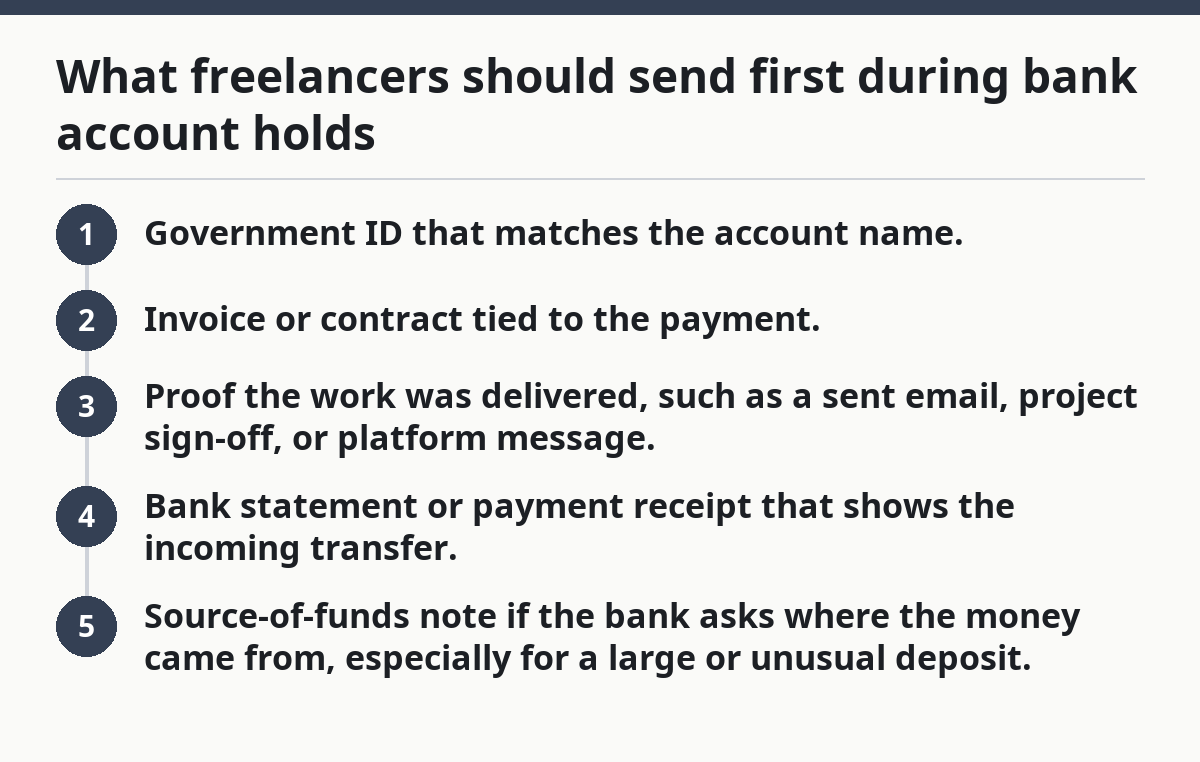
Freelancers should send a short, clean package: identity document, proof of the payment, and proof of the work behind the payment. That is the core of most bank account hold process reviews.
Picture this: the bank asks for “supporting documents” and gives you a upload box with a 10 MB limit. You do not need a pile of files. You need the right ones in the right order, named clearly enough that a reviewer can read them in under a minute.
The first packet should usually include:
- Government ID that matches the account name.
- Invoice or contract tied to the payment.
- Proof the work was delivered, such as a sent email, project sign-off, or platform message.
- Bank statement or payment receipt that shows the incoming transfer.
- Source-of-funds note if the bank asks where the money came from, especially for a large or unusual deposit.
Keep the file names plain:
ID.pdfInvoice-ClientName-2026-03.pdfPaymentReceipt.pdfContract.pdf
That simple structure matters because many reviewers are working against a queue. A bank analyst looking at 50 cases in a day is not hunting through messy screenshots.
A common miss is sending a contract alone. That proves work terms, but not that the payment cleared or that the service was delivered. Another miss is sending a payment receipt without the invoice. That shows money moved, but not why.
If the request mentions identity verification, answer that first. If it mentions source of funds, answer that first. Don’t make the bank infer anything that your documents could state outright.
How to answer a source-of-funds request without making it worse
A source-of-funds request is answered best with one sentence and the supporting files that make that sentence true. The bank wants the origin of the money in plain English, not a story with gaps.
Picture this: you get a message asking where $12,400 came from after a few large deposits land in one week. The bank is not asking you to write a memoir. It wants the payment path from buyer to invoice to deposit.
Use this format in your reply:
- “These funds came from freelance design services billed under invoice 1042.”
- “The attached contract and invoice match the payment reference.”
- “The work was completed on [date], and the payment cleared on [date].”
Then attach the supporting record set:
- Contract or statement of work
- Invoice
- Payment confirmation
- Proof of delivery or completion
- Any platform payout record, if the payment came through a marketplace
That “source of funds” label matters because it is broader than income proof. A bank may want to know whether the deposit came from a salary, a sale, a gift, a loan, or a business service. For freelancers, the answer is usually service revenue tied to a dated invoice.
Do not guess at the bank’s concern. If the question is “source of funds,” answer that. If the question is “source of wealth,” the request is broader and may call for older records too, such as prior tax returns or account history. If you’re unsure, ask the bank to restate the request in writing.
On the flip side, do not say “this is just normal freelance income” and stop there. Normal to you is not enough for a compliance review.
The step-by-step response plan when your account is frozen
The right response to a freeze is to stop guessing, pull the request into writing, and send a single clean reply with the exact records asked for. That keeps the case from drifting for days.
Picture this: you can still log in, but transfers are blocked and a banner says “account under review.” The clock starts now, because the first reply often sets the tone for the whole case.
- Open the bank message or secure inbox and read the exact request. The result you want is the list of documents, the deadline, and the contact path in one place; if anything is unclear, consult the bank’s instructions or a qualified professional before sending a reply.
- Match each request to one file. If the bank asks for proof of payment and proof of work, send both — not six extra PDFs that bury the answer.
- Write a short cover note. Say what the funds are, what the service was, and which attachment proves each point.
- Upload in the format the bank prefers, such as PDF or JPG, and stay under any size cap like **10 MB** per file or the app’s own limit.
- Save the submission receipt, case number, and timestamp. You want a record if the review drags or the bank asks again.
- Follow up only on the schedule the bank gives. If no schedule is given, ask for a case update after a reasonable wait, not every few hours.
The bank’s review team may ask for one more item after the first upload. That is normal. What costs time is sending a new batch that does not answer the original question, because the case gets pushed back to the queue.
A useful habit is to keep a ready folder with ID, recent invoices, contracts, and payout records. If the bank asks for a document from the last 90 days, you can pull it in minutes instead of rebuilding the trail under pressure.
This is also where risk controls show up. A bank might compare the name on the invoice, the name on the account, and the name on the payment sender. If those do not line up, the reviewer will slow down.
For that reason, keep the trail consistent before you ever need it, because the account review often turns on small mismatches rather than the payment size alone.
What documents freelancers should keep ready before trouble starts
Freelancers should keep a basic verification pack ready all year, because the best response to a hold is speed. The more complete the pack, the less room there is for confusion.
Picture this: you are asked for proof of earnings on a Friday afternoon, and the bank gives you until Monday. You do not want to search email, cloud storage, and old chats for a missing contract page.
A practical document checklist looks like this:
- Photo ID or passport
- Business registration, if you have one
- Recent bank statements
- Invoices for the last several payments
- Signed contracts or statements of work
- Proof of delivery, such as a sent file, approval email, or platform milestone
- Tax records that match the income, if the bank asks for wider verification
- Notes on recurring transfers, especially if payments come from several countries
The exact mix depends on the request. A smaller verification may need only ID and invoice copies. A deeper review may ask for tax documents, a business profile, or an explanation of several deposits over 30 days.
Keep the records in a folder with month names, not loose screenshots. PDF files help because they preserve dates and page order. Screenshots can work, but they often miss page numbers, sender details, or the full invoice footer.
Here’s the part many freelancers miss: your records should explain the business pattern as well as the single payment. A bank will look for a clean trail, not a lucky match. If the payment came through a marketplace, save the payout summary too.
For general account setup and cash-flow habits, the hub on freelance banking and payment accounts is the right next stop, and it connects naturally to the same recordkeeping habits that help with holds.
Common mistakes that make holds last longer
Freelancers make holds last longer when they reply with scattered evidence, inconsistent names, or emotional messages instead of clean proof. The bank is looking for facts, not frustration.
Picture this: you send five screenshots, three short replies, and a long explanation about how unfair the hold feels. None of that answers the review question, so the file sits untouched until someone has time to sort it.
Common mistakes:
- Sending the wrong file type. A blurry phone photo of a contract costs time because reviewers need to read dates and signatures. Use PDF when you can.
- Ignoring the specific question. If the bank asks for source of funds, a photo ID alone does not help. Send the matching invoice trail.
- Mixing personal and work payments without explanation. That makes the account pattern harder to read and slows the review.
- Changing the story midstream. If the first reply says the payment was for consulting, don’t later call it a refund or loan unless that is truly the case.
- Missing deadlines. A 48-hour request that gets answered on day five can drag the freeze out.
The cost is not just delay. Missed rent, late contractor pay, and blocked card payments can land all at once. That is why the better move is a single, organized reply with every item the bank asked for.
If the request is unclear, ask one direct question: “Which documents will satisfy this review?” That is better than a dozen messages. Clear questions usually get clearer answers.
How freelancers prevent bank account holds from turning into cash-flow shocks
Freelancers prevent most cash-flow damage by keeping a buffer, separating payment records, and making bank activity easy to explain. Prevention is less about avoiding all holds and more about not getting trapped by one.
Picture this: a payment is delayed for 7 days, but rent and software bills still clear on schedule. If your operating cash is too thin, a temporary review becomes a real problem. A reserve can soften the impact more than people expect.
Use these habits:
- Keep a cash buffer for one billing cycle if possible.
- Match invoices to deposits the same day they land.
- Save proof of delivery for every job, not just the big ones.
- Tell the bank if you expect an unusual payment spike, especially after a quiet month.
- Keep business activity readable: clean invoice numbers, clear payment references, and consistent naming.
A bigger pattern matters too. If your account suddenly takes payments from several countries, the bank may treat that as higher risk and ask for more proof. That does not mean you have done anything wrong. It means the account now looks different to the system.
Not every freelancer needs the same setup. A designer with three clients a month has different risk than a translator with dozens of small payments. The account that can explain the pattern clearly is the one that survives the review with less drama.
The truth is, the bank does not need a perfect business. It needs a traceable one. Give it dates, names, invoices, and delivery proof, and the hold is far less likely to turn into a drawn-out freeze.
Why do banks freeze freelancer accounts?
Banks freeze freelancer accounts when activity looks unusual, unclear, or high risk under their own controls. The trigger can be a large deposit, repeated transfers, a name mismatch, or a pattern that needs identity verification or source-of-funds proof. A freeze is usually a review step, not a final decision.
The fastest way through is to answer the exact request with matching records. If the bank asks for proof of income, send invoices and payment records. If it asks for identity, send the ID it requested, not a different document set.
What documents do banks ask for during verification?
Banks usually ask for identity proof, payment records, and documents that connect the money to the work. That often means a government ID, an invoice, a contract or statement of work, and proof that the service was delivered or the payment was earned.
If the request is for source of funds, the bank may also want recent bank statements, tax records, or payout summaries. The goal is a clean paper trail that shows where the money came from and why it belongs in the account.
How can freelancers prevent account holds?
Freelancers can reduce account holds by keeping clean records, using consistent invoice details, and saving proof of delivery for every payment. A bank is less likely to stall money when the account activity is easy to explain in under a minute.
The best defense is a ready file of ID, invoices, contracts, and recent statements. If a request arrives, reply quickly and send only what the bank asked for, with the full trail attached.
Drafted with AI; not yet reviewed by a person.
