
Last updated: November 19, 2026
Key Takeaways
- A separate tax reserve account structure uses two accounts: one for spending, one for tax money.
- Checking is for spendable business cash; the reserve is for tax cash.
- The transfer timing works best when it matches income timing and tax deadlines.
- The structure can fail if the reserve is treated like spare cash.
A freelancer tax reserve account structure keeps tax money out of spending money by splitting one checking account from one savings account or subaccount. This setup for How Freelancers Set Up a Separate Tax Reserve Account Structure is most useful when you need a clear place to hold estimated tax money for 12 months without mixing it with rent, software, or personal spending. The steps below show how to set it up, move money on a schedule, and avoid mixing estimated taxes with day-to-day cash.
Who this is for, and what it assumes
This setup is for freelancers who already have a personal or business checking account and can open a linked savings account or subaccount at the same bank. It assumes you already invoice clients, receive irregular deposits, and need a clean place for estimated taxes.
This is information, not financial advice; tax rules differ by country and change often, so a qualified adviser should check your own situation.
The structure works best when you need a place to hold tax money for 12 months without touching it for rent, software, or personal spending. It is not the right tool if you keep raiding the balance every week. If your cash flow is already chaotic, the account can help only if you keep the rules simple.
If you want the broader banking picture too, the hub on freelance banking and payment accounts sits above this page and covers the other account types in the stack.
What a separate tax reserve account structure actually is
A separate tax reserve account structure is a 2-account split: one checking account for income and regular bills, and one savings account or subaccount for tax money. The tax account is not a mystery pot. It is a named place where a fixed share of each payment goes before you spend the rest.
Picture this: you get paid on Tuesday, the invoice lands in checking, and a transfer moves the tax portion into savings the same day. The money never sits in your spending pool long enough to get claimed by groceries or rent. That is the point.
A subaccount is just a separate bucket inside a larger bank account. Some banks call it a “sub-savings,” “vault,” or “bucket,” but the job is the same: keep tax money visually and operationally separate. If your bank does not offer subaccounts, a plain savings account works fine.
One standard to keep in mind is estimated taxes. That term means tax payments you make during the year instead of waiting for a year-end bill. The account structure exists to make those payments easier to fund, and the IRS explains estimated taxes in its guidance on paying as you go. See IRS Publication 505 and the IRS estimated tax page for details.
How freelancers set up a tax reserve account
They do it by separating the money flow, not by memorizing a clever trick. The core move is simple: income lands in checking, a percentage moves to a reserve account, and the rest stays available for operating cash.
Here’s the catch: the account structure only works if the transfer rule is written down and repeated the same way every time. If you decide the amount “by feel,” the reserve will drift, so it helps to review the rule with a qualified tax professional if your income is uneven.
- Open or choose a checking account for income deposits. Verify that client payments, card sales, or platform payouts can land there without delays. If deposits are being routed into a mixed personal account, the structure is already muddy.
- Open a linked savings account or set up a subaccount named for taxes. Verify that the bank lets you transfer money online or in-app. If transfers require a branch visit or take several days, the account is harder to maintain.
- Pick one transfer rule and write it down. Use a fixed percentage of each payment or a fixed transfer after every deposit, and keep the rule unchanged for at least one quarter. Verify that the rule is easy to repeat. If you need to recalculate it every time, it will fail in a busy month.
- Set an automatic transfer schedule if your bank allows it. Choose the same day you receive income, or the next business day after the deposit clears. Verify that the transfer happens after funds are available. If the transfer bounces or gets reversed, the timing is too aggressive.
- Label the reserve account clearly. Use a name like “Tax Reserve” or “Estimated Taxes,” not “Emergency” or “Savings,” so the purpose is obvious at a glance. Verify that the label appears in the app and on statements. If the label invites spending, it is too vague.
- Track the reserve balance against upcoming estimated taxes. Check the account at least once a month and compare it with your next payment date. Verify that the reserve is still growing. If the balance is shrinking while income is steady, money is leaking out.
- Keep the tax money out of bill payments. Only move money from the reserve for actual tax payments or a documented adjustment. Verify that transfers out are rare and intentional. If the account becomes a spare checking account, the structure is broken.
- Review the setup every quarter. If your income pattern changes, your transfer rule may need a reset. Verify that the account still matches your workflow. If you keep skipping the transfer because the process is awkward, simplify the structure.
The best setups are simple enough to repeat without much thought. They often use one bank, one checking account, one reserve account, and one rule. In practice, that can be easier to keep accurate than a more complicated setup.
What should go in checking, and what should stay in reserve?
Checking holds spendable business cash; reserve holds tax cash. Checking should cover operating bills, payment processor fees, contractor invoices, and everyday spending that is not tax money. Reserve should hold the portion you set aside for income tax, self-employment tax, VAT, sales tax, or other taxes that apply in your location.
Picture this: you can see the checking balance and know what is truly available for the month, because the tax portion already left the room. That split helps prevent counting the same dollar twice.
A clean rule is to move tax money immediately after each client payment clears, then leave it alone. A cleaner rule is to use a separate subaccount inside savings for each tax type if your country requires different buckets. Some freelancers do fine with one reserve account. Others need more than one bucket because different taxes are due on different schedules.
Use the actual tax names used where you file. If your system has estimated taxes and a separate sales tax obligation, do not blur them together. The more different the obligations, the more helpful a clear label becomes.
Which transfer schedule works best?
A transfer schedule works best when it matches how often money comes in and how often taxes are due. Weekly transfers fit frequent deposits. Per-invoice transfers fit project work. Monthly transfers fit people whose income is steadier and easier to forecast.
Picture this: you get three payments in a month, and each one triggers the same transfer rule. That keeps the reserve tied to actual income instead of to guesswork at month-end.
If you earn unevenly, a per-payment schedule usually beats a calendar-only schedule. If you earn on a fixed rhythm, such as recurring retainer work, a monthly sweep can be easier to manage. The wrong schedule is the one you will ignore for 2 or 3 months at a time.
Common timing choices:
- Per deposit: move tax money as soon as a payment clears.
- Weekly: sweep one day each week if deposits come in often.
- Monthly: move a set share on the same date each month.
- Quarterly review: check the balance against upcoming estimated taxes and adjust the rule.
The schedule should be visible in your banking app or calendar. If you cannot explain it in one sentence, it is too complicated. The IRS also provides estimated tax due dates and worksheets, which can help anchor the timing.
The mistakes that break a tax reserve account
The structure breaks when people treat the reserve like spare cash. That usually happens in small, repeated steps, not one big mistake. The account still exists, but the money inside stops being protected.
Picture this: the balance looks healthy in March, then shrinks in small withdrawals for software, travel, and “just this once” spending. By the time estimated taxes are due, the reserve has become a hole.
- Using the same account for taxes and operating cash. The consequence is false confidence; the fix is a separate savings account or subaccount with a tax-only label.
- Waiting until quarter-end to move money. The consequence is a large, painful transfer; the fix is to move a share after each payment or on a weekly schedule.
- Choosing an arbitrary percentage and never reviewing it. The consequence is underfunding or an oversized reserve; the fix is a quarterly check against your actual tax pattern.
- Mixing tax money with personal savings. The consequence is accidental spending; the fix is a dedicated reserve account with no debit card attached, if possible.
- Ignoring different tax types. The consequence is the wrong money is available when a specific tax bill comes due; the fix is to split buckets by tax category when needed.
- Treating the reserve as proof that taxes are “done.” The consequence is forgetting to file or pay on time; the fix is to pair the account with a filing calendar and, if needed, confirm the process with a tax professional.
The truth is, the account is only half the system. The habit does the rest.
When does this setup stop working?
This setup stops working when the bank structure no longer matches the tax job. In those cases, a different arrangement is better than forcing one account to do everything.
You have multiple tax types due on different dates: one reserve bucket may blur the deadlines — use separate subaccounts or a stricter tracking sheet.
Your bank does not allow fast transfers: slow movement makes the reserve lag behind income — switch to a bank with instant internal transfers or a simpler linked account setup.
You keep spending from the reserve: the account is too easy to raid — remove the debit card, rename the account, or split it from your main app view.
Your income is too uneven for a fixed percentage: the rule will underfund some months and overfund others — review the percentage more often and tie transfers to cleared deposits.
You cannot track upcoming tax payments: the reserve becomes a blind bucket — pair it with a calendar and ledger before adding more money to it.
On the flip side, if your income is steady and your tax obligations are simple, a single checking account plus one reserve savings account is usually enough. More accounts can create more confusion, so keep the structure as plain as your filing pattern allows.
How do you know the structure is working?
It is working if tax money stays visible, separate, and ready when due. A good result looks plain: you can glance at the reserve balance, know what it is for, and move money only when tax time arrives.
Picture this: after 3 months, you can see a pattern. Deposits go in, a set share comes out, and the reserve grows without surprise withdrawals. That tells you the structure is doing its one job.
A working setup has three signs:
- Transfers happen on schedule without manual hunting.
- The reserve balance is not used for rent, groceries, or impulse spending.
- You can explain where the tax money lives in one sentence.
If one of those signs is missing, the structure needs adjustment, not optimism. The account itself is not magic. It is a container with rules.
What to do if your tax setup feels messy
It is messy because the money flow, not the math, is out of order. Start by cleaning the flow before you change the account count.
Picture this: you are opening statements, trying to guess which dollars are safe, and every transfer feels like damage control. That is the moment to simplify, not add more moving parts.
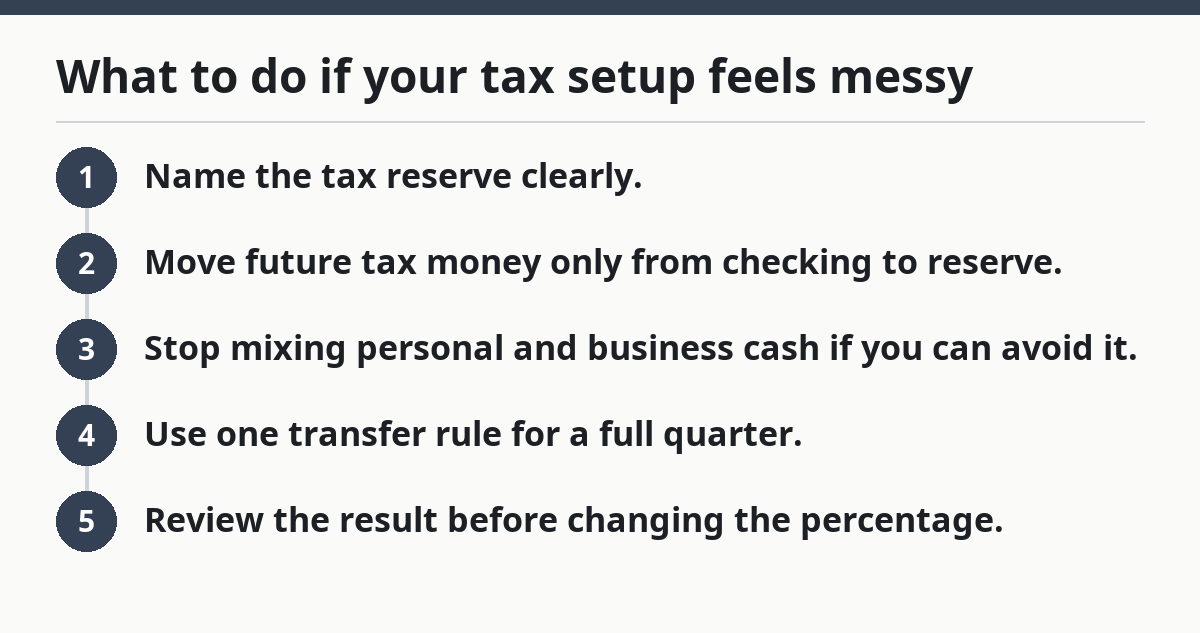
- Name the tax reserve clearly.
- Move future tax money only from checking to reserve.
- Stop mixing personal and business cash if you can avoid it.
- Use one transfer rule for a full quarter.
- Review the result before changing the percentage.
That sequence is enough for many freelancers. If it still feels unclear after that, a qualified tax or accounting professional can help align the structure with your local rules and filing calendar.
FAQ
Where should freelancers keep tax money?
Freelancers should keep tax money in a separate savings account or subaccount that is not used for daily spending. The point is to keep tax reserves out of the same pool as rent, groceries, and business operating cash. If your bank supports instant transfers, that makes the setup easier to maintain.
Can freelancers use a separate savings account for taxes?
Yes, freelancers can use a separate savings account for taxes. A savings account works well when it is clearly labeled and not tied to day-to-day spending. A subaccount is fine too if your bank offers one, because the key is separation, not the exact product name.
How often should tax money be moved into reserves?
Tax money should be moved into reserves as often as your income lands, or at least on a regular weekly or monthly schedule. If deposits are frequent, moving money after each cleared payment is easier to keep accurate. If income is steadier, one scheduled transfer can be enough.
Drafted with AI; not yet reviewed by a person.
