

Last updated: November 19, 2026
Quick answer: for a bigger project, deposits and milestone billing usually mean getting paid in stages instead of waiting for one end-of-job invoice. How Freelancers Use Deposits and Milestone Billing for Bigger Projects helps you set a clear payment schedule, protect cash flow, and tie each invoice to visible progress. The sections below show how to set the payment schedule, when to invoice, and how to tie each payment to real deliverables.
Key Takeaways
- A deposit starts the project and filters out people who are not ready to pay.
- Milestone billing splits a large job into smaller paid steps tied to deliverables.
- A payment schedule works best when it matches the actual shape of the project, not just the calendar.
- Retainers are for ongoing access or repeated work; deposits are for starting a defined project.
- The cleanest invoices name the milestone, the due date, and the work that opens the next step.
- Big projects need fewer surprises and more written checkpoints, or the invoice trail gets messy.
What milestone billing is doing for a bigger project

Milestone billing is how you get paid in parts while the work is still moving. If the project lasts 4 weeks or 4 months, the point is the same: each payment is tied to a deliverable the client can see, review, or approve.
Picture this: you’re quoting a website, a brand package, or a long report, and the client wants one invoice at the end. Milestone billing breaks that risk into pieces.
For a bigger project, the structure usually looks like this:
- a deposit to start
- one or more milestone invoices tied to draft or approval points
- a final payment before handoff or launch
- a retainer only if the work is ongoing, not a one-off build
A deposit is not the same as a milestone payment. The deposit says, “I am booking this work and starting now.” A milestone payment says, “This stage is complete, and the next stage can begin.”
You can usually make this easier to manage by linking it to the project scope. If the scope has 3 phases, the billing plan should have 3 payment checkpoints, not 9. That keeps the payment schedule readable.
Here’s the catch: milestone billing works only when the deliverables are concrete. “Strategy work” is vague. “Homepage wireframe approved” is billable.
How do you set a payment schedule that fits the project?
You set a payment schedule by matching money to the points where the project changes shape. If the project has a 2-week discovery phase, a 3-draft design phase, and a final handoff, the billing should follow those natural breaks.
Picture this: you’re pricing a project with research, drafts, revisions, and launch support. If you invoice only once a month, you may wait too long to collect cash after finishing a major chunk of work. A better schedule follows the work, not the calendar alone.
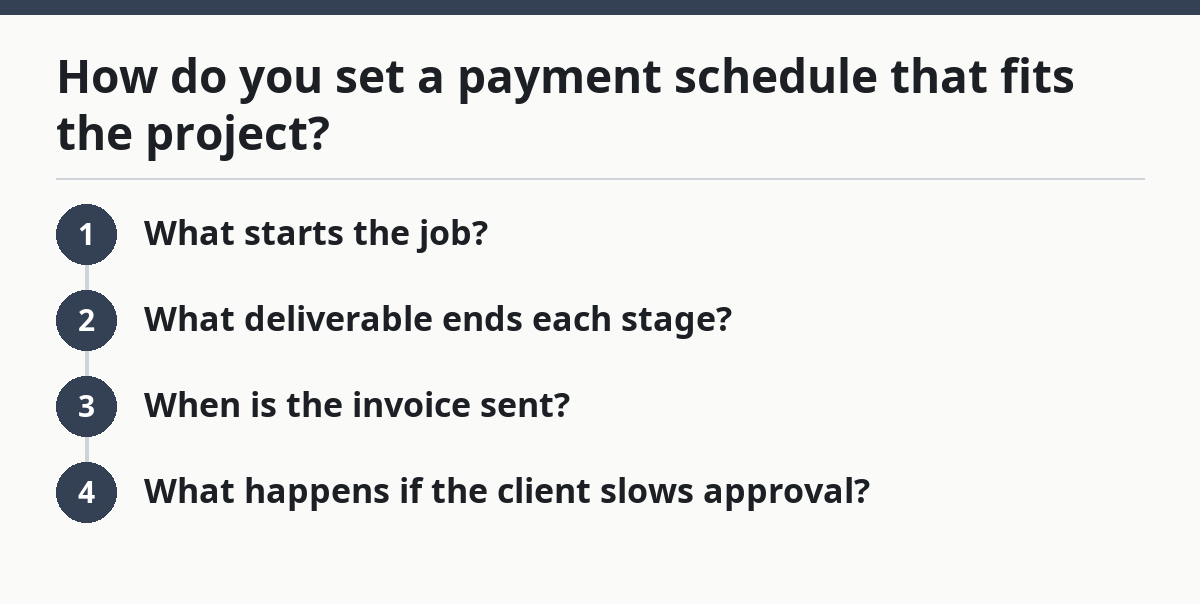
A practical payment schedule usually answers four questions:
- What starts the job?
- What deliverable ends each stage?
- When is the invoice sent?
- What happens if the client slows approval?
For larger projects, the schedule often includes:
- a deposit to reserve the slot, or another upfront amount that fits the job
- one invoice after a defined first deliverable
- one invoice after the next approved stage
- a final invoice before launch, delivery, or file transfer
Those percentages are examples of a shape, not a rule. The better question is whether each payment covers the risk at that point in the project. A long research phase deserves a different billing pattern than a short revision round.
Use the scope as the anchor. If the scope says “logo concepts, one revision round, final files,” then each invoice should map to one of those items. If the scope changes, the schedule should change too.
A schedule that is too loose costs time. A schedule that is too rigid costs trust.
How do milestone payments work in freelance contracts?

Milestone payments work by making each payment dependent on a named deliverable, a due date, and a clear approval point. The contract should say what is finished, what gets invoiced, and what happens next.
Picture this: you’re halfway through a project and the client asks for “just a few more edits.” If the milestone was never defined, that request can drag on for days while payment sits in limbo. A clear contract turns the conversation back to the agreed stage.
The structure is simple:
- milestone 1 is completed
- the milestone invoice goes out
- the client pays by the stated due date
- the next stage starts after payment or approval, depending on the agreement
The contract language should match the real work. If the milestone is “first draft delivered,” then the invoice goes out when the draft is sent, not after the client finishes reviewing it. If the milestone is “approved homepage mockup,” then invoice timing may wait for approval.
That difference matters because a milestone invoice can be triggered by delivery, by approval, or by both, but the trigger has to be clear before the work begins.
On the flip side, do not make every checkpoint too tiny. If you bill every 2 hours, the admin load can swallow the project. If you bill only twice on a 3-month project, you carry too much risk.
A good milestone system keeps the project moving:
- the client sees progress
- the freelancer gets paid in stages
- the scope stays tied to real outputs
For more on the bigger payment system behind this, see the hub on freelance billing and client payment systems and the related guide on freelance contracts.
Which deposit amount makes sense before work starts?
A deposit should be enough to show commitment and cover early work, but not so large that it creates friction before the project even starts. For many projects, the deposit is the first filter that separates serious clients from casual inquiries.
Picture this: you’re about to block off time for a three-phase project and hold off on other jobs. Without an upfront payment, you carry the risk while the client keeps the option to walk away. The deposit changes that.
Common ways to think about the deposit:
- it reserves the calendar slot
- it covers kickoff tasks, calls, research, or setup
- it gives the client a clear start signal
- it reduces the chance of no-shows and scope drift
A deposit is especially useful when the project has a long lead time or a lot of front-loaded work. It is less useful when the project is tiny and can be completed in one sitting. In that case, milestone billing may be overkill.
The deposit should not be confused with a retainer. A retainer usually buys ongoing access or recurring availability. A deposit is tied to one defined project and usually applies against the total project fee.
That distinction saves arguments later. If you call everything a retainer, the client may think they are paying for open-ended availability. If you call everything a deposit, recurring work can get underbilled.
You also want the deposit to fit the project scope. A project with a long research stage often justifies a stronger upfront payment than a quick production job. The cleaner the scope, the easier the deposit decision.
What should each milestone invoice include?
Each milestone invoice should name the stage, the deliverable, the amount due, and the payment deadline. If the invoice does not clearly point to the work, the client has to guess what they are paying for.
Picture this: you’re sending an invoice after the second revision round on a brand project. If the invoice says only “design services,” the client may ask for extra explanation before paying. If it says “Milestone 2: revised homepage mockup approved,” the link is obvious.
At minimum, a milestone invoice should include:
- the project name
- the milestone name
- the completed deliverable
- the invoice amount
- the due date
- any note about what starts after payment
That last part matters. A milestone invoice is not just a bill; it is a handoff signal. It tells the client that one stage is closed and the next stage is ready to open.
You do not need to pack the invoice with long notes. A short line is enough if the scope has already done the heavy lifting.
If the client signs off on a deliverable before payment, keep that approval trail aligned with the invoice. If the contract says payment comes first, do not hand over final files early. That is how projects slip out of order.
A clean invoice protects both sides. The client knows what they are paying for, and the freelancer knows which checkpoint was completed.
Common mistakes that make milestone billing messy
Milestone billing gets messy when the checkpoints are vague, too large, or too small. The project may still finish, but the payment trail becomes a headache.
Picture this: you’re halfway through a project and the client says the next invoice feels “early.” That usually means the milestone was never defined well enough. The fix is not more explaining later. It is better structure at the start.
The biggest mistakes are these:
- Vague milestones cost time because nobody knows what finished means. Use a deliverable, an approval, or a file handoff instead.
- Too few checkpoints push too much risk onto you. Add a deposit or an earlier invoice point if the project runs longer than a few weeks.
- Too many checkpoints create admin drag. If every small task has its own invoice, the project feels fragmented.
- Late invoicing delays cash flow. Send the invoice at the agreed trigger, not when you finally remember.
- Mixing retainer and deposit language causes disputes. Keep recurring access and project start payments separate.
The cost of these mistakes is not just time. It can stall the next phase of the project, force extra emails, and make the client think the billing is improvised.
A better way is to build the payment schedule around the work itself:
- start with a deposit
- mark 2 or 3 major milestones
- set the invoice trigger for each one
- define the final payment before delivery
That is enough for most larger projects. Anything more complicated should be reserved for projects with real complexity, not just nervousness.
For practical invoice and payment guidance, see invoice basics for freelancers and getting paid as a freelancer.
When should you use a retainer instead of milestone billing?
You should use a retainer when the client needs ongoing access, repeated work, or a reserved block of time rather than one fixed project. If the work is monthly, open-ended, or support-based, milestone billing may be the wrong shape.
Picture this: you’re being asked to “stay available” for design changes, content updates, or ad hoc calls over the next 30 days. That is not a normal project with a neat end point. It behaves more like a retainer.
A retainer fits work such as:
- monthly content support
- regular design updates
- advisory calls
- continuing maintenance
- repeated small tasks with no fixed finish line
Milestone billing fits work such as:
- a website build
- a rebrand
- a launch package
- a report
- a one-time campaign
The difference is about control. A retainer buys access and capacity. Milestone billing pays for visible steps in a defined scope.
If the project is both large and ongoing, you can mix the two. A setup fee or deposit starts the job, then a retainer may cover continued support after launch. Just keep the labels clean so the client knows what each payment buys.
The wrong fit hurts both sides. A retainer for a fixed build can confuse the client. Milestone billing for open-ended support can undercharge the time it takes to stay responsive.
For a deeper comparison, see retainers for freelancers and pricing freelance projects.
FAQ
Should freelancers ask for a deposit?
Yes. A deposit is a normal way to start a larger project with less risk. It shows commitment from the client and gives the freelancer a payment before the main work begins. For projects with research, planning, or schedule blocking, skipping the deposit is usually the weaker move.
How do milestone payments work in freelance contracts?
Milestone payments work by linking each invoice to a defined stage of the project. The contract names the deliverable, the trigger for billing, and the due date. That way, the client knows exactly what has been completed and what payment opens the next step.
When should a freelancer invoice for each milestone?
A freelancer should invoice as soon as the milestone trigger happens, not days later. That trigger is usually delivery, approval, or both, depending on the project terms. The faster the invoice goes out after the checkpoint, the easier it is to keep the payment schedule on track.
Sources
- IRS: Independent Contractor (Self-Employed) or Employee
- UK Government: Self-employed and independent contractors
- Nolo: Freelance Contracts
Drafted with AI; not yet reviewed by a person.
