
Last updated: November 19, 2026
Quick answer: for many freelancers, the practical starting point is a sole proprietorship, while an LLC is often the next step when liability protection matters. The S corp can help only when the numbers justify the extra administration. The topic here is Freelance Business Structures Compared: Sole Proprietor, LLC, S Corp, and Partnership, and the right choice depends on risk, tax treatment, and paperwork.
Key Takeaways
- Structure affects liability, taxes, and admin; check the IRS and a professional before filing.
- Sole proprietors keep the simplest setup for one-person freelance work.
- LLCs often balance separation and flexibility for growing freelancers.
- S corp status usually comes later, after profit and payroll support it.
Freelance business structure decides your liability, taxes, and paperwork, and the wrong fit can cost you time as well as peace of mind. In short: sole proprietor is simplest, LLC adds liability protection, S corp can change self-employment tax exposure, and a general partnership only makes sense when two people truly run the work together. The sections below sort out when each one helps, when it doesn’t, and what the trade-offs really are.
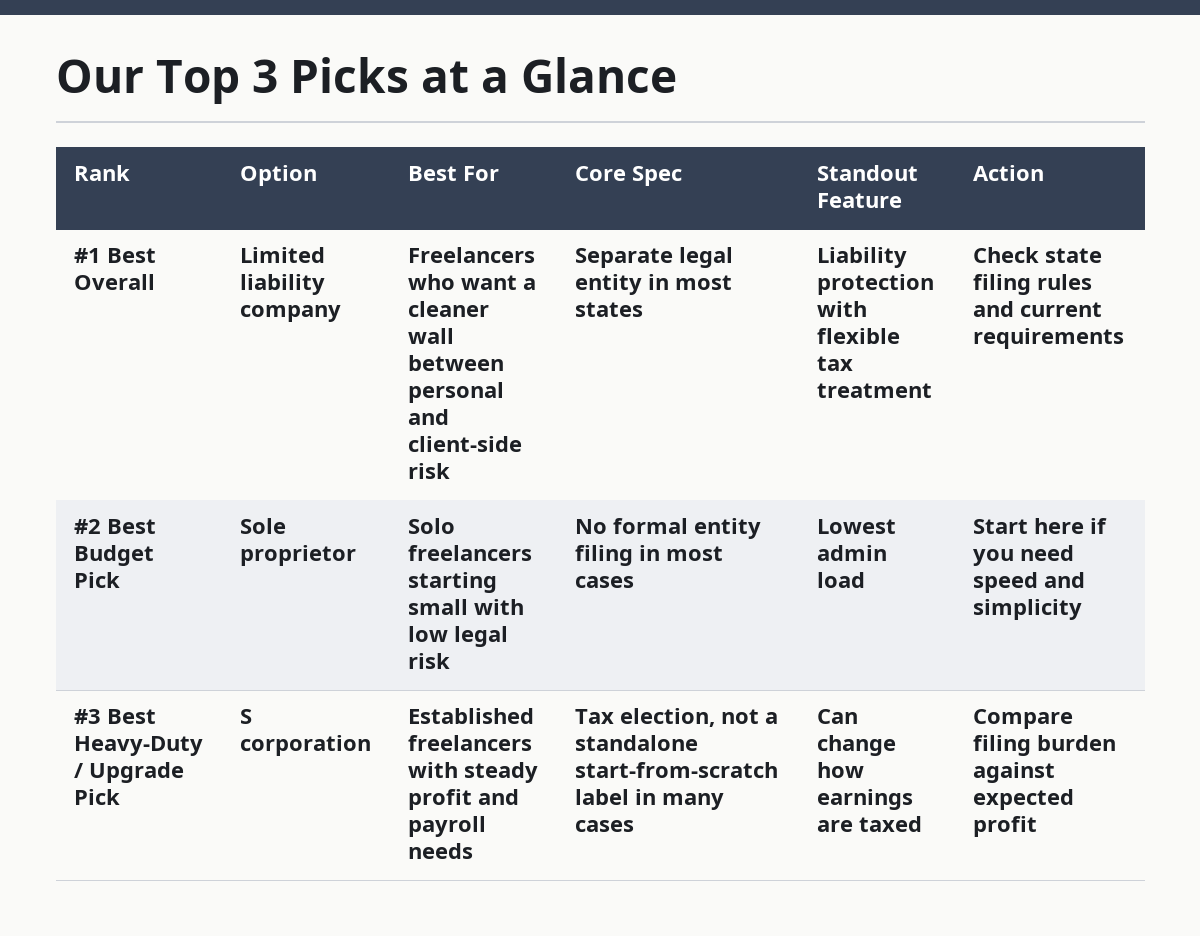
Our Top 3 Picks at a Glance
| Rank | Option | Best For | Core Spec | Standout Feature | Action |
|---|---|---|---|---|---|
| #1 Best Overall | Limited liability company | Freelancers who want a cleaner wall between personal and client-side risk | Separate legal entity in most states | Liability protection with flexible tax treatment | Check state filing rules and current requirements |
| #2 Best Budget Pick | Sole proprietor | Solo freelancers starting small with low legal risk | No formal entity filing in most cases | Lowest admin load | Start here if you need speed and simplicity |
| #3 Best Heavy-Duty / Upgrade Pick | S corporation | Established freelancers with steady profit and payroll needs | Tax election, not a standalone start-from-scratch label in many cases | Can change how earnings are taxed | Compare filing burden against expected profit |
If you’re already building a larger practice, the hub on freelance business formation and setup should sit beside this page for the rest of the setup sequence.
| Product / Option | Best For | Core Spec | Standout Feature | Action |
|---|---|---|---|---|
| Limited liability company | Solo freelancers who want a liability shield without giving up flexibility | Separate legal entity in most states | Can often be taxed as a sole proprietor, partnership, or corporation depending on filing choices | Check state filing steps and tax treatment |
| Sole proprietor | New freelancers, side gigs, and low-risk services | No entity filing in many cases | Fastest path to start working under your own name | Use when admin simplicity matters most |
| S corporation | Freelancers with enough profit to justify payroll and tax admin | Tax election under the corporate rules | May change how owner pay is split for tax purposes | Consider only when profit and paperwork both support it |
| General partnership | Two freelancers who truly operate as co-owners | Shared control and shared exposure | Simple to form in practice, but risky without a written agreement | Use only with clear roles and a signed partnership agreement |
What changes between these four structures?
Freelance structure changes three things that matter: liability, tax treatment, and administrative complexity. The core question is not “What sounds professional?” It’s “How much risk are you taking on, and how much paperwork can you live with?” For a general guide, the IRS and SBA both frame business-structure choices around those trade-offs.
A sole proprietor is the lightest setup. An LLC adds a legal layer. An S corp usually adds tax planning and payroll complexity. A general partnership adds shared ownership, but it also adds shared risk if the deal goes wrong.
Here’s the catch: the same freelancer can fit more than one structure over time. A designer might start as a sole proprietor, move into an LLC once clients grow, and later choose S corp tax treatment if the numbers support it. That path is common, but it is worth reviewing with a tax professional before changing structure.
- Sole proprietor: one person, one operation, least paperwork.
- LLC: separate entity, more formal, useful for liability protection.
- S corp: tax election with payroll rules; usually more admin.
- General partnership: two or more owners sharing profits and duties.
Sole proprietor: the cleanest start, and the easiest to outgrow
A sole proprietor is best when you’re a one-person shop and you want the fewest moving parts. If you’re a writer, photographer, consultant, or developer taking on small projects, this is the default structure for many freelancers.
The strength is obvious: it’s simple. You usually don’t need a separate entity filing just to start getting paid, and that means less overhead. The weakness is just as obvious: liability protection is weak because you and the freelance activity are not separated in the same way a legal entity can separate them.
That matters if a client dispute, injury, or contract problem lands on your desk. A sole proprietor structure does not build a wall around personal assets the way an LLC is designed to do.
- Good fit: solo freelancer with low-risk services and early-stage income.
- Bad fit: anyone with meaningful contract exposure, equipment risk, or client-side claims.
- Tax note: freelance income is generally tied to self-employment tax rules on the owner’s return.
The truth is, this structure wins on speed, not protection. It is a sensible starting point for many freelancers, but it is not the best long-term answer for every freelancer.
LLC: the best all-around fit for many freelancers
An LLC is often the strongest middle ground for a freelancer who wants more separation without jumping straight into corporate complexity. It wins for people who want a cleaner liability setup and still want flexible tax treatment.
That flexibility is why the LLC shows up in so many freelance conversations. In many states, it can be treated as a separate entity for legal purposes while still being taxed in a way that fits the owner’s situation. The exact tax result depends on how the entity is set up and how taxes are filed.
The downside is paperwork. You may have formation filings, annual reports, state fees, separate records, and stricter habits around keeping money and contracts separate. An LLC is not magic; it only helps if it is treated like a real entity, not a personal checking account with a logo.
A short list helps here:
- Strengths: liability protection, flexible tax options, cleaner separation.
- Weaknesses: formation steps, state maintenance, recordkeeping, possible extra cost.
- Best fit: freelancers with rising revenue, client contracts, or asset exposure.
On the flip side, an LLC is not always the cheapest or simplest move for a brand-new freelancer with tiny income and almost no risk. For that person, the paperwork can outrun the benefit. The SBA and many state filing offices note that costs and steps vary by state, so it is worth checking local rules first.
The S corp: useful only when the tax trade-off is real
An S corp is not a starting structure in the same plain sense as sole proprietor or LLC. For freelancers, it usually comes up as a tax election layer once income and admin volume justify it.
The main draw is tax treatment. A freelancer who has enough net profit may look at S corp status because the structure can change how owner compensation is handled for tax purposes. That’s the whole reason people consider it. It is not about sounding official. It is about whether the tax rules and payroll burden actually pay off.
The catch is the burden. Payroll, separate filings, and tighter compliance can make this a poor match for someone with uneven income or very low profits. If you’re still guessing at monthly revenue, an S corp can add work before it adds value.
This is the most common mistake I see in structure discussions: people jump to S corp because they heard it is “better for taxes.” Better for whom? Not for the freelancer with small or irregular profit and no appetite for bookkeeping.
- Best when: income is steady, profit is meaningful, and payroll admin is manageable.
- Poor fit when: revenue swings hard month to month or you want simple records.
- Compare it against: LLC taxation choices and the real cost of compliance.
For a number of freelancers, S corp status belongs later, not first.
General partnership: fine on paper, risky in practice
A general partnership is the structure that fits two freelancers who truly share ownership and control. It can work when two people are building one operation, splitting duties, and making decisions together.
The upside is shared effort. The downside is shared exposure. In a general partnership, one partner’s mistake can create risk for the other. That makes trust, role clarity, and a written agreement more than nice-to-have items.
This is where many generic articles stay vague and get the reader in trouble. They talk about “collaboration” and skip the fact that liability in a general partnership can be ugly if the relationship breaks down or one owner acts badly.
A partnership can make sense when both of these are true:
- Both people really co-own the work, clients, and money.
- Both people understand the legal and tax consequences.
If one person is mostly a contractor and the other is the real operator, a partnership often becomes the wrong tool. That mismatch causes disputes later.
The honest side-by-side: what actually changes the choice
Freelancers usually compare these structures by brand feel, but the real differences are simpler: who is exposed, how the taxes are handled, and how much admin you can stand. LLC wins on protection. Sole proprietor wins on simplicity. S corp wins only when tax math justifies the added burden. The IRS explains that these choices affect filing, taxation, and compliance, so the decision is practical, not cosmetic.
| Criteria | Sole Proprietor | LLC | Winner for this condition |
|---|---|---|---|
| Liability separation | Weak separation between owner and work | Stronger legal separation in most states | LLC when client risk matters |
| Startup friction | Very low | Moderate | Sole proprietor when speed matters |
| Ongoing admin | Light | Medium | Sole proprietor when you want fewer filings |
| Tax flexibility | Basic self-employment treatment | Flexible in many cases | LLC when you want options |
| Payroll complexity | None by structure | None by default, depending on tax setup | Sole proprietor for simplicity |
| Growth readiness | Limited | Strong | LLC for a growing practice |
| Owner separation | One owner only | One or more owners depending on setup | LLC for future expansion |
| Risk sharing | Not a partner structure | Can be used by one owner or more | LLC for solo risk control |
| Compliance load | Lowest | Higher than sole proprietor | Sole proprietor when admin is the dealbreaker |
| Best tax upgrade path | Moves later into entity choices | Can move toward S corp tax treatment if justified | LLC for long-term flexibility |
The table doesn’t say every freelancer should pick the LLC. It says the LLC is the best all-around platform when you care about protection and room to grow. That’s different.
Which structure fits which freelancer?
Choose the structure based on your real job, not your idealized one. A copywriter billing a few clients each month is in a very different spot from a consultant signing larger contracts or a two-person design shop sharing every project.
A sole proprietor fits you if you want to start immediately, keep admin light, and accept that the liability shield is thin. A limited liability company fits you if you want a cleaner legal wall and are willing to handle filings and records. A general partnership fits only when two real co-owners are operating side by side. An S corporation fits only when the tax and payroll cost can be justified by your profit level.
That last point matters. The S corp is not the “advanced” choice by default. It is the choice that makes sense after the numbers, not before them.
- Start simple if your freelance work is small and low-risk.
- Move to an LLC when contracts, assets, or client exposure grow.
- Consider S corp treatment only after the admin cost stops feeling heavy.
- Use a partnership only when both owners are equal enough to sign up for shared risk.
For reference, the IRS discusses self-employment tax rules and business classification at IRS.gov, and the SBA has plain-language guidance on business structures. Those are worth reading before you file anything.
When the usual advice flips
The standard answer flips in a few specific situations. Since risk and revenue do not stay flat, the best choice can change too. First, if you have almost no risk and very little income, a sole proprietor can be the right long-term answer, not just a temporary one. Extra filings would buy little.
Second, if you already have steady profit and real bookkeeping discipline, an S corp may move up the list. Not because it is glamorous, but because the tax structure may become worth the extra admin. That is a numbers question, not a status question.
Third, if you are co-owning the work with another person, a general partnership may look easy but still be the least forgiving choice if the relationship is uneven. In that case, a more formal structure is often the better match.
Fourth, if liability is the main worry, the LLC becomes the front-runner fast. That’s the structure’s whole job. It does not erase risk, but it gives you a better legal frame than a plain sole proprietorship.
The verdict: which one to choose and why
Choose sole proprietor if you’re a one-person freelancer with low legal risk and you want the lightest setup. Choose LLC if you want liability protection and room to grow without jumping into heavy payroll rules. Neither if you’re guessing at the structure while ignoring contracts, taxes, and state filing duties.
The best answer for most freelancers is not the fanciest one. It’s the structure that matches the real risk, the real income, and the real amount of admin you can keep up with.
Which business structure is best for a freelancer?
The best structure for a freelancer is usually the one that fits the current risk level and paperwork tolerance. For a solo worker with simple income, a sole proprietor can be enough. For someone who wants a liability shield and more room to grow, an LLC is usually the stronger all-around choice.
When does a freelancer need an LLC?
A freelancer needs an LLC when liability protection starts to matter more than bare-bones simplicity. That often happens when client contracts get larger, assets become more exposed, or the work feels too risky to leave in a sole proprietor setup. The need is practical, not ceremonial.
Can a freelancer switch from sole proprietor to LLC later?
Yes, a freelancer can switch later, and that transition is common. Keep the records clean, separate business money from personal money, and check the filing steps in your state before you change structure. The IRS and state agencies can help you confirm the process.
Drafted with AI; not yet reviewed by a person.
