
Last updated: November 19, 2026
Quick answer: A freelancer adds a confidentiality clause to a client agreement in 7 steps: define confidential information, limit use, add exceptions, set the duration, cover return or deletion, align it with any NDA, and sign before work starts. In How Freelancers Add a Confidentiality Clause to a Client Agreement, the clause should fit the project, the files, and the risk.
A freelancer adds a confidentiality clause to a client agreement by placing a short, plain rule in the client agreement that says what counts as confidential information, how long the duty lasts, and what happens if the work includes an NDA. The clause should be specific enough to cover private client information and trade secrets, but short enough that the client can read it in under 2 minutes.
Key takeaways
- A confidentiality clause belongs in the client agreement, not in a side note or a long email thread.
- The clause needs three basics: what is secret, what the freelancer may do with it, and what exceptions apply.
- An NDA is often a separate document, but it can also sit beside a confidentiality clause in the same contract.
- Trade secrets deserve tighter wording than casual “keep this private” language.
- A clear clause is usually plain, narrow, and tied to the actual job, not a copy-paste block from a different project.
What is a confidentiality clause?

A confidentiality clause is a contract term that stops a freelancer from sharing a client’s private information. In a client agreement, it tells both sides what must stay private, such as source files, client lists, pricing, internal plans, or trade secret material.
The clause matters because “confidential” can mean different things in different jobs. A logo project may need protection for draft files and brand plans, while a research job may need stronger language for data, formulas, or unreleased product details. If the clause is vague, it can miss the very thing the client wanted protected.
A good clause is narrower than a full NDA and often easier to use. A separate NDA can handle a broader promise before the project starts, while the client agreement can repeat the core rule in 1 clear place. The U.S. Patent and Trademark Office and WIPO both treat trade secrets as a serious category, so if the work touches them, a freelancer should consider a professional review and use careful wording.
This page fits the larger freelance contracts and client policies hub, because the clause only works when it sits inside a full agreement with the rest of the job terms.
How do you add a confidentiality clause to a client agreement?
You add a confidentiality clause by writing the rule into the contract before work starts and tying it to the exact project. Use the client agreement itself as the place where the rule lives, then match the language to the work, the files, and the risk.
-
Open the client agreement and place the clause in the terms section near payment, ownership, or data use so the client sees it in the same document that controls the job.
-
Define confidential information in plain terms, such as draft content, internal notes, passwords, source material, client data, pricing, and trade secrets tied to the project.
-
Set the use limit so the freelancer may use the information only to perform the work, not for side projects, self-promotion, or reuse with another client.
-
Add the exceptions for information that is already public, already known before the project, independently developed, or released with written permission.
-
State the return or deletion rule for files, notes, and copies at the end of the project so the client knows what happens when the job closes.
-
Match the clause to an NDA if one exists, so the contract and the NDA do not give conflicting answers about time limit, scope, or permitted disclosure.
-
Review the final draft before signing, because one missing line about exceptions or duration can turn a useful clause into a dispute.
A clause that fits a 2-page agreement will often read better than a block copied from a 20-page legal packet. The goal is not more words; it is fewer weak words and more exact ones.
What should the clause say?

A strong confidentiality clause should say who is bound, what information is covered, what the freelancer may do, and how long the duty lasts. It should also say whether the client can share the information with outside vendors, accountants, or legal counsel.
The clearest version names the type of information instead of using only the word “confidential.” For example, “client strategy documents, unpublished campaign drafts, and login credentials” is better than “all information related to the project.” The first version gives both sides a real boundary.
The clause should also separate confidentiality from ownership. A freelancer can keep client information private without giving up portfolio rights, unless the contract says otherwise. That matters because some clients want secrecy, while others want the right to show work later with permission.
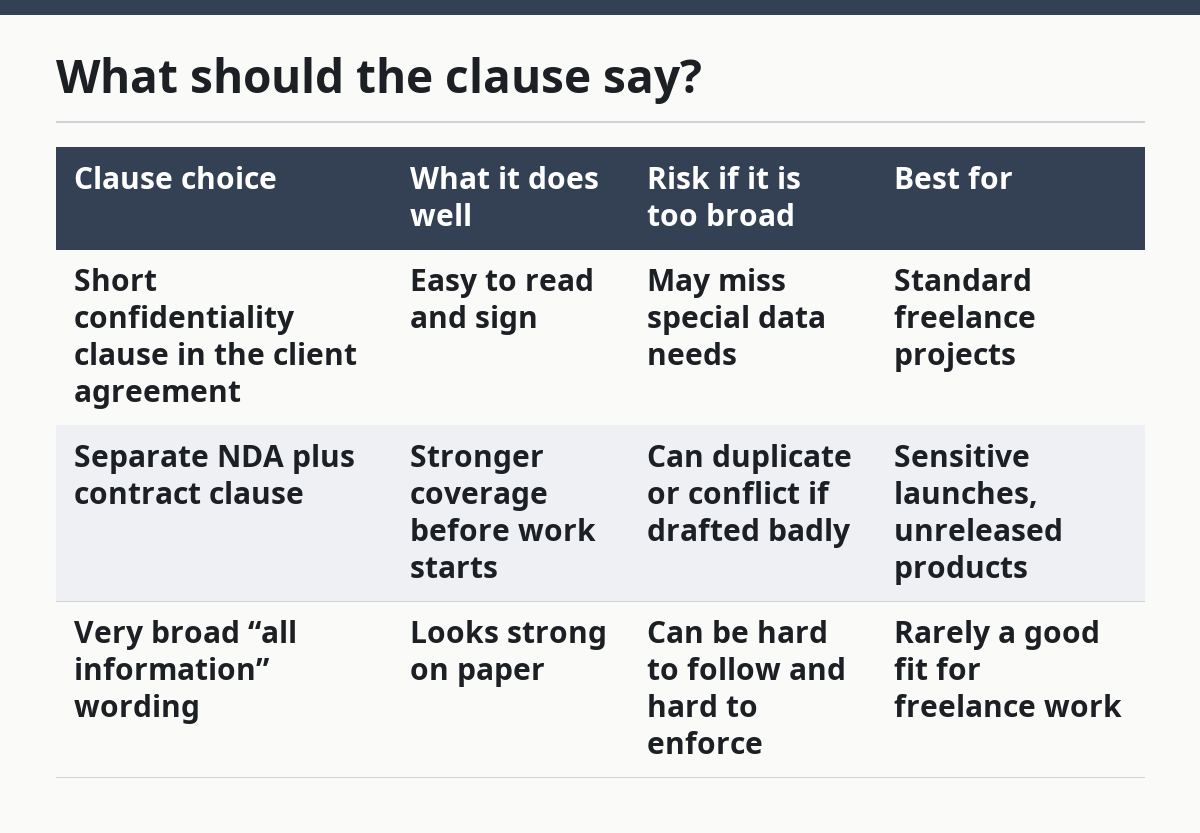
Here is a practical comparison:
| Clause choice | What it does well | Risk if it is too broad | Best for |
|---|---|---|---|
| Short confidentiality clause in the client agreement | Easy to read and sign | May miss special data needs | Standard freelance projects |
| Separate NDA plus contract clause | Stronger coverage before work starts | Can duplicate or conflict if drafted badly | Sensitive launches, unreleased products |
| Very broad “all information” wording | Looks strong on paper | Can be hard to follow and hard to enforce | Rarely a good fit for freelance work |
Broad language sounds safer, but it often creates confusion. A client may think every email, note, and draft is secret forever. A freelancer may think the rule does not cover publicly available material or work already known from another source. Plain limits avoid that fight.
When do you need an NDA instead?
You need an NDA instead of a simple clause when the client wants a separate promise before the main agreement starts. An NDA can be signed on day 1, before any proposal, sample file, or discovery call reveals sensitive material.
That matters in jobs involving trade secrets, unreleased products, investor material, or private client information that is more sensitive than normal project detail. A clause in the client agreement is useful, but it may come too late if the freelancer already saw sensitive material during early talks. In those cases, the NDA protects the gap before contract signing.
A simple rule helps here: use a confidentiality clause for standard freelance work, and use an NDA when the client needs secrecy before the contract is signed or when the material is unusually sensitive. If the client wants both, keep the language aligned so the NDA and the agreement agree on the same core points.
This is not the right move for every job. A small editing assignment or a one-off social post may not need a separate NDA at all. Forcing one into every project can slow down sign-off and make the client feel the paperwork is out of proportion to the work.
What mistakes cause problems?
The biggest mistakes are vague wording, missing exceptions, and a clause that is too broad for the job. Each one creates a different cost: confusion, negotiation delay, or a contract that looks strong but is hard to follow.
A vague clause costs time because neither side knows what counts as private. If the contract never names files, plans, data, or trade secrets, the freelancer may treat some material as fair game and the client may disagree later. The fix is simple: list the kinds of information that matter in this project.
A missing exception costs trust because a clause that ignores public information or prior knowledge can sound unfair. That can make a client hesitate to sign, especially if the work touches public research, marketing copy, or widely shared reference material. The fix is to say what is not covered, not just what is covered.
A clause that is too broad costs clarity because it can trap normal business use. If the wording blocks every discussion, every draft, and every file forever, the contract may become harder to live with than to enforce. The fix is to match the clause to the actual risk, not to use a giant block from a different industry.
Can a freelancer edit a template clause?
Yes, a freelancer can edit a template clause, but the edit should make the clause fit the job rather than make it sound more legal. A template is a starting point, not a final answer.
The more useful edits are the simple ones: replace generic “services” language with the actual project, name the kinds of confidential information involved, and add the right exception list. If the template mentions a 5-year duty, a broad no-disclosure rule, or a return-of-materials clause, check whether that matches the client’s request and the type of work.
A template also needs a second look when the job touches data handling. If the freelancer sees login details, client records, or internal files, the clause should say what use is allowed and what the freelancer must not copy, store, or share beyond the project. That is where template language often gets too thin.
One caution: a template that feels “close enough” can be worse than no clause at all if it creates false comfort. A freelancer who is not sure whether the wording fits a regulated, sensitive, or high-value project should pause and get the contract reviewed by a qualified professional before signing.
How do you keep it readable?
You keep it readable by using short sentences, one idea per line, and plain nouns instead of legal fog. A client should be able to spot the rule in less than 2 minutes and know what changed from the last draft.
A concise clause often works better because precision, not volume, does the real protection. Words like “confidential,” “public,” “trade secret,” “written consent,” and “project materials” do useful work when they are defined clearly. Long strings of stacked adjectives usually make the clause harder to follow without making it safer.
This is also where the clause should fit the rest of the contract. If the agreement already has a section on ownership, file use, or data handling, the confidentiality clause should not fight with those terms. It should support them. That makes the contract easier to sign and easier to apply when the work gets messy.
What should a freelancer ask before sending it?
A freelancer should ask what kind of information the client wants protected, who can see it, and whether the client wants a separate NDA first. Those questions keep the clause tied to the actual job instead of to a generic form.
The other useful question is how long the duty should last. Some clients care about the project window only, while others want the duty to continue after the job ends. That difference matters more when the work involves trade secrets, product plans, or private client information that still has value later.
A last check is practical: will the client need to show the agreement to legal counsel, an investor, or a partner before signing? If yes, a clear clause can speed that review. If no, a simple clause may be enough and a longer legal block may only slow the deal.
Do freelancers need an NDA?
No, not every freelancer needs an NDA. Many jobs work fine with a confidentiality clause inside the client agreement, especially when the work is ordinary and the sensitive material is limited.
An NDA becomes more useful when the client needs secrecy before the contract is signed or when the project involves trade secrets, product launches, or other private client information. If the risk is low, a simpler clause is often easier for both sides to sign.
What should a confidentiality clause cover?
A confidentiality clause should cover the kinds of private information that matter in the project, the limits on use, the exceptions, and the length of the duty. It should also say what happens to the material at the end of the job.
If the clause touches trade secrets, it should be tighter and more specific than a casual “keep this private” sentence. A useful clause names examples, such as drafts, source files, passwords, and internal plans, instead of leaving the whole rule to guesswork.
Can I use a simple NDA in a freelance contract?
Yes, a simple NDA can sit inside a freelance contract if it is written clearly and matches the job. That is often enough for standard freelance work where the main concern is keeping client information private during the project.
The risk is overdoing it. A simple NDA that is too broad can scare off the client or create confusion about what can be used, shared, or kept after the job ends. If the project involves serious trade secrets or pre-signing disclosure, a separate NDA may be the better fit.
Drafted with AI; not yet reviewed by a person.
