
Last updated: November 20, 2026
Quick Answer: freelancers can usually stop 3 recurring bank charges from quietly draining cash flow by tracking monthly maintenance fees, ATM fees, and wire transfer fees the day they post. In How Freelancers Track Bank Account Fees and Avoid Monthly Charges, the goal is to record every fee, match it to the right category, and set a rule for minimum balance and monthly fee alerts. The steps below show exactly what to record and how to avoid charges that keep coming back.
Key Takeaways
- Track each fee as soon as it posts, not at month-end.
- Put monthly maintenance fees, ATM charges, and wire transfer fees in separate lines.
- Watch minimum balance rules closely; one missed day can trigger a fee.
- Use a simple ledger with the date, bank name, fee type, amount, and reason.
- Cut avoidable charges by changing habits, not by guessing what the bank will waive.
What bank fees should a freelancer track first?
Track the fees that hit cash flow every month before you worry about rare charges. For most freelancers, that means the monthly fee, minimum balance charges, ATM fee, and wire transfer fee. Those four line items are the ones most likely to repeat and quietly shave off profit.
The catch is that banks often group fees under vague names like “service charge” or “account maintenance.” That hides the real cost unless you label it yourself. A fee that looks small on one statement can become a real drag over a year, especially if you keep a low balance for taxes or irregular income.
- Monthly maintenance fee: the regular charge for holding the account.
- Minimum balance fee: a charge triggered when the balance drops below the bank’s threshold.
- ATM fee: a charge for using an out-of-network machine.
- Wire transfer fee: a charge for sending or receiving money by wire.
For a freelancer, the point is not just recording the amount. It is knowing which fee is caused by the account itself and which one comes from your own behavior. That split tells you what can be fixed fast.
A good place to start is the monthly statement. Read every fee line, then tag it with one of those four categories. If a fee repeats every 30 days, it belongs in a recurring cost bucket, not in random overhead.
How do you build a simple fee-tracking ledger?
A simple ledger tracks the date, fee type, amount, and reason in one place. A spreadsheet works fine, and so does a notes app if you keep it disciplined. The point is to create one clean record that shows which bank charges are predictable and which ones are avoidable.
For example, you may open your banking app on the first business day of the month and try to remember why $12 vanished three weeks ago. A ledger fixes that problem before it turns into guesswork. It also helps when you compare one month to the next.
Here’s a clean setup:
| Date | Bank | Fee type | Amount | Reason | Avoidable? |
|---|---|---|---|---|---|
| 2026-01-03 | Bank A | Monthly maintenance fee | $12 | Account plan charge | Yes |
| 2026-01-11 | Bank A | ATM fee | $3 | Out-of-network withdrawal | Yes |
| 2026-01-18 | Bank A | Wire transfer fee | $25 | Sent payment to vendor | Sometimes |
| 2026-01-31 | Bank A | Minimum balance fee | $10 | Balance dipped below rule | Yes |
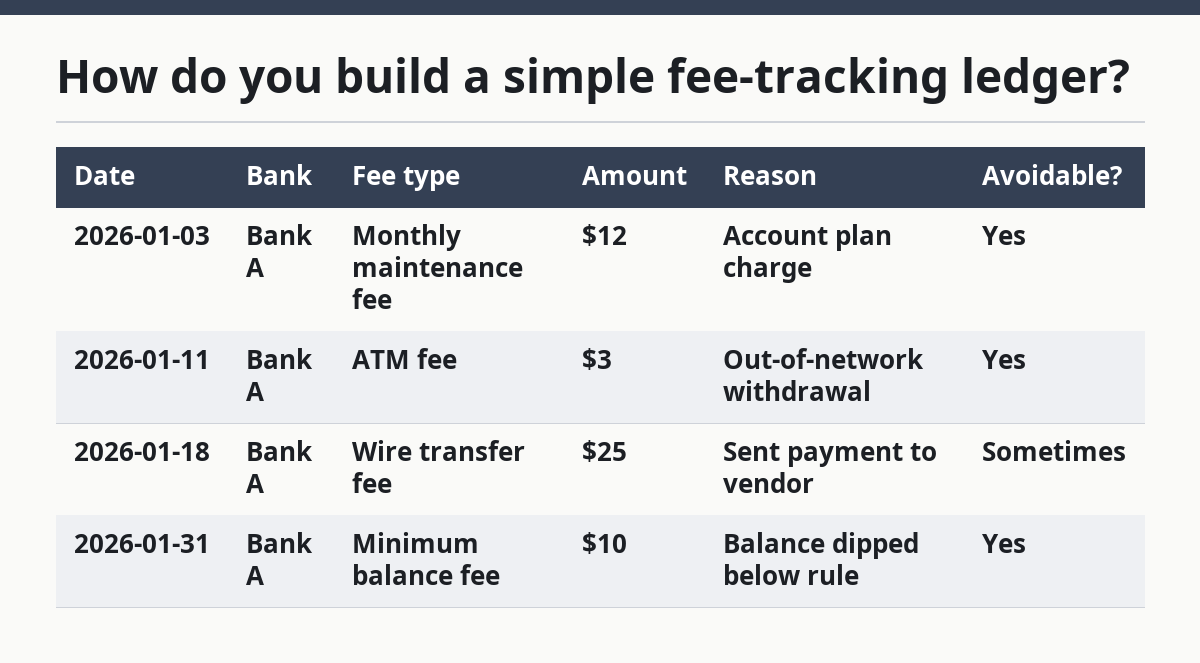
That structure works because it answers the questions a freelancer actually asks later: What happened? Why did it happen? Can I stop it next month?
To keep it useful, record the fee the same day it posts. Waiting until the end of the quarter means the memory is gone and the pattern is fuzzy. A fee log only works if it stays current.
A 5-step fee-tracking routine
- Open the statement or app once a week. Use a 10-minute block, not a vague “later” promise, and scan for fee lines.
- Tag each fee by type. Use monthly fee, minimum balance fee, ATM fee, or wire transfer fee so the pattern stays obvious.
- Write the reason in plain words. “Used ATM near airport” beats a blank note every time.
- Mark the fee as avoidable or unavoidable. This helps separate banking cost from business cost.
- Review the total at month-end. Add the fees together and compare them with the prior month so the trend is visible.
The truth is, a ledger is only useful if you can glance at it in under 60 seconds. If the record takes longer than that, it will not survive a busy month.
How can freelancers avoid monthly bank charges?
Freelancers avoid monthly bank charges by meeting the account rules before the bank applies the fee. That usually means keeping a required minimum balance, using the account enough to qualify for a waiver, or switching to an account with no monthly maintenance fee. The bank’s rules decide the charge, not your budget.
For freelancers with irregular income, the balance can dip for three days near the end of the month. That short dip can be enough to trigger a fee, even if the account looked healthy earlier. Banks often care about the balance on a specific day or average balance over a statement cycle.
Start by reading the fee disclosure or account terms. Look for the exact trigger: a flat monthly maintenance fee, an average daily balance requirement, or a minimum deposit rule. The language matters because a bank can waive the fee in one way and still charge it in another.
- If the rule is a minimum balance, keep a cushion above that floor.
- If the rule is a monthly deposit, route one regular payment into the account.
- If the rule is a direct deposit, confirm that freelance transfers count, because many do not.
- If the rule is a fee waiver threshold, mark the number on your calendar for the last week of the month.
Here’s the catch: avoiding one fee can create another if you chase the wrong workaround. For example, leaving extra cash in the account to dodge a monthly fee can leave less money available for taxes or expenses. That trade-off matters when income is uneven.
The cleanest fix is to build a small buffer and check the account before the statement closes. A 3-minute check near month-end is cheaper than paying a fee you could have seen coming.
What is the best way to handle ATM fees and wire transfer fees?
A practical way to handle ATM fees and wire transfer fees is to reduce how often you use them and record them as separate business costs when you do. These are not the same problem as monthly maintenance fees. One comes from access, the other from movement of money.
ATM fees are usually easy to avoid if you plan cash withdrawals ahead of time. Out-of-network machines can charge both your bank and the machine owner, so one withdrawal can turn into two charges. If you need cash for travel, tolls, or a vendor who still wants cash, get it once instead of making several small withdrawals.
Wire transfer fees take more planning. They often show up when you pay a contractor, move money between accounts, or send funds across borders. Because wires can be expensive, it helps to reserve them for cases where speed or certainty matters.
Use this rule:
- ATM fee: avoid when possible; use in-network ATMs.
- Wire transfer fee: use only when the payment needs wire speed or wire certainty.
- Recurring cash need: forecast it at the start of the month.
- Repeat wire need: ask whether a bill pay or ACH option is available.
A lot of freelancers miss the hidden cost here. One $25 wire fee may not feel serious, but four wires in a month can become a real line item. That is money that could have covered software, insurance, or taxes.
If a wire fee happens once, log it. If it happens twice, ask why the payment method is so expensive. Repeated wire charges are a signal, not a random annoyance.
How do you read a bank statement without missing hidden charges?
You read a bank statement by checking every line that is not a deposit, purchase, or transfer. The hidden charges are usually grouped under bland labels, and that is why they get missed. A 5-minute scan can catch more than a casual glance after the balance has already changed. According to the CFPB, bank account fees and disclosures can vary by account, so the statement and fee schedule matter.
For example, you may open the PDF and see three charges with nearly the same label. One is a monthly fee, one is an ATM charge, and one is a wire transfer fee. If you do not sort them now, they all blend into “bank stuff” by the next statement cycle.
Look for these patterns:
- Repeating fee on the same day each month = likely monthly maintenance fee.
- Balance-related charge after a low-cash week = likely minimum balance fee.
- Small charge after cash withdrawal = likely ATM fee.
- Larger charge tied to a payment move = likely wire transfer fee.
Then do one simple check: compare the current statement with the last one. If the same fee appears twice, it deserves a rule. If it appears once, it still deserves a note. A one-time charge can become a monthly habit if you do not catch the cause.
A short statement review on the day the statement closes gives you the full month’s cost while the details are still fresh. Waiting 30 days makes the pattern harder to see.
Which fees are avoidable, and which ones are just part of the account?
Some fees are avoidable, and some are the cost of using a specific account structure. Monthly maintenance fees and minimum balance charges are often avoidable if you meet the bank’s terms or change accounts. ATM and wire fees are more situational; they may be worth paying when they save time or protect a payment.
Here’s the honest split:
- Avoidable by behavior: monthly fee, minimum balance fee, many ATM fees.
- Sometimes necessary: wire transfer fee, out-of-network ATM fee when no alternative exists.
- Worth reviewing yearly: any fee that repeats 3 months in a row.
A common mistake is treating all bank fees as fixed. That keeps the account on autopilot and makes small charges look normal. They are not normal if they can be stopped with one change in how the account is used.
The better move is to rank fees by frequency and pain. A fee that hits every month deserves more attention than a one-off charge. A fee that happens once a quarter may still be a problem if it is tied to the wrong account setup.
If the account keeps producing fees even after you track them for 2 or 3 cycles, the issue is usually the account terms, not the ledger. At that point, the record has done its job: it shows the cost is real and recurring.
What does a clean monthly review look like?
A clean monthly review totals fees, spots the repeat charges, and decides on one action for next month. It takes about 15 minutes if the ledger is current. The point is not to admire the numbers; it is to stop the same fee from showing up again.
For example, the statement closes, and you already know the month included a monthly maintenance fee, one ATM fee, and a wire transfer fee. That means the review is not a mystery hunt. It is a simple decision point.
Use this end-of-month checklist:
- Add up all bank fees for the month.
- Group them by type: monthly fee, minimum balance, ATM, wire.
- Mark which ones were avoidable.
- Pick one fix for the next cycle.
- Write that fix in the ledger before you close the file.
A simple example helps. If the fee total was higher because of two out-of-network ATM withdrawals, the next month’s fix is obvious: withdraw cash once, from an in-network machine. If the issue was a minimum balance fee, the fix is to hold a larger buffer or change the account rule.
This is where fee tracking turns into savings. Not from one dramatic move, but from one small correction after another. That is the work.
Which bank fees matter most to freelancers?
The fees that matter most to freelancers are the ones that repeat: monthly maintenance fees, minimum balance charges, ATM fees, and wire transfer fees. Those are the charges that can turn a cheap account into an expensive one over a few statements.
Monthly fees matter because they are predictable. Minimum balance charges matter because uneven income makes them easy to trigger. ATM fees matter because they are often tiny enough to ignore and frequent enough to add up. Wire fees matter because they can hit hard on payment days.
A freelancer does not need perfect banking. A freelancer needs visible banking. If a fee is visible in a ledger, it can be managed. If it is invisible, it becomes part of the margin loss.
How can freelancers avoid maintenance fees?
Freelancers can avoid maintenance fees by reading the account rules and meeting the waiver conditions before the statement closes. Common fixes include keeping the required minimum balance, setting up a qualifying deposit, or using an account that does not charge a monthly maintenance fee.
The key is to check the exact trigger. A bank may waive the fee for one balance rule and still charge it if the account dips below the threshold on the wrong day. If the rule is hard to meet, the cleaner fix is often to change the account setup instead of trying to remember a monthly workaround.
Should bank fees be categorized as business expenses?
Bank fees should usually be categorized as business expenses if they come from business banking activity. That includes monthly fees, ATM charges used for business cash needs, and wire transfer fees tied to payments or collections.
The category matters because it keeps the fee visible in your records and helps show the true cost of running the business. If the fee is personal, keep it separate. If the fee is linked to freelance activity, label it clearly and keep the statement or ledger note with it.
For accounting or tax treatment, a freelancer should check with a qualified professional who knows the local rules.
Drafted with AI; not yet reviewed by a person.
