
Last updated: November 19, 2026
Set a feedback and approval policy before the first draft leaves your desk. Tell the client who gives feedback, where it goes, how long they have to reply, and what counts as approval. That keeps one review round from turning into five, and it gives the project a clear end point.
Key takeaways
- A clear policy names the reviewer, the response window, and the approval deadline.
- Keep feedback in one place, such as a doc, task list, or email thread, so comments do not scatter across 3 channels.
- Ask for decision makers up front; one stakeholder can stall a project if the chain is vague.
- Give clients a simple format for notes, such as page, issue, and fix, so revisions stay usable.
- Put the policy in plain language, then repeat it at the start of every review round.
How do freelancers set feedback and approval expectations?
Freelancers set feedback and approval expectations by spelling out the review window, the approval deadline, the response time, and the person who can sign off. That policy should be simple enough to copy into an email or client onboarding note, and specific enough that nobody has to guess what happens after a draft is sent.
-
Write the feedback request in a client email and name the review round, such as “Round 1 review.”
This gives the client a label for the stage and makes it clear that the draft is not the final version. -
Choose the approval deadline in the same note, such as 2 business days or 48 hours.
A deadline turns “send comments when you can” into a real checkpoint. -
List the stakeholder who can approve the work, then name any backup decision maker.
That keeps the project from waiting on comments from 3 people who cannot actually sign off. -
State the feedback format in 1 short line, such as “Please reply with page, issue, and suggested fix.”
A format cuts down on vague notes like “make it better” and saves time in the next review round. -
Confirm the response time and what happens if nobody replies by the deadline.
That can be as simple as “If I do not hear back by Friday at 5 p.m., I will assume the draft is approved for the next step.” -
Repeat the same policy at the start of each new review round.
Repetition matters because clients forget, especially when a project has 2 or more stakeholders.
The point is not to sound strict. The point is to make the next action obvious. A client who knows the deadline, the reviewer, and the format can answer faster and with less friction.
What belongs in a feedback and approval policy?
A feedback and approval policy should cover 5 items: the review window, the approval deadline, the response time, the feedback format, and the decision maker. Anything else is optional unless the project is complex enough to need more structure.
| Policy item | What it answers | Good example | Why it helps |
|---|---|---|---|
| Review window | When feedback is due | 2 business days | Prevents open-ended delay |
| Approval deadline | When sign-off is expected | Friday at 5 p.m. | Gives the project a stop point |
| Response time | How fast the client replies | Within 24 hours of the request | Keeps the review moving |
| Feedback format | How comments should be sent | Page, issue, fix | Reduces vague notes |
| Decision maker | Who can approve | One stakeholder named in advance | Avoids mixed signals |
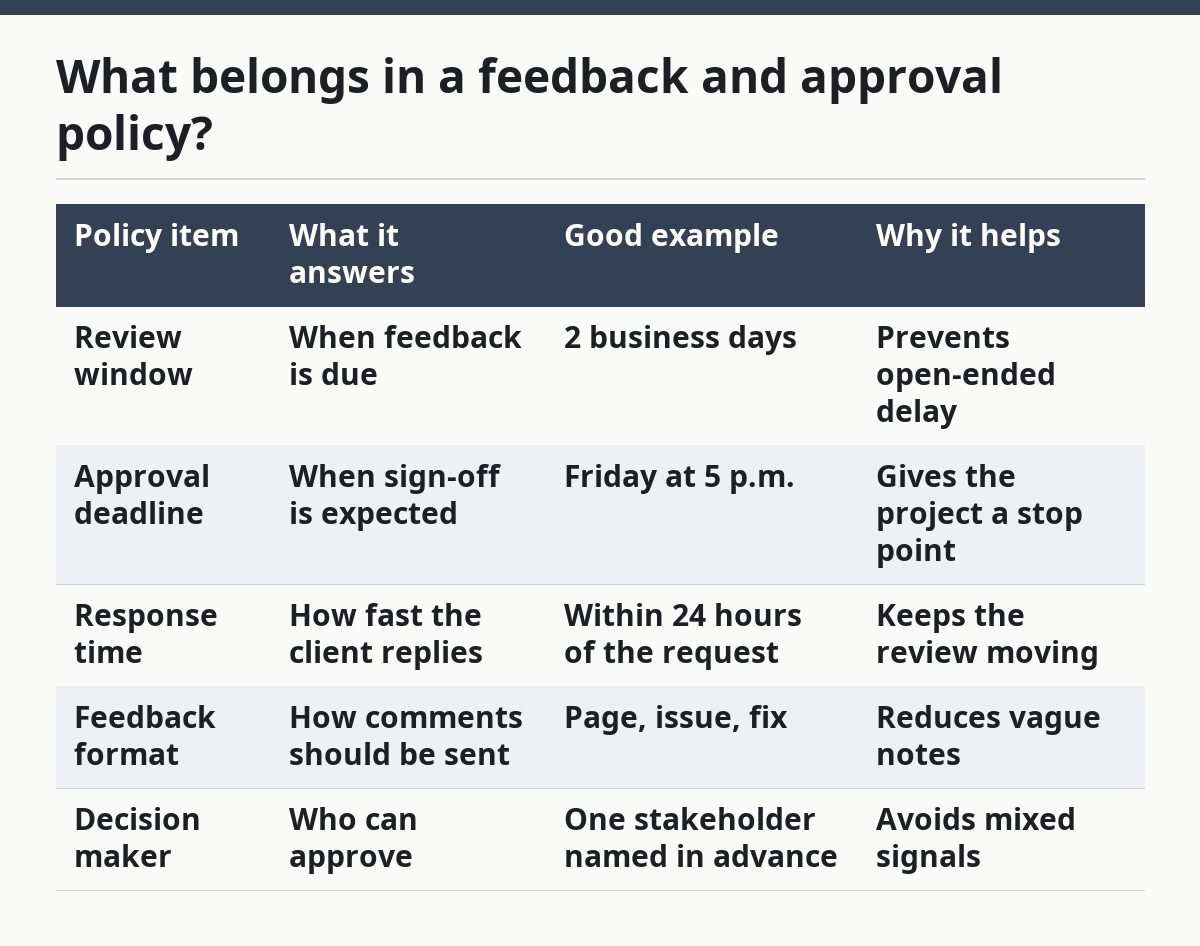
A generic article often skips the decision maker and focuses only on timing. That leaves the worst problem untouched: 4 people comment, 1 person approves, and the project waits for the wrong voice. Naming the stakeholder up front fixes that better than adding another reminder later.
The policy should also fit the size of the job. A logo draft may need a shorter review window than a 12-page report, but the structure stays the same. What changes is the deadline, not the principle.
How do you ask for client feedback without confusion?
You ask for client feedback without confusion by making the request short, direct, and tied to one review round. The best feedback request answers three questions at once: what is being reviewed, when the reply is due, and how the client should respond.
A useful request can look like this in plain language:
- “Please review Round 1 by Thursday at 3 p.m.”
- “Send feedback in one email with page, issue, and fix.”
- “If you are happy with the draft, reply with approval.”
That kind of request works because it narrows the job. The client does not have to decide whether to leave notes in a document, send a message, or wait until next week.
It also helps to say what kind of feedback you want. A design client may need notes on layout, copy, or brand fit. A writing client may need comments on facts, tone, or structure. If you want only one kind of comment in the first review round, say so before the draft goes out.
A weak request sounds open and polite, but it creates drag:
- “Let me know what you think whenever you get a chance.”
- “Feel free to send any thoughts.”
- “I’m open to feedback.”
Those lines do not set a response time, and they do not tell the client what kind of approval you need. They are easy to ignore, which is why they often lead to silence for 3 days or more.
What if there are multiple stakeholders?
A multi-stakeholder project needs one named approver, one feedback channel, and one rule for mixed comments. When 2 or more people have opinions, the freelancer needs a clear path for deciding which comments count.
The simplest rule is this: one person collects feedback, and one person gives the final approval. If a team wants input from several people, that can happen inside the company first. The freelancer should not have to sort through separate messages from finance, marketing, and operations and then guess which note wins.
Use this comparison to decide how much structure the project needs:
| Situation | Best setup | Risk if you skip it |
|---|---|---|
| Single client | One reviewer, one approval deadline | Delay is easy to fix but easy to miss |
| Small team | One decision maker, shared feedback doc | Comments conflict across emails |
| Larger client team | One stakeholder collects notes, one stakeholder approves | Review can stall for days |
| Fast-turn project | 24-hour response time, one channel | The schedule slips after a single unanswered thread |
A common mistake is letting every stakeholder comment directly. That sounds efficient at first, but it often creates 2 problems: duplicated notes and competing edits. One person wants the tone softer, another wants it sharper, and neither person is responsible for final sign-off.
The fix is not more back-and-forth. The fix is a rule before the first review round: who gathers the notes, who approves, and where the final answer comes from.
How do you handle review windows and approval deadlines?
You handle review windows and approval deadlines by attaching each review round to a clear date and a clear result. A review window is the time the client has to send notes, and the approval deadline is the point at which the draft is treated as approved or moved forward.
A clean setup gives the client a short list of choices:
- approve the draft,
- send consolidated feedback,
- or ask for a new review round.
That structure matters because “I’ll get back to you soon” is not a decision. A deadline turns a fuzzy promise into a real step in the workflow.
The deadline should match the project pace. A small update can often move on after 24 or 48 hours, while a larger deliverable may need a longer window. What matters is consistency. If one review round is 2 days and the next is 7 days with no reason, the client will not know what to expect next time.
It also helps to say what happens if the deadline passes. That is not a threat; it is a workflow rule. Without that line, silence becomes a hidden approval problem, and the project can stall because nobody wants to be the first to close the loop.
A freelancer who skips deadlines usually pays in admin time. The cost is not just delay. It is the extra message, the extra follow-up, and the mental reset of reopening the same draft 3 times.
What feedback format works best?
A feedback format works best when it is simple enough to follow in one pass and precise enough to act on without guessing. The most useful format is usually a short note tied to a page, section, or item, followed by the issue and the fix.
That can be as simple as:
- Page 2
- Headline feels too long
- Shorten to one line
This kind of format keeps comments usable. It also cuts down on broad remarks like “make it cleaner” or “this section feels off,” which sound helpful but do not tell the freelancer what to change.
The format should fit the work. For written deliverables, a document comment or emailed list may be enough. For visual work, the client may need to point to a file, a slide number, or a section title. The exact tool matters less than the rule: one note, one location, one clear fix.
A poor format usually causes 3 kinds of waste. First, the freelancer has to hunt for the right comment. Second, the client forgets what they meant. Third, the revision round gets longer because the original note was too vague to act on.
This is also where the policy earns trust. A client who sees a clear template understands that the review round has structure, not pressure. That makes approval easier because the path is visible from the start.
What mistakes cost freelancers the most?
The biggest mistakes are vague timing, missing decision makers, and scattered feedback, and each one costs time. Vague timing causes delay. Missing decision makers causes looped conversations. Scattered feedback causes rework that may not match the final approval.
The most common slip is treating “review” as if it means the same thing to everyone. One client thinks review means “read when free.” Another thinks it means “send notes tonight.” If the freelancer does not define the review window, both versions can exist at once, and that is where the delay starts.
Another mistake is asking for feedback from a group without naming the approver. The cost is not just confusion; it is conflict. One stakeholder may want a change that another stakeholder rejects, and the freelancer becomes the middle step in a 2-person debate.
The third mistake is accepting feedback in too many places. Email, chat, document comments, and phone notes can all exist in one project, but they should not all be active at the same time. One channel is easier to manage and easier to close at the end of a review round.
Who is this not for? It is not for freelancers who already have a formal project manager handling approvals. If someone else owns the sign-off process, the freelancer can still share a short feedback request, but the full policy may belong elsewhere in the workflow.
For most solo freelancers, though, a simple policy is the cleaner choice. It turns a messy review into a process the client can follow in under 5 minutes.
What should your client review policy say?
Your client review policy should say who reviews, how long they have, how feedback is sent, and when approval is final. It should also say what happens if the deadline passes without a reply. That is the core of the feedback and approval policy, and it is enough for most client work.
A plain version can include these lines:
- Review round name
- Approval deadline
- Response time
- Feedback format
- Decision maker
- Next step after approval
Keep the language simple. If the client has to decode legal-sounding sentences, the policy will get ignored. A short, direct policy is easier to read on a phone and easier to quote in a follow-up email.
One useful habit is to repeat the policy at the exact moment the draft is delivered. Do not bury it in onboarding only. The client is most likely to act when the draft arrives, so that is the moment to restate the 2-day window or 48-hour deadline.
The policy should also leave room for a second review round when the project calls for it. That does not mean every job gets extra rounds. It means the client knows the difference between a review round and final approval, which is the whole point of setting expectations in the first place.
How long should clients have to give feedback?
Clients should have a clear review window, such as 24 hours, 48 hours, or 2 business days, depending on the project pace. The exact number matters less than the fact that it is stated before the draft is sent. A defined window is easier to honor than an open-ended request.
How do I stop approval delays?
Approval delays shrink when the policy names one decision maker, one feedback channel, and one approval deadline. The client should know who signs off and what happens if the deadline passes. A reminder works better when it points back to a rule already agreed on, not a new expectation created after the delay starts.
What should my client review policy say?
Your client review policy should say the review round, the response time, the feedback format, and the approval deadline. It should also say who can approve and where feedback should go. If you keep it to a few plain lines, the client can use it without asking for a second explanation.
Drafted with AI; not yet reviewed by a person.
