
Last updated: November 19, 2026
Quick Answer: Write How to Write Freelance Payment Terms in a Contract by stating the deposit, milestone timing, net terms, late fee, and pause rule in plain language. Freelance payment terms in a contract should say when money is due, how much is due up front, what happens at each milestone, and what happens if payment is late. If those points are clear in writing, the contract does the work an awkward email thread cannot.
Key takeaways
- Put the payment terms in the contract, not in a separate chat thread.
- State the deposit, milestone schedule, net terms, and late fee in plain language.
- Tie payment to a clear date, deliverable, or approval event, so there is no debate about when the clock starts.
- Add a pause clause so work can stop if an invoice goes unpaid past the agreed window.
- Keep refund language narrow and specific; vague promises create arguments later.
- If the deal is unusual, ask a lawyer to review the wording before you sign. See also the FTC’s guidance on clear contracts and the Small Business Administration for contract basics.
Start with the one thing money terms must do

Payment terms must answer one question: when does the money become due? That answer belongs in the freelance contract itself, not only on an invoice, because an invoice usually comes after the work is already underway.
Begin by naming the payment trigger in one sentence. A trigger can be a signed contract, a deposit invoice, a completed milestone, final delivery, or a written approval email. If the trigger is “upon receipt of invoice,” say so. If the trigger is “7 days after milestone approval,” say that instead. A contract that says “payment due promptly” is too vague to enforce cleanly.
Use concrete timing language. Common terms such as net 15 and net 30 mean payment is due 15 or 30 days after the invoice date. If you use one of those terms, write the exact start date too, because the due date should be obvious from the contract without guessing. For example: “Final payment is due net 15 from the date of the final invoice, issued after delivery of the approved draft.”
A good payment clause also separates three things that are often mixed together:
- when work starts,
- when an invoice may be sent,
- when the payment is overdue.
That separation matters because the invoice date and the delivery date may not match. If you blur them, the due date becomes easy to dispute.
One useful standard here is a simple formula: event + time window + consequence. Example: “50% deposit due on signing, 25% due on first milestone approval, 25% net 15 after final delivery.” That structure gives both sides a roadmap and keeps the payment terms readable in one pass.
How do I write freelance payment terms in a contract?
Write freelance payment terms by defining the deposit, the milestone schedule, the net terms, the late fee, and the work pause clause in that order. That sequence covers the full life of the payment, from the first dollar to the last overdue invoice.
Use this core procedure:
- Name the upfront payment. State the deposit amount as a percentage or fixed sum, such as 30% before work starts. The result should be that no work begins until the deposit clears, if that is your rule.
- Map the project into milestones. Divide the job into 2 to 4 checkpoints tied to deliverables, like outline, first draft, design draft, or launch file. The contract should show exactly what gets billed at each stage.
- Set the invoice timing for each milestone. Say whether billing happens on completion, on approval, or on a calendar date. If you use net 15 or net 30, the invoice should say when that clock starts.
- Write the late payment clause. Add the late fee, grace period, and pause right in the payment section. A late fee can be a flat amount or a monthly percentage, but it must be stated clearly in the contract to avoid surprises.
- Include the work pause rule. Say that work stops if payment is 7 days late, 10 days late, or another specific window. The result should be that both sides know the project can be frozen without a new negotiation.
- Close with the refund rule. Explain what happens if the project ends early, the scope changes, or the work is cancelled. The best approach is to specify which payments are earned and which prepaid amounts, if any, are handled separately.
A simple template sentence can help: “The freelancer will invoice 40% as a deposit upon signing, 30% upon completion of the first milestone, and 30% net 15 after final delivery.” That one line covers three payment events without extra legal clutter.
Do not overload the clause with accounting detail. A contract is not an invoice template. It should tell the parties who owes what, when, and what happens if the timeline slips by 5 or 10 days. Leave remittance address, invoice number, and payment platform details for the invoice itself.
What should a deposit clause say?
A deposit clause should say how much is due, when it is due, and whether it is refundable. A deposit is the cleanest way to confirm commitment, but the clause has to say what the deposit buys.
For many freelance contracts, the deposit is a percentage of the total fee, often 25% to 50% depending on the size and risk of the job. The exact figure matters less than the rule: no deposit, no start, unless the contract explicitly allows otherwise. If the work requires blocking calendar time, reserving a slot, or turning away other jobs, the deposit should be tied to that reserved capacity.
State whether the deposit is credited against the total project fee or treated separately, and ask a lawyer if the wording is unclear. The usual setup is that it counts toward the final price, so the last invoice is smaller. Example: on a $4,000 project, a 25% deposit means $1,000 is due at signing and the remaining $3,000 is billed later under the milestone schedule.
Refund language needs care. A vague line like “deposit is nonrefundable” can create friction if the project is cancelled before any work is done. A better clause explains the condition under which the deposit is earned. For example, the contract can say the deposit is earned once the project is scheduled and kickoff work begins. If the work never starts because the freelancer fails to deliver, a broad nonrefundable clause may look unfair and invite dispute.
The trade-off is simple: a large deposit protects the freelancer, but it can scare off cautious buyers. A smaller deposit is easier to accept, but it gives less protection if the project falls apart early. The right answer depends on the size of the job and how much calendar time the project blocks.
How milestones and net terms work together
Milestones and net terms work together by separating performance from payment timing. Milestones define what was completed; net terms define when the invoice must be paid after that completion.
Milestone billing works best when the deliverables are visible and distinct. A 3-step project might use outline, draft, and final revision. A 2-step project might use kickoff and delivery. The key is that each milestone must be something the reader can point to and say, “That happened.”
Write each milestone in contract language that uses objective signs:
- completed outline approved in writing,
- first draft submitted by email,
- final files delivered in source format,
- revision round completed within 5 business days.
Once the milestone is defined, attach the payment rule. For instance: “Invoice due on milestone completion, payable net 15.” That means the invoice is sent when the milestone is done, and payment is due 15 days later. If you use net 30, say so explicitly. Net 30 gives the payer more time, but it also stretches the freelancer’s cash flow. That is the trade-off.
Avoid linking payment to “satisfaction” unless the contract explains what that means. Satisfaction is too subjective on its own. A better approach is to tie payment to deliverables and a limited revision period, such as 2 rounds of revisions, then payment regardless of later internal approvals. That keeps the contract from turning into an open-ended review cycle.
If a project has only one delivery, milestone language may still help. You can use one milestone for a deposit and one for final delivery, with final payment due net 15. That often fits a simpler billing structure better than adding checkpoints that the work does not need.
For broader billing systems, this clause should line up with the rest of the freelance billing and client payment systems on the site, so your contract, invoice, and collection process say the same thing in the same order.
What belongs in a late payment clause?
A late payment clause should define when payment is late, what fee applies, and when work stops. Without those three parts, “late” becomes a complaint instead of a contract term.
Start with the overdue trigger. Say the invoice is late after a fixed number of days, such as 5 business days past the due date. That gives both sides one clear counting method. If you use net 15 or net 30, the overdue clock begins after that period ends, not when the invoice is sent.
Then state the late fee. You can use a flat amount, a monthly percentage, or another clearly described charge, but the clause must be specific enough that no one has to guess. A vague “late fees may apply” line is weak because it does not tell the payer what the fee is. The better wording is direct: “Invoices unpaid 7 days after the due date may incur a late fee of X” or “a finance charge of Y per month on the unpaid balance,” if that is the arrangement.
Add a grace period only if you are willing to wait. A 3-day or 5-day grace period can reduce friction on small projects, but it also delays enforcement. If your work depends on steady cash flow, a grace period may help the relationship while still giving you a cutoff date.
The pause clause is just as important as the fee. Say that work pauses automatically if payment is not received within the stated period. A pause clause should also explain what happens next: deadlines move, delivery dates shift, and resumption may require the balance plus any restart fee, if one is stated in the contract. That protects the schedule from drifting for 2 or 3 weeks while the invoice sits unpaid.
This is one place where a generic contract can fail badly. If the late fee is harsh but the pause clause is missing, the freelancer keeps working for free. If the pause clause exists but the overdue trigger is vague, the client may argue the payment was not actually late. Put both pieces in the same paragraph.
Which mistakes make payment terms harder to enforce?
The biggest mistakes are vagueness, silence on late payment, and mixing contract terms with invoice details. Each one costs time because it creates a fresh argument after the work has started.
The first mistake is using soft words like “soon,” “promptly,” or “upon completion” without a calendar rule. Those phrases sound professional but do not tell either side when the bill is due. Replace them with a date, a day count, or a net term.
The second mistake is forgetting the refund policy. If a project ends halfway through, the contract needs to say whether unfinished work is billed pro rata, whether the deposit is kept, and whether any prepaid balance is returned. Without that clause, the parties end up arguing over what “fair” means after the fact.
The third mistake is making the late fee impossible to understand. If the clause is buried in a paragraph about scope, revisions, and intellectual property, the payment terms lose force. Keep the money language separate and easy to find.
The fourth mistake is letting the payment structure drift away from the actual workflow. If the project has 3 review cycles but the contract only has one final invoice, the cash pressure lands at the worst possible time. Match the payment schedule to the work schedule.
The fifth mistake is leaving out the work pause clause because it feels unfriendly. That choice can cost more than discomfort. A pause clause is not a threat; it is a boundary. It tells both sides what happens if the invoice is still open after 7, 10, or 15 days.
A final point: if the deal is unusually large, cross-border, or bundled with licensing or resale rights, a lawyer should review the payment language before signing. That is especially true if the contract includes penalty-style late charges, cancellation fees, or a nonrefundable deposit that could be challenged later.
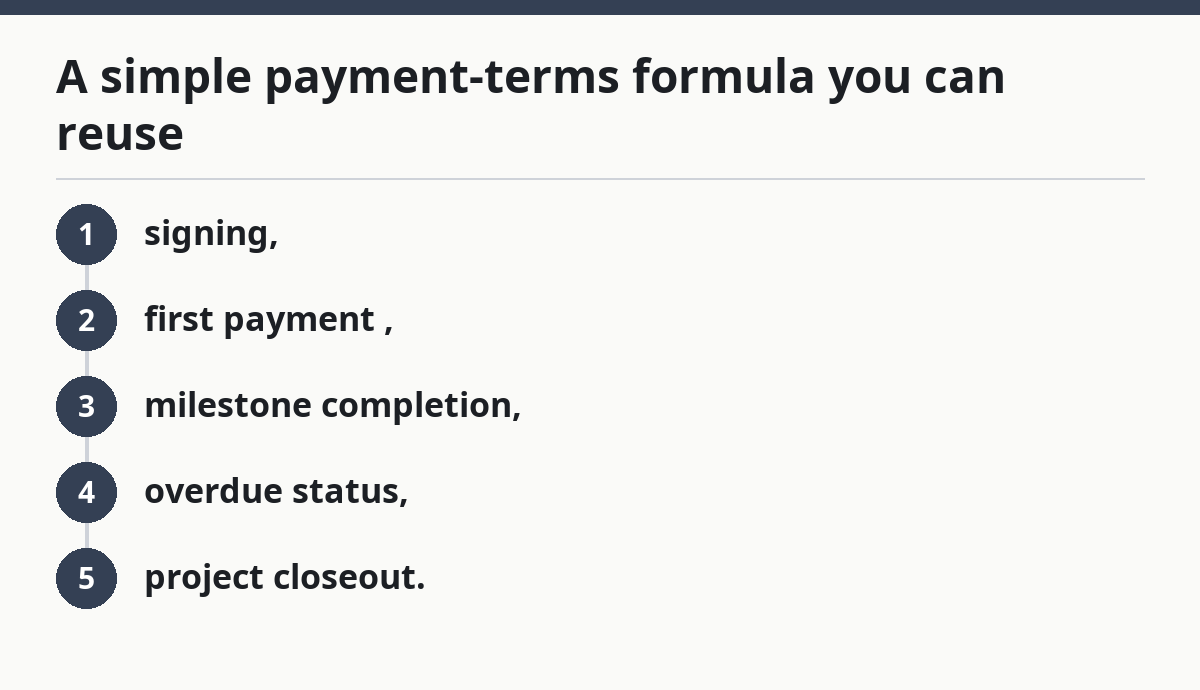
A simple payment-terms formula you can reuse
A reusable formula makes payment clauses easier to draft and easier to read. The formula is: deposit + milestone schedule + net terms + late fee + pause clause + refund rule.
A short example sounds like this: “A 30% deposit is due on signing. The remaining fee is billed in two milestone invoices, payable net 15. Any invoice unpaid 7 days after the due date may incur a late fee, and work pauses until the balance is paid. If the project ends early, completed work remains billed and any unused prepaid balance is handled under the refund policy.”
That structure is useful because it keeps the contract focused on 5 moments that matter:
- signing,
- first payment,
- milestone completion,
- overdue status,
- project closeout.
It is also flexible enough for a $500 assignment or a $15,000 engagement. The numbers change, but the logic stays the same. If you are building a standard freelance contract, this is the section to copy, adjust, and keep consistent across proposals and invoices.
The main limit is that one-size-fits-all language can fail on unusual jobs. If the work is highly custom, heavily revised, or tied to a product launch date, the contract may need a different billing rhythm. In that case, the safest move is to simplify the payment path rather than stack on exceptions.
FAQ
What payment terms should freelancers use?
Freelancers should use payment terms that define the deposit, the due date, and the late-payment consequence in plain language. A common structure is a deposit on signing, milestone invoices during the project, and net 15 or net 30 for the balance. The best term is the one that matches the work schedule and cash-flow risk.
Should I ask for a deposit?
Yes, if the project reserves time, starts with research, or has a meaningful upfront cost. A deposit confirms commitment and reduces the chance of unpaid kickoff work.
Drafted with AI; not yet reviewed by a person.
